I preached this sermon at the Parish of St. Paul in Newton Highlands, a small congregation in one of Boston's nearby suburbs. I'm grateful to the Priest-in-Charge, the Rev. Cara Rockhill, and the lay leaders and members of the parish, for their invitation and hospitality. I'm a great believer in offering apologies when they are needed and appropriate, and you will see at the beginning of the sermon an apology for the length of my sermon of a few weeks ago. This is my third or fourth time preaching in this parish, which I serve as a consultant on behalf of the Episcopal Diocese of Massachusetts.
The sermon is new, written and spoken for a particular time and place, but some of you will recognize both the title of the sermon and some of its content from retreats and meditations I have offered in the past.
In the name of the OneWho made usWho saves usand Who walks with us always,Amen.
It’s good to be back here with you.
Thank you for your hospitality.
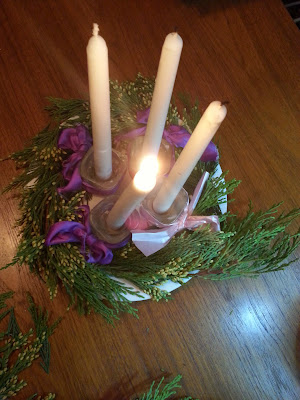
We have an Advent wreath here.
Take a moment (or two) to gaze at the flame of that first candle,
the one we have lit in our communal space
in this sanctuary.
Simply gaze.
Take a long slow breath or two
and look at that one light.
(Silence.)
* * *
Advent and Christmas are in some ways
the ultimate celebration of space,
the celebration of God entering human space
in the most intimate way possible:
by becoming human.
The celebration of word become flesh,
of word becoming flesh
the discovery that God-the-other
is also God-with-us[1]:
That is the good news of Advent.
We celebrate in Advent
God's invitation
for us to view our space
—our society,
our environment,
our neighbor,
our own flesh—
as sacred,
pregnant with justice and hope,
filled with hidden treasure.
But Advent is also a celebration
of time
and a celebration in time.
God enters
not just our space
but our time:
our history,
our present moment,
our human future.
Advent
challenges
our very relationship to time.
Advent challenges our impatience
and invites us to enter God's patience.
It is the season
of taking the long view,
the view beyond
our own small range of vision.
If we are to hear the good news
that God is
Emmanuel, God-with-us,
we may have to slow down.
To slow down externally, bodily,
But also to slow down inside
—which can be even harder than slowing down with our body
or slowing down our behavior.
Often God speaks very softly,
in ordinary ways and places,
in the daily events of our lives.
If the good news
is to take root in us,
we need to enter God's time,
God's timetable.
Advent
is not a flashy season.
It takes time for good news to sink in,
for love to grow,
for wisdom to ripen,
for lives to be transformed,
for truth to dawn in us,
for hope to take shape.
So in Advent, season of waiting for Christ,
we take in the good news slowly,
steadily,
lighting candles one at a time,
adding a new insight,
a layer of understanding,
every day
and every week.
(and) Yet
Advent is also a time to enter
God's impatience,
a time of righteous anger,
a time when prophets
challenge our apathy and paralysis
and urge us forward.
It is a season of visions and yearnings,
in which the stories and songs in the scriptures
speak of a God
who longs to transform
our hearts,
our society,
and creation itself –
soon, now, urgently.
***
One of these visions
is in the text from the prophetic book of Isaiah
for this first Sunday of Advent.[2]
Did you notice
how much this reading,
in addition to its images taken from nature,
addresses our life in human community,
including the community of nations?
God's righteousness and wisdom
and our human responses to them
are, in the text, directly related
to whether and how humans make peace or war,
whether we make the land into a battleground
or cultivate it.
The "swords into plowshares" passage[3]
is so well known
that we can gloss over it,
or in some way romanticize it.
Or perhaps more likely,
think it is nothing but a vision or a dream.
That metaphor has, however, been used in recent history
to describe something concrete:
what in the late 1970s we began calling "economic conversion"—
—the shifting of industrial, manufacturing, and scientific priorities
from military to civilian.
The movement continued for a couple of decades
and found its way into policy conversations:
there was even a bill
introduced in 1977 by bipartisan sponsors in the Senate
and then in the House of Representatives.
It was called the National Economic Conversion Act
and was repeatedly reintroduced through the years
but never became law.
Nowadays we speak more often
Of another kind of economic and environmental conversion:
Away from over-use of fossil fuels
and over-production of carbon emissions
that threaten us and God’s earth on which we live
with a greater danger than swords
and toward forms of energy
that can keep us and our children
and our companion plants and animals
and soil and water and sky
healthy and full of life.
Swords into plowshares.
It is up to us to take up the vision
and turn it into reality,
wherever we can.
Swords into plowshares.
* * *
So here we are:
smack in the middle
of cosmic,
personal, political,
ecclesial,
social, and economic
issues and upheavals,
all at once.
We are also
in the realm of visions of the messianic age,
which both Jews and Christians cultivate,
though in different ways.
The characteristics of that age,
of that kin-dom,
are the same, though:
peace among humans,
harmony in nature,
and the transformation
—some of it subtle, some of it dramatic—
that makes these possible.
* * *
Meanwhile, Jesus,
as the Gospel of Matthew presents him,
is far from meek and mild.
He warns us, puts us on alert,
shakes us up.
"Keep awake!"
Advent may be the slow and gentle season,
but it is—equally—
also the shake-up season.
God enters time,
but
the end of time is looming.
Jesus
grabs his companions by the collar.
No gentleness in this Gospel.
But no hypervigilance either.
By which I mean no jitters,
no super-speedy-overwrought reflexes.
Rather, we can read the Gospel as an invitation
to be awake and alert in a centered way.
It may be useful to read this Gospel in tandem
with a good dose of Buddhist mindfulness practice:
Can we be alert
but not reactive,
ready for the storm
but not overwhelmed
by its presence?
Can we spend Advent mindfully,
letting go of some of the reactivity
that has characterized so many of our conversations and responses
this election season
and the two preceding election cycles?
Can we spend Advent mindfully,
letting go of the reactivity that rises from us
not just in political conversations
but in many of our circumstances
today?
Can we spend Advent
mindfully, gently,
in the present
despite all the uncertainty and anxiety we are carrying
–in our work lives,
our relationships,
our family lives—
and yes, our church lives?
* * *
One of the challenges of this season
is to readjust our sense of time:
to discern when it is appropriate
to enter into God's patience
and when it is time to enter into God's impatience.
Perhaps it is also, then,
a time to learn mindfulness in a new way.
It is helpful to do this in community.
That's why we have the seasons of the church year.
That's why we have each other.
* * *
Today, on this first Sunday of Advent,
this first day of the new year[4]
and in the next few days,
before you do anything else,
take time.
Rest
in the patience of God.
All else will unfold,
in God's time.
Amen.
[1] Emmanuel = “God with us” in Hebrew.
[2] The Revised Common Lectionary texts are here.
[3] A similar use of this image exists in chapter 4 of Micah, another prophetic book of the Bible.
[4] The new liturgical year.