Showing posts with label holy humans. Show all posts

Monday, May 19, 2014

In the sanctuary and on the streets, alleluias and shared bread

Text posted first on Facebook last night.

 
Brewer Fountain, Boston Common


Two profoundly beautiful worship experiences today.

The first in the morning at Emmanuel Church in the City of Boston with Mendelssohn anthem; let's-tackle-this-one sermon with focused biblical analysis by the Rev. Pam Werntz; three baptisms; thanksgiving for 10 years of marriage equality; bread and wine blessed and shared; the final Bach cantata of Emmanuel Music's 2013-14 cantata season, glorious in praise and beauty. Candles and the play of light. Alleluias in hearts and voices.

The second, also with alleluias, a bit later in a very different setting: on Boston Common with Common Cathedral (often spelled common cathedral w/ no caps) in a congregation of mostly homeless men and women with some housed people as well, a dynamic young woman leading worship, and a youth group serving sandwich lunch before the service. A message of God's unconditional love for all and of God's very presence in our midst, a highly participatory service, with a structure but a lot of spontaneity (same structure as the other Sunday Eucharist but much simpler, pared down), and heartfelt Prayers of the People. Ragged at the edges in all the right ways, reverent, raw, with much assurance of forgiveness and comfort. Bread and grape juice blessed and shared. Sunlight, clouds, wind, the play of light.

Communion and contemplation in both places. And welcome. And song. And healing.

Not either/or. Both/and. The Church is a wide, deep, and diverse reality. Alleluia.


Emmanuel Church before the liturgy, 5th Sunday of Easter
Photos here are of parts of the worship space, the physical context. I don't take photos during worship; we do have photographers at Emmanuel who document some of our celebrations;  photographers and writers about common cathedral respect the anonymity and privacy of participants.

Friday, February 14, 2014

Barbara Harris, Bishop: Silver Anniversary and Ecumenical Reflection

The following essay appeared in the March 10, 1989 issue of the Catholic lay-edited magazine Commonweal under the title "When the Spirit Leads: Barbara Harris, Bishop." The editors cut out the last sentence without consulting me. They made a few less drastic changes which I note below the text of the essay. This text, with some minor copyediting, is my original version.

Barbara Harris was consecrated bishop on February 11, 1989 and served as Bishop Suffragan of the Episcopal Diocese of Massachusetts (1989-2003). She served as Assisting Bishop in the Diocese of Washington (2003-2007). Happily, she is back among us in Massachusetts. We will celebrate the 25th anniversary of her consecration this Sunday, February 16, 2014, with a Gospel Vesper Service.


[February, 1989]

A day or two before the consecration of Barbara Clementine Harris as Suffragan Bishop of the Episcopal Diocese of Massachusetts, Cardinal Bernard Law and Greek Orthodox Bishop Methodios issue written statements of welcome. The statements are cordial. They also speak of the danger Harris’s consecration presents for reconciliation among Christian churches, or what has become commonly known as “Christian unity.”

At the consecration, the gospel music of St. Paul’s African Methodist Episcopal Church choir alternates with the delicate melodies of the Chinese Congregation and classical European harmonies of Trinity Church choir. The stately cadence of the Book of Common Prayer moves us forward, but in the musical realm there is a preferential option in the air: clearly, the day belongs less to Mozart and more to the music of the Black church. The celebration flows. This is no Tower of Babel: we each hear God speaking in our own tongue.

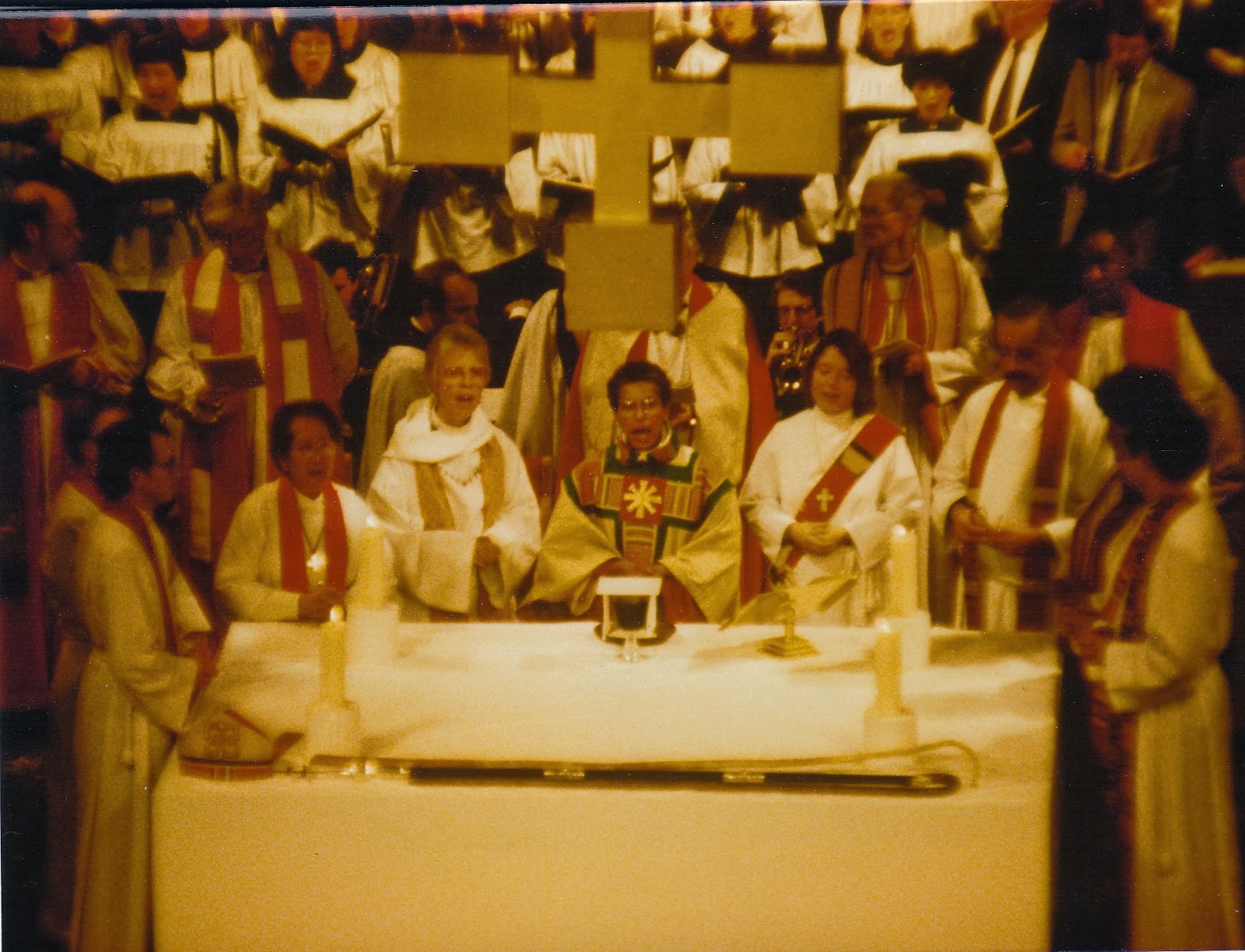
As Barbara Harris walks down the center aisle, a tiny woman whose voice and presence can fill a cathedral, over 8,000 people burst into applause. (“Not very characteristic of the Episcopal Church,” says one member of the congregation, Mary Shannon.) Throngs of priests, row upon row of beaming women and men, process down the side aisles of Boston’s Hynes Auditorium. Barbara Clementine Harris, a woman and a priest of African descent, is consecrated a bishop by the laying on of hands, according to the tradition of the apostles, by 55 men, most of them white. All through the celebration, the bishops have been purposeful, solemn, and excited, with the calm certainty that God, through them, is doing a good thing.

In describing the celebration, those who were there speak of unity. Mary Shannon repeatedly uses the term “body” to speak of the church and of her experience of this day –“finally being part of the body...” “... all of us together in one body.” She is wearing a locket with a picture of her 80-year-old mother, a member of St. Andrew’s Parish in Seattle, who “still carries her white gloves with her in church yet has rolled with the changes.” She speaks in the plural: her mother, her daughters, her husband, her women friends, all rush into the conversation. “I cried,” she says. “I just felt so happy for all of us.”

Modene Dawson of Philadelphia speaks of another unity. For her, and for many African-Americans in the assembly, the significance of the event extends beyond the church. “It’s beautiful for the country,” she says. “It shows racial harmony.” The church which conducts this celebration is not apart from the world; it is the body which proclaims to the world that God is alive in history.

Paul Matthews Washington, in his sermon, speaks about God and history. Harris’s friend and mentor, he is Rector Emeritus of the Church of the Advocate in Philadelphia, which feeds, clothes, and sanctifies the poorest of the city. In this church was held the first ordination of Episcopal women to the priesthood, in the summer of 1974, less than 15 years ago. Harris, a member of the church, led the procession, carrying the cross.

“We cannot,” says Washington, “overlook the fact that this woman being consecrated today is not just an American woman. She is a Black woman... This is a woman... who has had to struggle; she’s been despised, she’s been rejected... God has lifted up one who was at the bottom of society and has exalted her to be one of His chief pastors.”

Washington speaks of Harriet Tubman, who “nineteen times went back into the land of bondage,” thanking God for her freedom by helping to free others. He speaks of Mary, the mother of Jesus, who was raised from her lowly estate and sang of God’s power to raise up the humble and put down the mighty from their thrones: “Mary,” he says after quoting the Magnificat, “was an oppressed woman. That’s how Holy Mary Mother of God felt!” He weeps as he recalls the slavery and oppression of Black people in this country. “Only in understanding the past can we fully appreciate God’s action in this event,” he says.

The Episcopal Church, a church of power and privilege, has chosen “a have-not,” says Washington, but also one who “burns when others are offended,” a “disturbing prophet.” Harris has for years –in her public relations and policy work in the corporate world, in her parish, in her work with the Episcopal Church Publishing Company, in her pastoral ministry—advocated racial and economic justice, taken up the cause of women, spoken out against homophobia; she has, says Washington, devoted enough time to prison chaplaincy “to serve a two-year sentence herself.”

The Right Reverend Barbara Harris, newly robed in bright vestments with Ashanti designs and symbols, presides at her first Eucharist as bishop. Among the concelebrants are Carter Heyward, one of the “Philadelphia Eleven” ordained at the Church of the Advocate, and Florence Tim-Oi Li, the first woman ordained a priest in the Anglican Communion, in Hong Kong, one generation ago. At the distribution, Harris slips over to the far side of the auditorium and gives communion to the people in the hearing-impaired section, who have been singing with their hands for three hours.

A bishop is, among other things, a maker of unity. Barbara Harris has already begun to make unity; but not in the ways in which unity was previously understood or structured. Her brother bishops, Law and Methodios, fear for the health and welfare of Christian unity. But where are the real rifts in our lives today? Are they doctrinal? Where is the real, urgent need for unity? And when we say “unity,” what do we mean? Whose unity, which unity, and at what cost?

The deeper chasm today is not between Protestants and Catholics, or Greek Orthodox and Episcopalians. It is, much more, between haves and have-nots, between Blacks and whites, between men and women, between the Northern and Southern Hemispheres. These are the wounds in need of healing, in church and in society. As for denominationalism, it is no longer the principal intrachurch split. Far deeper is the gap within each of our faith communities between fundamentalists and non-fundamentalists.

Early in the service, the Presiding Bishop, Edmond L. Browning, asks if anyone knows of any reason why the consecration ought not to proceed. Two men come to the microphone. The first calls the consecration “a sacrilegious imposture,” the second “an impediment to the realization of the visible unity of the Church for which Christ prayed.” There will be a problem, they argue, with the value of any sacrament celebrated by Harris.

Bernardine Hayes, a computer systems analyst, self-described “dormant Catholic,” and veteran civil rights and peace activist (she is currently Vice President of WAND, Women’s Action for Nuclear Disarmament), had never before today “seen a woman offer the sacraments. She is so clearly affiliated with the poor,” Hayes adds. “She strikes me as a true minister.” Hayes feels something stir within her during the liturgy –“the realization that the piece of my life which is missing is the spiritual piece.”


This was, she says, "like a Pentecost."

Whose unity?

The intervention of the dissenters highlights the lack of unanimity in the church about the consecration (although Browning is quick to point out, at the post-consecration press conference, that the overwhelming majority of Episcopalians support it). But it is, in its way, a step on the road to greater unity. Perhaps the two men will change their minds; perhaps never. What is hopeful and healthy and makes a body strong is that their pain was not swept under the rug. However token, this part of the ceremony honors difference: and the unity of the Episcopal Church around this celebration –the unity behind the liturgy— is not the easy unity of unreflecting liberals. It has been hard won, tempered by prayer and struggle, and forged through the participatory process of decision-making in the Episcopal Church, a community that gave us two-thirds of the signers of the Declaration of Independence.

Elizabeth Pearson Rice-Smith, a United Church of Christ minister who witnessed both the ordination of the “Philadelphia Eleven” and Barbara Harris’s consecration, believes that “if our vision of church unity embraces diversity in God’s ministries and the human experience of faith, there is much less need to split off. I think,” she adds, “that women are willing to say things about the messy stuff that don’t condemn or blame or banish. We want to create spirited change that doesn’t mean war, that doesn’t mean people don’t talk to each other, that doesn’t mean annihilation.”

Which unity, and at what cost?

Christians do still need to speak with one another about Eucharist and ministry, about theological thought and ecclesial practice. But the context of this discussion has changed, and so have the discussion questions themselves. Unable and unwilling to hide her particularity, unlikely to temper her prophetic stance, Barbara Harris –not in spite of this but because of this—is a maker, not a breaker, of unity.


(c) Jane Redmont 1989


A few other changes – skip this if you don’t care about the minutiae: The editors also lower-cased “Black,” which I had in upper case, and made a spelling change that eliminated my metaphor “singing with their hands.” They changed it to “signing with their hands.” Of course the congregation members in question were signing –but adding “with their hands” would in that case have been unnecessary. The celebration was full of song, and part of the beauty of it was that people sang with both voice and hands. I was seated in the section next to the one using American Sign Language. The editors also deleted the paragraph with Rice-Smith’s quote.

I was still a Roman Catholic at the time I wrote this essay.

 A decade later, in 1999, a few years after I moved to California, I was invited to be on the panel of speakers at the 10th anniversary celebration of Bishop Harris’s consecration. The invitation came from the Rev. Canon Edward Rodman, with whom I had often been on the television show “In Good Faith” on WCVB-Channel 5 (then the ABC affiliate in Boston). I served as the Roman Catholic voice on the panel and offered some insights from a Catholic feminist perspective.

A few years later –12 years ago last month— I was received into the Episcopal Church. The discernment leading to this reception –and the lengthy process toward ordination to the priesthood, a vocation dating back to the 1970s– are another story for another time and place.
 
Thanks be to God for Bishop Barbara!


Thursday, April 18, 2013

On the day of the memorial service for the victims of the Boston Marathon bombing

Today, behind the mourners in public places, the rescuers, the demonstrators, the loud speakers, there are --always, still-- those who clean and scrub, those who cannot get away from work, those caring for the very young and the very old, those who cannot get easily from one place to the other, and the artists, the writers, the poets, who need the quiet solitude and the unsung space and time before the singing, and who, in their own way, hold up and reweave the world. Remember them.

(c) Jane Redmont

Thursday, March 28, 2013

A Maundy Thursday image


A few weeks ago I took this picture on the beach in Honolulu, a quick shot with my phone camera, late in the day. The younger woman was tying the older woman's shoe. It was an act of love and service on a beach that is largely filled with tourists on vacation and local people who come to surf or, often, just to watch the sunset. Though the picture is not literally a foot-washing, it is an icon of Holy Thursday (also known as Maundy Thursday).

I've also posted an old sermon about --what else?-- feet, for this holy day. And Jesus, of course. See here.

Friday, April 27, 2012

Perseverance, suffering, a word from a Desert Father, a commentary, and a commentary on the commentary

During Lent I read excerpts from a book by David G.R. Keller (an Episcopal priest and scholar)  Desert Banquet: A Year of Wisdom from the Desert Mothers and Fathers (Liturgical Press 2011).

It is now the season of Easter (which lasts for 50 days, remember and celebrate!) but I picked up the book again yesterday. It has a meditation for each day and this was yesterday's. Each meditation is composed of a short saying by a Desert Father or Mother and a paragraph-long commentary by Keller.
Abba John continued, "Do your work in peace. Persevere in keeping vigil, in hunger and third, in cold and nakedness, and in sufferings."
Abba John knew the path to transformation must be single-minded but is not easy. The "work" is not an end in itself and we will have difficulty letting go of control of life and our false self. A decision to commit our lives to God does not automatically mean freedom from temptations or anxieties. We will be distracted from God's voice. The desert elders valued stillness because it helped them do their "work in peace." Their peace was not the absence of inner conflict. It was resting in an openness to God's grace. One example is "keeping vigil," a period, usually at night, where various postures of openness, combined with chanting psalms or expressions of a desire for God's presence, open the heart for God's presence. Fasts from food and water helped keep their focus on God rather than physical satisfaction. The desert nights were cold and their clothes were simple. The self-imposed hardships brought a variety of "sufferings" that would refine the soul's quest. (Meditation for April 26, Keller, p. 78.)
To which I add:
For us and for many around us, the desert is the daily reality: because of poverty, oppression, sorrow, alienating work, the demands of family and other relationships. 
 The question then becomes not so much choosing those sufferings and fasts in the night (and the day) but how to live in a holy manner with the desert fasts and hardships that are imposed on us. The same discipline applies. 
Amid the sufferings that we did not seek, can we keep our focus on God? Can we open our hearts? Can we somehow seek and find stillness and rest in God's grace? Can we decolonize our souls? Can we live in our bodies with hope in the Presence? Can we too, like the desert mothers and fathers, keep vigil?
Cross-posted in slightly different form on Facebook on April 26. 

William Henry Jackson (1843-1942), Granite Rocks Base of Laramie Peak, 1870.

Saturday, October 15, 2011

We'll be back soon - and a few words about Teresa de Ávila and #OccupyGSO

Greetings, friends.

The blog has been dormant for two and a half months for a variety of reasons: some travel, the start of the academic year in a continually demanding job, a lot of Facebook activity (I am going to start cross-posting, I think), a bit of illness (nothing life-threatening), and other demands and choices. I'll be back soon though with regular posts. Just wanted to leave a note to let readers know that the blog is still alive.


Today, October 15, Catholic, Anglican, and some other Christians in the West celebrate the feast of Teresa of Ávila, 16th century Spanish Catholic woman of Jewish descent (her paternal grandfather was forced to convert to Christianity), reformer of the Carmelite religious order, mystic, and theologian. The Roman Catholic Church also honors Teresa as one of only three women "Doctors of the Church." Her prayer-poem "Nada te turbe" ("Let nothing disturb you") has become well-known and exists in a beautiful chanted version from the Taizé community.  Enjoy the chant by clicking here

The original poem is longer, but the words used in the Taizé chant are these: 
Nada te turbe, nada te espante
Quien a Dios tiene, nada le falta
Nada te turbe, nada te espante
Solo Dios basta

Also, #OccupyGreensboro, one of the many gatherings related to #OccupyWallStreet, begins this afternoon. (I currently live in Greensboro, North Carolina.) Local newspaper story here. (I think the man quoted at the end is overly optimistic: we are in another Gilded Age already.) For the human stories at the base of the movement around the U.S., see here.  In fact, read them first.  Stay tuned.  Peace to all.

St. Teresa as a young woman, painting by François Gérard (France, 1770−1837)

Sunday, July 31, 2011

Feast of Ignatius of Loyola


Happy Feast of Ignatius of Loyola! This is a link to a [2007] blog post about Ignatius, his feast, his rooms in Rome (which I had the joy of visiting), some new statues, the Infanta Juana, and related topics. I just fixed about half a dozen broken links, so everything should work.

This comes with deep gratitude to the worldwide Ignatian community.

Cross-posted on Facebook.

Monday, January 31, 2011

Merton (born on this day in 1915) on the work of peace compared to the work of war


"If this task of building a peaceful world is the most important task of our time, it is also the most difficult. It will, in fact, require far more discipline, more sacrifice, more planning, more thought, more cooperation and more heroism than war ever demanded."

-Thomas Merton, who was born on this day in 1915
(died Dec. 10, 1968)


Cross-posted on Facebook.

Thursday, January 20, 2011

Wulfstan of Worcester: Anniversary

Today is the 9th anniversary of my formal reception into the Episcopal Church and the feast of Wulfstan of Worcester, about whom I wrote at some length two years ago.

Bishop Wulfstan's Crypt, Worcester Cathedral, England

Sunday, January 2, 2011

For the new year

One of my favorite Pete Seeger songs, written by David Mallett:

The Garden Song


Photo: Sugar Creek Township, Greene County, Ohio

Tuesday, December 28, 2010

December 28: Feast of the Holy Innocents

A.k.a. Childermas to you high-church C of E types.


In addition to the best-known paintings of the Massacre of the Innocents by Giotto di Bondone (above) and Pieter Brueg[h]el the Elder (below), I am posting some other depictions of the killing of the innocents. But first, a biblical reminder.

When the wise men had departed, an angel of the Lord appeared to Joseph in a dream and said, "Get up, take the child and his mother, and flee to Egypt, and remain there until I tell you; for Herod is about to search for the child, to destroy him." Then Joseph got up, took the child and his mother by night, and went to Egypt, and remained there until the death of Herod. This was to fulfill what had been spoken by the Lord through the prophet, "Out of Egypt I have called my son."

When Herod saw that he had been tricked by the wise men, he was infuriated, and he sent and killed all the children in and around Bethlehem who were two years old or under, according to the time that he had learned from the wise men. Then was fulfilled what had been spoken through the prophet Jeremiah:

"A voice was heard in Ramah,
wailing and loud lamentation,
Rachel weeping for her children;
she refused to be consoled, because they are no more."
Matthew 2:13-18


Fra Angelico


Matteo di Giovanni

Giovanni Pisano

Why the attraction of the subject matter? The drama of course; the sheer injustice; the terror; the worst loss a mother can ever endure: the killing of her child -- multiplied by the hundreds and thousands. Mary and Joseph save their baby from death, but later Mary will endure the loss of her son as an adult and be helpless to protect him, as are the mothers in this scene. As are so many mothers.

In last year's December 28 post, I posted pictures of children much closer to our time as well as information about agencies helping children. Remember them. Care for the vulnerable. Holy Innocents, pray for us, and in your blood and the suffering of your mothers remind us to prevent more pain, more deaths, more tears, and to weep in solidarity with those who mourn. In Christ's name, Amen.


Giovanni Pisano, Pistoia Pulpit, detail

Click on photo to enlarge and see detail.

Sunday, December 26, 2010

December 26: St. Stephen's Day - blog flashback

Well, the Episcopal Church has transferred the feast of Stephen till tomorrow, today being a Sunday (you can't liturgically celebrate a Sunday and a saint's day on the same day, or rather you can, but you may not).

Meanwhile, the Roman Catholic Church --or at least the U.S. Catholic Conference of Bishops-- has bagged Stephen entirely, because the 26th is not only a Sunday but the first Sunday after Christmas, which in the Catholic Church is the Feast of the Holy Family.

Since I have no liturgical celebrations to attend or at which to preach or officiate, I'm sticking to the original calendar. Today is the feast of Stephen, so there.


No energy, or rather, still hardly any words. Writer's block or something. Here is last year's post on Stephen, which itself has a flashback to two years before that and a feast of St. Stephen poem. Gentle readers, you have probably forgotten both posts anyway, so enjoy the (re-) read.

And thank you for bearing with me. I am well but in a bit of an odd relationship to words. Trying to find a voice again. My job tends to destroy it and I recently spent two or three weeks correcting final papers in other people's voices, many of them with bad grammar, syntax, and usage. Lord, have mercy on your indentured servants in the academy.

Posted on December 27, dated December 26.

Orthodox icon: Stephen the Protomartyr

Monday, August 9, 2010

An Open Letter to Anne Rice

My open letter to Anne Rice, an essay on the church, its flaws, and why you can't be a Jesus-person alone in a corner, is up at the Episcopal Café.

Feel free to circulate prn.

Cross-posted on Facebook.

Saturday, July 31, 2010

Ignatius Day: another butterfly

Happy feast of Ignatius of Loyola. Here is another butterfly, fluttering about the flowers at noontime on a rare warm-but-not-hot grey day. It is more yellow than the photo makes it seem, as is the beige-looking butterfly below (at the bottom of that post). The BlackBerry camera distorts some colors.


Wednesday, July 14, 2010

Thoughts on church, change, and living the Gospel: more from Sölle and Naudé (1985)


A follow-up on yesterday's post.

From earlier in the 1985 interview with Beyers Naudé and Dorothee Sölle:  

Naudé:
 
... If we mean by the church mainly the institution, the structure, the visible, traditional symbols, then I believe that the church, in that sense, will experience one crisis after another, until it comes to the recognition, understanding, that the church, in the real sense of the word, is where the people of God are, where life is being discovered again, the true meaning of love, of human community, of mutual concern for one another, of caring of people, of seeking true meaningful relationship, understand between people, not only between Christians but between all people. Therefore, in that sense I am very hopeful about what is happening, not only in our country [South Africa], but also in other countries, because there are new perspectives, of the Christian faith and of truth, which are being discovered and which are being, as it were, agonized about by so many small groups of people... If I think of South Africa, what encourages me is the fact that sometimes the most meaningful revelation about a new understanding of Christian faith and about the Christian church and about Christian community comes from the poorest, comes from those communities which are normally not seen to be the ones with authority or with power, or comes from those who normally never believe themselves to have any real message. But when you begin to listen to what they are saying, it is absolutely marvellous ... to discover how little I know and how much I need to be constantly converted, in my whole understanding, in my whole willingness, therefore, in true humility to sit at the feet of such people, and learn and hear. ...In that sense I believe there is a tremendous future for the Christian community in the world.
Sölle:

I agree... I think the growth of the true church today comes not from within but from the outside, from the peace groups, from the women's groups, from those groups who in certain fields of post-Christian culture live and think and understand more and more the meaning of the gospel, rather than those who claim to be masters of the gospel, namely those white male, middle-class theologians. ... I think that there is a growth of faith in new forms all over the world, and some of the signs of it are very classical signs, it's base communities..., it is martyrdom, which is one of the classical signs of where does the church live and grow. We in the first world, in relative freedom, don't experience martyrdom in the strict sense of the word. But I think we have to prepare ourselves and others in our midst for more restrictions, discrimination. The price to be a Christian will be higher in the next twenty years, will become higher and higher; it will be much tougher, if you really want to be a Christian. ...I think Christ didn't promise us victory. I think that would be an illusion. Christ promised us life, and that includes death. Christ didn't tell us that we would win. Other people tell us that all the time... We hope to win; we fight to win; we give our blood and our lives... but I think we cannot understand our own struggle in terms of success and non-success.

Hope for Faith: A Conversation
jointly published by Eerdmans and the World Council of Churches in 1986


A post on a related topic (Sölle on the church), from last summer: click here.

This post is especially in response to Claire's comment in the previous post.

Taking the long view


C.F. Beyers Naudé and Dorothee Sölle, at the end of a long interview-conversation in 1985.

(Published first in Dutch --the conversation took place in the Netherlands-- the interview came out in English as Hope for Faith: A Conversation, jointly published by Eerdmans and the World Council of Churches in 1986.)

Sölle:

I think Christ didn't promise us victory... Christ promised us life, and that includes death. Christ didn't tell us that we would win. Other people tell us that all the time... We hope to win; we fight to win; we give our blood and our lives... but I think we cannot understand our own struggle in terms of success and non-success.

Naudé:

Well, the question that I would like to put to you would be this: Do you, in yourself, have the strength to endure whatever may come to you by way of disappointment, by way of rejection, by way of non-recognition, by way of waiting, perhaps your whole life, without being able to participate in the victory of the truth that you are standing for? Do you believe that you will be able to sustain yourself through these years up to the very end?

Sölle:

I am thinking of a friend's answer to that when I was in a state of despair, and had this sense of meaninglessness and never reaching anything, and then he talked about the cathedrals which were built during the Middle Ages. Most of them were built over 200 years, some over 300 years even, and some of the workers in those cathedrals never saw the whole building, they never went to pray there, they never saw the glass and all the beautiful things they gave their life for. And then this friend said to me: "Listen, Dorothee, we who are building the cathedral of peace, maybe we won't see it either. We will die before it is complete, and yet we are going to build it. We are going on even if we won't live in that building." 

XXX

xxx

Friday, May 21, 2010

Apollonia, the toothy saint


I had oral surgery a few days ago and have been meaning to write this post since last week, but life has been busy, first with a little road trip out of state to a family Bar Mitzvah (photos on Facebook for those of you who are FB people) and then a wedding of two young Guilford alumns (ditto, smaller album), then getting ready for the surgery, and finally the surgery and recovery. I am doing fine, healing slowly and being creative with liquid and soft foods, but the point of this post is the saint for tooth trouble and dentists, Apollonia.

Apollonia was a Christian woman from Alexandria, Egypt, in the 3d century of the Common Era. Part of her martyrdom involved getting her teeth smashed and/or pulled out; hence she is often represented in Christian iconography with pincers and a big tooth.

Apollonia's torturers threatened her with death by fire if she did not renounce the faith. In her zeal for the faith she threw herself on the pyre before they could take her there.

One of my old friends says she bets that it had nothing to do with zeal for the faith and much more to do with the fact that the tooth pain was so horrid that anything was better than enduring it any more! She's got a point... The fact remains, though, that Apollonia had already lived a long life of holiness and service and that she was a woman of deep devotion and determination.

The image above is from an English church. You can find it on an interesting website on Norfolk churches.

Both Orthodox and Catholic Christians observe Apollonia's feast day (February 9). I think we Anglicans should join them. After all, she is an ancient Alexandrian martyr.

Note: Alexandria was a virgin but probably also a deacon. parthénos presbûtis, the phrase used to describe her in the martyrologies, does not necessarily mean "an older virgin" but more likely, according to the scholars, an ordained deacon/ess. There is plenty of scholarship on women deacons, not just as deaconesses as an unordained order, but as ordained deacons.

Did you know there has even been an international Orthodox conference on women in the diaconate whose proceedings, published in 1998, have been endorsed by His All Holiness Patriarch Bartholomew, the Ecumenical Patriarch?

Here's a rather dreadful 15th century painting of Apollonia's torture. I mean the torture is dreadful, not the painting.

And then there's this (Heilsbronn Cathedral, Bavaria, 16th century):


This is likely a modern facsimile of medieval iconography. It is the illustration on a dental office called "Apollonia House" in the U.K.

This is a serigraph from the 1980s.

This is probably the best known representation, a painting by Francisco de Zurbarán (early 17th century).

I am rather more fond of the English one at the top of this post.

There are images of Apollonia all over Europe.

There are also reputed pieces of her in several countries including Italy, Belgium, Germany, and Portugal.

Saint Apollonia, pray for us!

Thursday, March 25, 2010

"Photos of a Prophet" - a Romero retrospective and tribute


Andy, in the comments to the previous post, recommended this wonderful pdf-format slide show. It's actually a book available in exhibit form available in slide show form. The wonders of technology!

These are archival photos of Monseñor Romero and his people, from Romero's childhood to the days after his death. Well worth a look.

The exhibit is currently at Grace Cathedral, San Francisco. Information here.

Priests carry Archbishop Romero’s coffin out of the Metropolitam Cathedral of San Salvador, March 30, 1980. Photo: Private collection of the Photography Center of El Salvador

Wednesday, March 24, 2010

Oscar Arnulfo Romero, ¡Presente!


Today was the 30th anniversary of the martyrdom of Monseñor Romero, Archbishop of San Salvador.

I will post more when my teaching week is over, but for now, here are two links.

At this one, which is mostly in Spanish but has links to other languages, you will find a wealth of resources including a slide show in PowerPoint (click on "XXX Aniversario") with rich quotes by Romero and many other words and images to ponder.

This one is a biography in English by a U.S. poet and activist who has engaged in Central America solidarity work for many, many years and knows what she is talking about.

"A church that does not unite itself to the poor in order to denounce from the place of the poor the injustice committed against them is not truly the Church of Jesus Christ."*-San Oscar Romero de las Americas


¡Romero vive!