Showing posts with label hope. Show all posts

Monday, May 19, 2014

In the sanctuary and on the streets, alleluias and shared bread

Text posted first on Facebook last night.

 
Brewer Fountain, Boston Common


Two profoundly beautiful worship experiences today.

The first in the morning at Emmanuel Church in the City of Boston with Mendelssohn anthem; let's-tackle-this-one sermon with focused biblical analysis by the Rev. Pam Werntz; three baptisms; thanksgiving for 10 years of marriage equality; bread and wine blessed and shared; the final Bach cantata of Emmanuel Music's 2013-14 cantata season, glorious in praise and beauty. Candles and the play of light. Alleluias in hearts and voices.

The second, also with alleluias, a bit later in a very different setting: on Boston Common with Common Cathedral (often spelled common cathedral w/ no caps) in a congregation of mostly homeless men and women with some housed people as well, a dynamic young woman leading worship, and a youth group serving sandwich lunch before the service. A message of God's unconditional love for all and of God's very presence in our midst, a highly participatory service, with a structure but a lot of spontaneity (same structure as the other Sunday Eucharist but much simpler, pared down), and heartfelt Prayers of the People. Ragged at the edges in all the right ways, reverent, raw, with much assurance of forgiveness and comfort. Bread and grape juice blessed and shared. Sunlight, clouds, wind, the play of light.

Communion and contemplation in both places. And welcome. And song. And healing.

Not either/or. Both/and. The Church is a wide, deep, and diverse reality. Alleluia.


Emmanuel Church before the liturgy, 5th Sunday of Easter
Photos here are of parts of the worship space, the physical context. I don't take photos during worship; we do have photographers at Emmanuel who document some of our celebrations;  photographers and writers about common cathedral respect the anonymity and privacy of participants.

Friday, February 14, 2014

Barbara Harris, Bishop: Silver Anniversary and Ecumenical Reflection

The following essay appeared in the March 10, 1989 issue of the Catholic lay-edited magazine Commonweal under the title "When the Spirit Leads: Barbara Harris, Bishop." The editors cut out the last sentence without consulting me. They made a few less drastic changes which I note below the text of the essay. This text, with some minor copyediting, is my original version.

Barbara Harris was consecrated bishop on February 11, 1989 and served as Bishop Suffragan of the Episcopal Diocese of Massachusetts (1989-2003). She served as Assisting Bishop in the Diocese of Washington (2003-2007). Happily, she is back among us in Massachusetts. We will celebrate the 25th anniversary of her consecration this Sunday, February 16, 2014, with a Gospel Vesper Service.


[February, 1989]

A day or two before the consecration of Barbara Clementine Harris as Suffragan Bishop of the Episcopal Diocese of Massachusetts, Cardinal Bernard Law and Greek Orthodox Bishop Methodios issue written statements of welcome. The statements are cordial. They also speak of the danger Harris’s consecration presents for reconciliation among Christian churches, or what has become commonly known as “Christian unity.”

At the consecration, the gospel music of St. Paul’s African Methodist Episcopal Church choir alternates with the delicate melodies of the Chinese Congregation and classical European harmonies of Trinity Church choir. The stately cadence of the Book of Common Prayer moves us forward, but in the musical realm there is a preferential option in the air: clearly, the day belongs less to Mozart and more to the music of the Black church. The celebration flows. This is no Tower of Babel: we each hear God speaking in our own tongue.

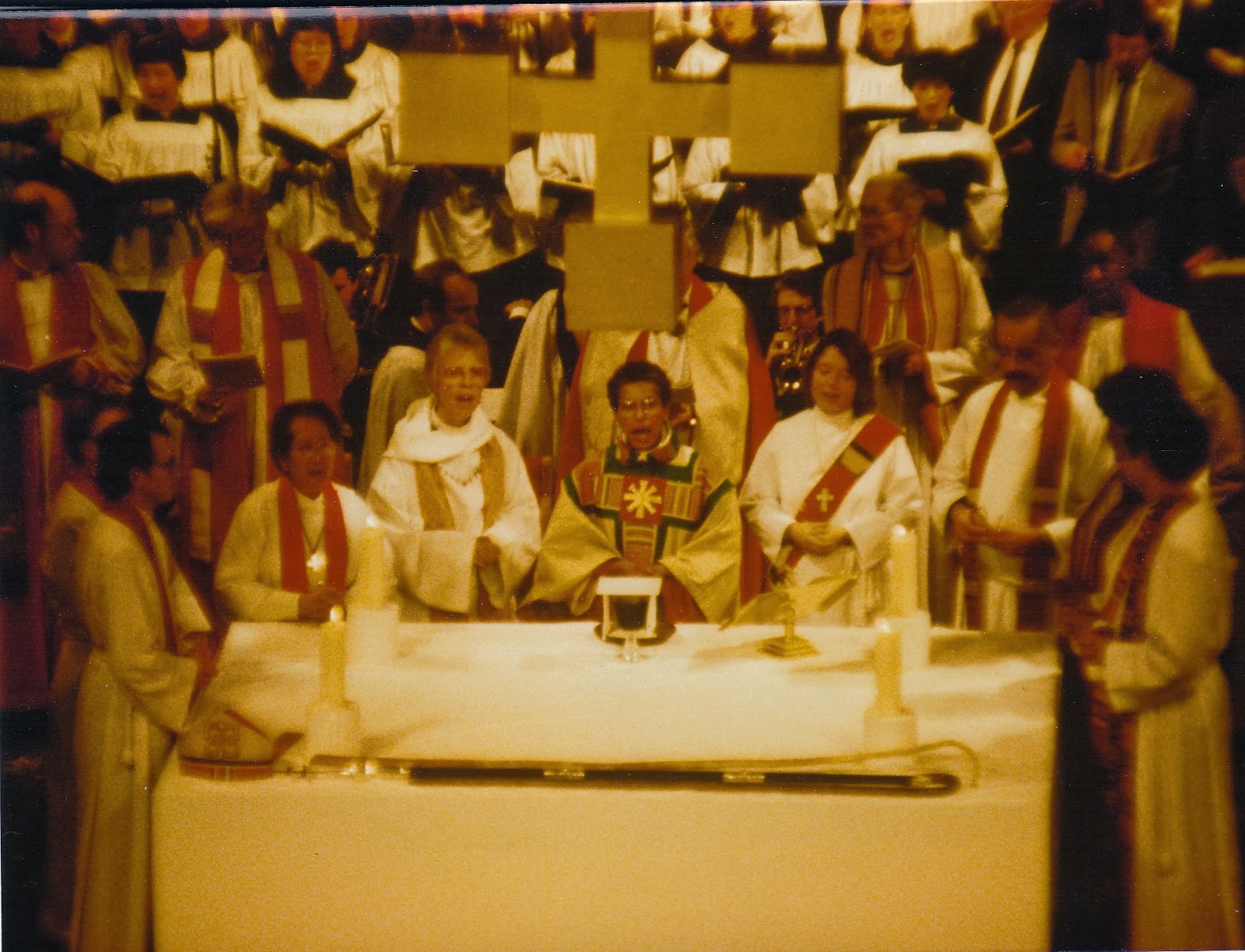
As Barbara Harris walks down the center aisle, a tiny woman whose voice and presence can fill a cathedral, over 8,000 people burst into applause. (“Not very characteristic of the Episcopal Church,” says one member of the congregation, Mary Shannon.) Throngs of priests, row upon row of beaming women and men, process down the side aisles of Boston’s Hynes Auditorium. Barbara Clementine Harris, a woman and a priest of African descent, is consecrated a bishop by the laying on of hands, according to the tradition of the apostles, by 55 men, most of them white. All through the celebration, the bishops have been purposeful, solemn, and excited, with the calm certainty that God, through them, is doing a good thing.

In describing the celebration, those who were there speak of unity. Mary Shannon repeatedly uses the term “body” to speak of the church and of her experience of this day –“finally being part of the body...” “... all of us together in one body.” She is wearing a locket with a picture of her 80-year-old mother, a member of St. Andrew’s Parish in Seattle, who “still carries her white gloves with her in church yet has rolled with the changes.” She speaks in the plural: her mother, her daughters, her husband, her women friends, all rush into the conversation. “I cried,” she says. “I just felt so happy for all of us.”

Modene Dawson of Philadelphia speaks of another unity. For her, and for many African-Americans in the assembly, the significance of the event extends beyond the church. “It’s beautiful for the country,” she says. “It shows racial harmony.” The church which conducts this celebration is not apart from the world; it is the body which proclaims to the world that God is alive in history.

Paul Matthews Washington, in his sermon, speaks about God and history. Harris’s friend and mentor, he is Rector Emeritus of the Church of the Advocate in Philadelphia, which feeds, clothes, and sanctifies the poorest of the city. In this church was held the first ordination of Episcopal women to the priesthood, in the summer of 1974, less than 15 years ago. Harris, a member of the church, led the procession, carrying the cross.

“We cannot,” says Washington, “overlook the fact that this woman being consecrated today is not just an American woman. She is a Black woman... This is a woman... who has had to struggle; she’s been despised, she’s been rejected... God has lifted up one who was at the bottom of society and has exalted her to be one of His chief pastors.”

Washington speaks of Harriet Tubman, who “nineteen times went back into the land of bondage,” thanking God for her freedom by helping to free others. He speaks of Mary, the mother of Jesus, who was raised from her lowly estate and sang of God’s power to raise up the humble and put down the mighty from their thrones: “Mary,” he says after quoting the Magnificat, “was an oppressed woman. That’s how Holy Mary Mother of God felt!” He weeps as he recalls the slavery and oppression of Black people in this country. “Only in understanding the past can we fully appreciate God’s action in this event,” he says.

The Episcopal Church, a church of power and privilege, has chosen “a have-not,” says Washington, but also one who “burns when others are offended,” a “disturbing prophet.” Harris has for years –in her public relations and policy work in the corporate world, in her parish, in her work with the Episcopal Church Publishing Company, in her pastoral ministry—advocated racial and economic justice, taken up the cause of women, spoken out against homophobia; she has, says Washington, devoted enough time to prison chaplaincy “to serve a two-year sentence herself.”

The Right Reverend Barbara Harris, newly robed in bright vestments with Ashanti designs and symbols, presides at her first Eucharist as bishop. Among the concelebrants are Carter Heyward, one of the “Philadelphia Eleven” ordained at the Church of the Advocate, and Florence Tim-Oi Li, the first woman ordained a priest in the Anglican Communion, in Hong Kong, one generation ago. At the distribution, Harris slips over to the far side of the auditorium and gives communion to the people in the hearing-impaired section, who have been singing with their hands for three hours.

A bishop is, among other things, a maker of unity. Barbara Harris has already begun to make unity; but not in the ways in which unity was previously understood or structured. Her brother bishops, Law and Methodios, fear for the health and welfare of Christian unity. But where are the real rifts in our lives today? Are they doctrinal? Where is the real, urgent need for unity? And when we say “unity,” what do we mean? Whose unity, which unity, and at what cost?

The deeper chasm today is not between Protestants and Catholics, or Greek Orthodox and Episcopalians. It is, much more, between haves and have-nots, between Blacks and whites, between men and women, between the Northern and Southern Hemispheres. These are the wounds in need of healing, in church and in society. As for denominationalism, it is no longer the principal intrachurch split. Far deeper is the gap within each of our faith communities between fundamentalists and non-fundamentalists.

Early in the service, the Presiding Bishop, Edmond L. Browning, asks if anyone knows of any reason why the consecration ought not to proceed. Two men come to the microphone. The first calls the consecration “a sacrilegious imposture,” the second “an impediment to the realization of the visible unity of the Church for which Christ prayed.” There will be a problem, they argue, with the value of any sacrament celebrated by Harris.

Bernardine Hayes, a computer systems analyst, self-described “dormant Catholic,” and veteran civil rights and peace activist (she is currently Vice President of WAND, Women’s Action for Nuclear Disarmament), had never before today “seen a woman offer the sacraments. She is so clearly affiliated with the poor,” Hayes adds. “She strikes me as a true minister.” Hayes feels something stir within her during the liturgy –“the realization that the piece of my life which is missing is the spiritual piece.”


This was, she says, "like a Pentecost."

Whose unity?

The intervention of the dissenters highlights the lack of unanimity in the church about the consecration (although Browning is quick to point out, at the post-consecration press conference, that the overwhelming majority of Episcopalians support it). But it is, in its way, a step on the road to greater unity. Perhaps the two men will change their minds; perhaps never. What is hopeful and healthy and makes a body strong is that their pain was not swept under the rug. However token, this part of the ceremony honors difference: and the unity of the Episcopal Church around this celebration –the unity behind the liturgy— is not the easy unity of unreflecting liberals. It has been hard won, tempered by prayer and struggle, and forged through the participatory process of decision-making in the Episcopal Church, a community that gave us two-thirds of the signers of the Declaration of Independence.

Elizabeth Pearson Rice-Smith, a United Church of Christ minister who witnessed both the ordination of the “Philadelphia Eleven” and Barbara Harris’s consecration, believes that “if our vision of church unity embraces diversity in God’s ministries and the human experience of faith, there is much less need to split off. I think,” she adds, “that women are willing to say things about the messy stuff that don’t condemn or blame or banish. We want to create spirited change that doesn’t mean war, that doesn’t mean people don’t talk to each other, that doesn’t mean annihilation.”

Which unity, and at what cost?

Christians do still need to speak with one another about Eucharist and ministry, about theological thought and ecclesial practice. But the context of this discussion has changed, and so have the discussion questions themselves. Unable and unwilling to hide her particularity, unlikely to temper her prophetic stance, Barbara Harris –not in spite of this but because of this—is a maker, not a breaker, of unity.


(c) Jane Redmont 1989


A few other changes – skip this if you don’t care about the minutiae: The editors also lower-cased “Black,” which I had in upper case, and made a spelling change that eliminated my metaphor “singing with their hands.” They changed it to “signing with their hands.” Of course the congregation members in question were signing –but adding “with their hands” would in that case have been unnecessary. The celebration was full of song, and part of the beauty of it was that people sang with both voice and hands. I was seated in the section next to the one using American Sign Language. The editors also deleted the paragraph with Rice-Smith’s quote.

I was still a Roman Catholic at the time I wrote this essay.

 A decade later, in 1999, a few years after I moved to California, I was invited to be on the panel of speakers at the 10th anniversary celebration of Bishop Harris’s consecration. The invitation came from the Rev. Canon Edward Rodman, with whom I had often been on the television show “In Good Faith” on WCVB-Channel 5 (then the ABC affiliate in Boston). I served as the Roman Catholic voice on the panel and offered some insights from a Catholic feminist perspective.

A few years later –12 years ago last month— I was received into the Episcopal Church. The discernment leading to this reception –and the lengthy process toward ordination to the priesthood, a vocation dating back to the 1970s– are another story for another time and place.
 
Thanks be to God for Bishop Barbara!


Tuesday, December 24, 2013

"Will you do the same this Christmas...?"


When the world was dark
and the city was quiet,
you came.
You crept in beside us. 
And no one knew.
Only the few
who dared to believe
that God might do something different.
Will you do the same this Christmas, Lord?
Will you come into the darkness of tonight's world;

not the friendly darkness
as when sleep rescues us from tiredness,
but the fearful darkness,
in which people have stopped believing
that war will end
or that food will come
or that a government will change
or that the Church cares?
Will you come into that darkness

and do something different
to save your people from death and despair?
Will you come into the quietness of this town,

not the friendly quietness
as when lovers hold hands,
but the fearful silence when
the phone has not rung,
the letter has not come,
the friendly voice no longer speaks,
the doctor's face says it all?
Will you come into that darkness

and do something different,
not to distract, but to embrace your people?
And will you come into the dark corners 

and the quiet places of our lives? 
We ask this not because we are guilt-ridden
or want to be,
but because the fullness our lives long for
depends upon us being as open and vulnerable to you
as you were to us,
when you came,
wearing no more than diapers,
and trusting human hands
to hold their maker.
Will you come into our lives,
if we open them to you
and do something different?
When the world was dark

and the city was quiet
you came.
You crept in beside us.
Do the same this Christmas, Lord.
Do the same this Christmas.

from Cloth for the Cradle, Iona Community
read at the Carol Sing at Emmanuel Church, Boston

Image (unattributed) from the blog What the Helfer

Monday, May 6, 2013

The sad, glorious, fragile spring of this year

Posted the paragraphs below the photo yesterday afternoon (Sunday, May 5) on Facebook - and (why was I surprised?) though I felt like a voice in the wilderness when I posted it, it drew many comments, most of which expressed kinship and understanding. So perhaps I was giving voice to something many of us feel right now.

The photos are from yesterday and the past few weeks in Boston.


This spring feels sad. Glorious flowers everywhere, here one week but gone the next, and the world a mess. Like my friend Lindy, who wrote about this a couple of days ago, I find that some days are just for weeping --or at least grieving if the tears don't come, which often they don't. It is worse on the days one can't cry, I think. I find consolation in the fact that Dorothy Day, surely one of the strong holy people of the 20th century and among the ones who did the most good, tough as she was, sat and wept with great frequency.

Once in a blue moon she got to weep with a friend. This is a passage about times with her friend Catherine de Hueck Doherty ("the Baroness"), a woman of very different background and temperament from hers, but who was her comrade in Christian work of mercy and justice, and who after Dorothy's death, remembered:

"When I moved to Harlem, Dorothy Day and I became even closer. There were only about five miles between her house and my Harlem house. So occasionally when we both had enough money, let’s say about a dollar, we would go to Child’s where you could get three coffee refills (for the price of one cup), and we used to enjoy each cup and just talk.

Talk about God. Talk about the apostolate. Talk about all the things that were dear to our hearts.
But we were both very lonely because, believe it or not, there were just the two of us in all of Canada and America, and we did feel lonely and no question about it.
Catherine de Hueck Doherty, Restoration, February 1981

This story came via Fr. Bob Wild (who is doing research on Day and Doherty) on the Madonna House website, but I remember reading it in the Dorothy Day anthology edited by Robert Ellsberg.


All photos (c) Jane C. Redmont. If you reproduce them without permission or attribution, the archangel in  charge of copyrights will get fiery mad. Please give credit where credit is due. Thank you.

Sunday, December 16, 2012

Guns, Grief, and Gaudete: Sermon for the Third Sunday of Advent, after the Newtown Massacre

The Third Sunday of Advent (Gaudete Sunday), year C                                               
December 16, 2012                                                                                         

St. Mary’s House, Greensboro

Zephaniah 3:14-20
Canticle 9 [from Isaiah 12:2-6]
Philippians 4:4-7
Luke 3:7-18


In the name of God
Who creates us,
Who saves us, and
Who remains with us always,
Amen.


Charlotte Bacon, 6 years old

Daniel Barden, 7 years old

Rachel Davino, 29 years old

Olivia Engel, 6 years old

Josephine Gay, 7 years old

Ana Marquez-Greene, 6 years old

Dylan Hockley, 6 years old

Dawn Hocksprung, 47 years old

Madeline Hsu, 6 years old

Catherine Hubbard, 6 years old

Chase Kowalski, 7 years old

Jesse Lewis, 6 years old

James Mattioli, 6 years old

Grace McDonnell, 7 years old

Anne Marie Murphy, 52 years old

Emilie Parker, 6 years old

Jack Pinto, 6 years old

Noah Pozner, 6 years old

Caroline Previdi, 6 years old

Jessica Rekos, 6 years old

Avielle Richman, 6 years old

Lauren Russeau, 30 years old

Mary Sherlach, 56 years old

Victoria Soto, 27 years old

Benjamin Wheeler, 6 years old

Allison Wyatt, 6 years old

[short silence]

Nancy Lanza, age unknown

Adam Lanza, 20 years old


Let us pray.

O God, who came into the world
as a fragile child
and who lived as one of us,
even unto death;
Risen One,
Mysterious One beyond our understanding,
who created and creates us,
who seeks us out,
and whom we seek;
Comforter and advocate,
our shield and our strength,
hold us in our grief;
Oh Holy One,
in Whose name we gather,
Amen


Like most preachers in this country,
I threw away the first draft of my sermon on Friday afternoon.

Advent took on starker colors.
It became more urgent, its prophetic calls more sharp.
At the same time
it went into slow motion
as our world does after trauma.

Twenty-six people shot and killed,
each shot several times, from the medical examiner’s account,
in an elementary school in a quiet, privileged community
in Connecticut.

Most of them children.
More than half of them girls.
Their teachers, all women,
killed trying to protect them.

A young man
not long out of childhood,
killing others and himself,
and before that, killing his own mother.

The rose color of Gaudete Sunday, the Sunday of rejoicing,
this third Sunday of Advent,
and the words of our first scripture readings for today,
clash with our reality.

It shouldn’t happen.
The blood,
the guns,
the police,
the media,
the empty children’s rooms
   with weeping parents,
the questions.

I threw away my sermon.

And then I asked myself:
why don’t I throw away that sermon every week?

Where, in our sermons,
in our prayers,
in our community work,
are the names of the children
who die of gun violence
every day?

 In 2008 and 2009
—these figures are from the U.S. Centers for Disease Control and Prevention— [1]
5,740
children and teens
were killed by guns.

Five thousand
seven hundred
and forty.

In two years.

This number would fill more than 229 public school classrooms
of 25 students each.

More than 170 of the children
killed during those two years
were pre-schoolers.

Black children and teens,
who were 15 percent
of the total child population in the US
during those two years,
accounted for 45 percent
of all child and teen gun deaths.

Trayvon Martin.
We remember his name – do we?
But do we know the other names?
Do our news media publish them?
Do we pray them?
Do we remember them?
Do we weep for them?

This shouldn’t happen
in a quiet suburban community.

It shouldn’t happen in a noisy urban community.

It shouldn’t happen to any mother’s child.

Or to any mother.
Or father.
Or human person of any kind.

Columbine High School, Colorado.
Wedgwood Baptist Church, Texas.
Atlanta day trading, Georgia.

            I know you want to put your hands over your ears–
bear with me and with this list for another minute—

Lockheed Martin,  Mississippi.
Living Church of God, Wisconsin.
Red Lake High School and Reservation, Minnesota.
Amish School, Pennsylvania.
Virginia Tech University, Virginia
Northern Illinois University, Illinois.
American Civic Association center, New York state
Fort Hood Army Base, Texas
Tucson congressional constituent meeting, Arizona
Oikos University, California
Seattle café, Washington state
Movie theatre, Colorado
Sikh temple, Wisconsin

I skipped some.

We don’t feel much like rejoicing on this Gaudete Sunday.

And religious platitudes won’t help us.

The voice and visions from today’s scriptures from Zephaniah and Isaiah,
words of justice and joy,
speak to some of us
but fail to reach others among us.

Some of us feel more like the passage from Jeremiah,
the same passage quoted in the gospel of Matthew on the massacre of the innocents:
“...a voice is heard in Ramah, lamentation and bitter weeping.
Rachel is weeping for her children;
she refused to be comforted for her children,
because they are no more.[2]

When children die,
our God dies.
Our faith is shaken.
Our hope begins to faint.
Our visions and dreams turn to nightmares.

Into this world
this very world
Jesus was born
and is born
and will be born.

In this world,
John the Baptizer
spoke,
and speaks,
to both rich and poor,
to the occupied and the occupiers,
the conquered and the empire,
the religious and the not so religious,
the violent and the silent.

Last week we encountered John already,
preaching repentance –
-- repentance and forgiveness.
Repentance first.

And did you notice that the author of the gospel of Luke
very carefully named the context, political and economic,
of John’s preaching -- do you remember?

"In the fifteenth year of the reign of Emperor Tiberius, when Pontius Pilate was governor of Judea, and Herod was ruler of Galilee, and his brother Philip ruler of the region of Ituraea..." and so on –“the word of God came to John...

We might well say:
In the seventh year of the Roberts Court at the Supreme Court of the United States, the seventeenth year since the founding of the World Trade Organization,[3] the one hundred and twelfth Congress, the fourth year of the presidency of Barack Obama, when Bev Perdue was governor of North Carolina, the word of God came...

This week,
the gospel’s author, and John the Baptizer,
get very practical.
 
What should we DO?

What should we do?

One of the things we tend to do when a catastrophe happens is to simplify.

We want a cause. We want a reason. We want a simple answer.

We want it theologically
and we want it socially.

We want it theologically:
You know that saying, “Everything happens for a reason”?
What a load of theological hogwash that is. 

As if we could know.
 
On an emotional and spiritual and theological level,
we don’t know.

We need to sit, in Advent, in the night,
in our not-knowing,
the not-knowing in which faith is forged,
the place where hope will be born
–in this we trust—
in the faint light of the rose and purple candles.

But this will not happen fast
or easily.

And socially, we want a simple answer too.

That is another kind of “everything happens for a reason”
which might be rephrased as 
“everything happens for one reason.”

No; I think
that things generally happen
for several reasons.

In the case of the Connecticut killings,
and of other killings by gun violence in this nation,
the lax gun laws, yes.
Yes. Yes.

AND
the fact that it is easier to get a gun
than to get mental health care.
The lack of good mental health care.
The stigma
that those of us who have suffered from mental illness still bear.

The glorification of violence in our entertainment industry
and the shaping of our desires
through this industry.

The images and models of masculinity in our culture.

Social isolation.

And this country’s particular sin:
We enslaved each other through violence.
We are a country enslaved to violence.

AND

whatever it is
that causes humans to kill each other,
as the ancient story of the brothers Abel and Cain recounts.

We are all entangled with this.

Call it evil, call it sin, call it the way of the world;
call it what you want.
We are, one way or another, a part of it –
- some perhaps more than others, but all of us.

Today’s collect[4]
puts it in old-fashioned language: “we are sorely hindered by our sins.”

We hear this against the backdrop of last week’s gospel:
the reality of repentance
and that of forgiveness.


What should we DO?
Say the people
in today’s gospel.

John the Baptizer,
in the Gospel of Luke,
encounters different audiences
who ask what they should do
to change.

The crowd asks.
The tax collectors ask.
Even the soldiers ask.

John takes these groups of people
where they are.
They are not starting from the same place.

No hoarding, he says to one group.
No skimming, to the other.
No extortion, to the third; no abuse.

It’s not everything.
But it’s a place to start.


In Advent,
we live
between God’s patience
and God’s impatience.

Advent is a time to rediscover
both of these,
God’s patience
and God’s impatience,
and to discern
when and where 
to respond to them
by living in them:

Living God’s patience:
in grieving together,
in holding each other’s hands,
in listening,
in doing the small, daily things
that assure us, after the catastrophe,
that we are still alive.

Living God’s impatience:
in outrage
and action
for justice;
for change.


Dorothee Soelle, the German theologian,
has always been helpful to me.
She grew up during the Shoah [the Holocaust]
and after World War II, she said,
she didn't have much stomach for
“the God who so gloriously reigneth."
For her,
in that period of history,
God was weak
and did not have enough friends.

The God who is with us
in Advent,
and who will be with us at Christmas
as a fragile child,
needs us 
as friends.


Let us pray.

Come, o brother Jesus.
Come, o wounded savior.
Come, weak God who shows us strength where there is none.

Come, challenger of empires
and of the language of empires
and of the weapons of empires.

Come to us and make us your friends.
Come to us who are charged with protecting
you,
your children,
your life.

Come to us who fail;
come to us who struggle;
come to us who need forgiveness.

Come to us
and teach us to work
patiently
stubbornly
together
for life.

Come, Lord Jesus.
Weep with us.
Hold our hands.
Stay in our hearts.

Come, Lord Jesus.
Anger us.
Be our guide.
Teach us to be your friends.
Teach us your hope.

Amen.


[1] These figures and others are detailed and analyzed in the Children’s Defense Fund report on children and gun violence, "Protect Children Not Guns 2012." http://www.childrensdefense.org/child-research-data-publications/data/protect-children-not-guns-2012.pdf
[2] Jeremiah 31:15.
[3] In a shorter, related meditation for an Advent retreat, I also included in this enumeration “in the sixty-eighth year since the establishment of the Bretton Woods Institutions.”  I include these transnational economic institutions (the Bretton Woods institutions –the World Bank and the International Monetary Fund— and the World Trade Organization) because politics and economics, as they were two thousand years ago though in different ways, are deeply connected, and because our lives are affected by economic as well as political institutions. You can replace the names and institutions above at will. Try it.
[4] Stir up your power, O Lord, and with great might come among us; and, because we are sorely hindered by our sins, let your bountiful grace and mercy speedily help and deliver us; through Jesus Christ our Lord, to whom, with you and the Holy Spirit, be honor and glory, now and for ever. Amen. Collect for the Third Sunday of Advent, the Book of Common Prayer.

Friday, April 22, 2011

Good Friday: A Meditation on the Eleventh Station of the Cross

I am always moved and inspired by the Stations of the Cross at St. Mary's House. (Yes, Episcopalians have Stations of the Cross, though not everywhere.) A different person offers a meditation for each of the 14 stations, many spoken, some sung, one or two visual. So much wisdom, talent, heart, and faith for one small congregation.

Here is my meditation on the eleventh station, "Jesus Is Nailed to the Cross."


Jesus Is Nailed to the Cross


Were you there?

Are you there?

Will you be there?

Were you there ******** [italics indicate Jane singing a cappella]
when they crucified my Lord?
Were you there
when they crucified my Lord?
Oh, oh…
Sometimes
it causes me to tremble,
tremble, tremble…
Were you there
when they crucified my Lord?

These stories come from the witness of Kelsey McNicholas,
a student at Guilford College and a volunteer
with the humanitarian organization No More Deaths
which seeks out migrants in the desert
to give them water, food, medical care,
and presence.

When undocumented immigrants are caught
by the U.S. border patrol,
they are
detained.
Manuel González told Kelsey
that while in detention
on the U.S. side of the border,
our side,
he'd only been given peanut butter to eat.

Ricardo Emilio Sánchez,
walking beside Manuel and Kelsey,
chimed in
that he had been given a tiny cold hamburger
and a small juice
for the whole day.

During Kelsey’s time in Nogales, Mexico,
across the border from Tucson, Arizona,
other people who had recently been detained
on the other side,
our side,
and then deported back to the Mexican side,
told her
that they weren't allowed to sleep.
Guards would come in and blare music
to keep them from sleeping.

Women described being stripped
to their last layer of clothing
in a highly air conditioned room.

Men described
having seventy people crammed into one room,
so packed that three had to sleep in the bathroom,
preventing anyone from using the facilities for three days.

Were you there
when they nailed him to a tree?
Were you there
when they nailed him to a tree?
Oh, oh …
Sometimes
it causes me to tremble,
tremble, tremble…
Were you there
when they nailed him to a tree?

During the dangerous crossing
from Mexico to the U.S.
and on occasion
in the other direction,
women, children, and men
driven by economic necessity,
risk their lives
there, in the heat and the rocks.

Some die.

The bodies of those who died in the desert,
if they are not found soon enough,
disappear.
The desert heat and dryness
eat them away
and they are gone.
Flesh, bones.
Clothes.

Sometimes
after they die
or
if they are lucky,
after they are caught, arrested, and detained,
in the desert
a child’s shoe remains,
or a backpack,
or a small shrine to La Virgen de Guadalupe
in a hole in a rock.

The volunteers find them:
the shoe,
the backpack,
the shrine.

Sometimes, too, the border patrol discovers
these traces of human lives,
of faith,
fear,
the drive to survive.

Far away
from the hot desert
in which the migrants
walk in the
in-between place
between there and here
we are busy
making laws.

Were you there
when they pierced him in the side?
Were you there
when they pierced him in the side?
Oh, oh …
Sometimes
it causes me to tremble,
tremble, tremble…
Were you there
when they pierced him in the side?

Far away
from the hot desert of Arizona,
in the deserts of Australia
and Sudan
the droughts worsen.

In Alaska,
the caribou have changed their migration patterns
because the ice melts too soon.

In Japan,
some survivors of Hiroshima are still alive
while neighbors of Fukushima power plant wonder
whether they will become ill
next week
next month
or next year.

In Harlem and San Francisco.
Black and brown children,
God’s youngest
children,
are disproportionately represented
among children with asthma
wheezing and coughing in emergency rooms
with anxious parents at their side.

In fields and factories
on this continent north and south
workers labor amid chemicals
not fit for human consumption
so that we can have
our strawberries
and our t-shirts.

We have nailed the earth God made
to a cross of
heat and waste.

Were you there
when the sun refused to shine?
Were you there
when the sun refused to shine?
Oh, oh …
Sometimes
it causes me to tremble,
tremble, tremble…
Were you there
when the sun refused to shine?

By the cross of Jesus the Christ
the soldiers of the Empire
mock
and taunt
and violate
the precious body
of God.

They leave.

And behind them,
at the place of shame and death,
in the open torture chamber in the hot sun
only a few, few friends remain,
witnessing.

Mary of Magdala.
Mary the mother of Jesus.
One or two other women.
The beloved disciple,
whose name
we may or may not know.

Only their presence protests.

But they are present.

It is dangerous in the Roman Empire
even to stay and watch
the crucified.
Even more dangerous
to take the body down
and bury it with care
rather than letting birds, animals,
the hot sun,
destroy it
and its remains.

Were you there
when they laid him in the tomb?
Were you there
when they laid him in the tomb?
Oh, oh …
Sometimes
it causes me to tremble,
tremble, tremble…
Were you there
when they laid him in the tomb?


Were you there?

Are you there?

If we do not cry out
The stones will cry out.

But must we leave it to the stones?


Jane Carol Redmont
Good Friday 2011
St. Mary's House, Greensboro

Sunday, January 2, 2011

For the new year

One of my favorite Pete Seeger songs, written by David Mallett:

The Garden Song


Photo: Sugar Creek Township, Greene County, Ohio

Tuesday, December 28, 2010

"The Low Road"

A couple of months ago I rediscovered this old poem by Marge Piercy. It is from her book The Moon Is Always Female.

What can they do
to you? Whatever they want.
They can set you up, they can
bust you, they can break
your fingers, they can
burn your brain with electricity,
blur you with drugs till you
can t walk, can’t remember, they can
take your child, wall up
your lover. They can do anything
you can’t blame them
from doing. How can you stop
them? Alone, you can fight,
you can refuse, you can
take what revenge you can
but they roll over you.

But two people fighting
back to back can cut through
a mob, a snake-dancing file
can break a cordon, an army
can meet an army.

Two people can keep each other
sane, can give support, conviction,
love, massage, hope, sex.
Three people are a delegation,
a committee, a wedge. With four
you can play bridge and start
an organisation. With six
you can rent a whole house,
eat pie for dinner with no
seconds, and hold a fund raising party.
A dozen make a demonstration.
A hundred fill a hall.
A thousand have solidarity and your own newsletter;
ten thousand, power and your own paper;
a hundred thousand, your own media;
ten million, your own country.

It goes on one at a time,
it starts when you care
to act, it starts when you do
it again after they said no,
it starts when you say We
and know who you mean, and each
day you mean one more.
P.S. I just found out on Piercy's website that she wrote a memoir called Sleeping with Cats, published in 2002. Click to link at the name of the book and have a look at the review excerpts.