Showing posts with label suffering and evil. Show all posts

Thursday, July 17, 2014

The children

Children, children, children. Children running away from violence and poverty in Central America, children sent back to violence and poverty in Central America, children killed on a beach in Gaza, children hungry and unsafe on the streets of these United States, children deathly ill with cholera in South Sudan. Cry out, o stones.

I first posted this lament on Facebook about 12 hours ago, Wednesday July 16, 2014.

Photo: Reuters, Gaza, July 16, 2014

Friday, February 14, 2014

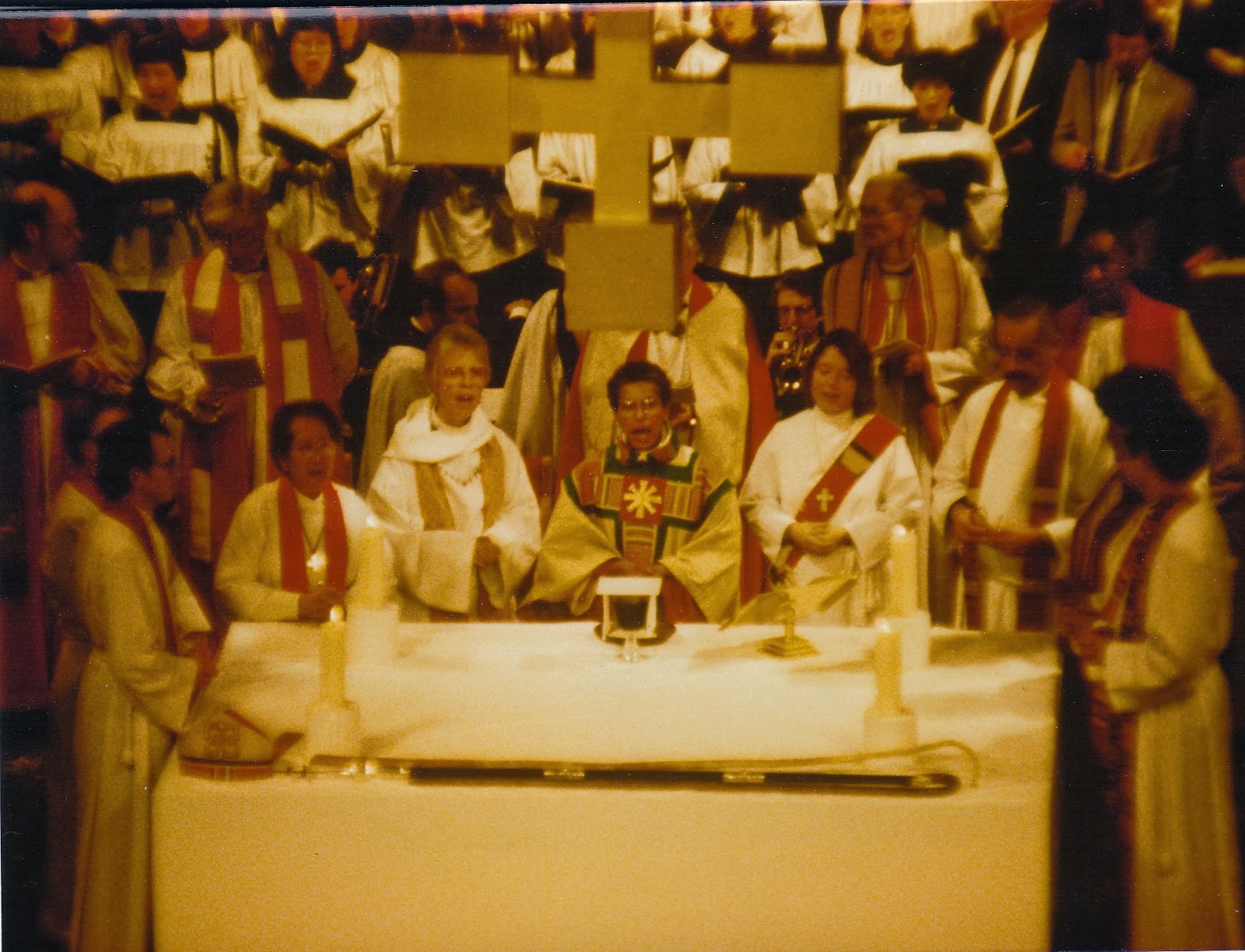
Barbara Harris, Bishop: Silver Anniversary and Ecumenical Reflection

The following essay appeared in the March 10, 1989 issue of the Catholic lay-edited magazine Commonweal under the title "When the Spirit Leads: Barbara Harris, Bishop." The editors cut out the last sentence without consulting me. They made a few less drastic changes which I note below the text of the essay. This text, with some minor copyediting, is my original version.

Barbara Harris was consecrated bishop on February 11, 1989 and served as Bishop Suffragan of the Episcopal Diocese of Massachusetts (1989-2003). She served as Assisting Bishop in the Diocese of Washington (2003-2007). Happily, she is back among us in Massachusetts. We will celebrate the 25th anniversary of her consecration this Sunday, February 16, 2014, with a Gospel Vesper Service.


[February, 1989]

A day or two before the consecration of Barbara Clementine Harris as Suffragan Bishop of the Episcopal Diocese of Massachusetts, Cardinal Bernard Law and Greek Orthodox Bishop Methodios issue written statements of welcome. The statements are cordial. They also speak of the danger Harris’s consecration presents for reconciliation among Christian churches, or what has become commonly known as “Christian unity.”

At the consecration, the gospel music of St. Paul’s African Methodist Episcopal Church choir alternates with the delicate melodies of the Chinese Congregation and classical European harmonies of Trinity Church choir. The stately cadence of the Book of Common Prayer moves us forward, but in the musical realm there is a preferential option in the air: clearly, the day belongs less to Mozart and more to the music of the Black church. The celebration flows. This is no Tower of Babel: we each hear God speaking in our own tongue.

As Barbara Harris walks down the center aisle, a tiny woman whose voice and presence can fill a cathedral, over 8,000 people burst into applause. (“Not very characteristic of the Episcopal Church,” says one member of the congregation, Mary Shannon.) Throngs of priests, row upon row of beaming women and men, process down the side aisles of Boston’s Hynes Auditorium. Barbara Clementine Harris, a woman and a priest of African descent, is consecrated a bishop by the laying on of hands, according to the tradition of the apostles, by 55 men, most of them white. All through the celebration, the bishops have been purposeful, solemn, and excited, with the calm certainty that God, through them, is doing a good thing.

In describing the celebration, those who were there speak of unity. Mary Shannon repeatedly uses the term “body” to speak of the church and of her experience of this day –“finally being part of the body...” “... all of us together in one body.” She is wearing a locket with a picture of her 80-year-old mother, a member of St. Andrew’s Parish in Seattle, who “still carries her white gloves with her in church yet has rolled with the changes.” She speaks in the plural: her mother, her daughters, her husband, her women friends, all rush into the conversation. “I cried,” she says. “I just felt so happy for all of us.”

Modene Dawson of Philadelphia speaks of another unity. For her, and for many African-Americans in the assembly, the significance of the event extends beyond the church. “It’s beautiful for the country,” she says. “It shows racial harmony.” The church which conducts this celebration is not apart from the world; it is the body which proclaims to the world that God is alive in history.

Paul Matthews Washington, in his sermon, speaks about God and history. Harris’s friend and mentor, he is Rector Emeritus of the Church of the Advocate in Philadelphia, which feeds, clothes, and sanctifies the poorest of the city. In this church was held the first ordination of Episcopal women to the priesthood, in the summer of 1974, less than 15 years ago. Harris, a member of the church, led the procession, carrying the cross.

“We cannot,” says Washington, “overlook the fact that this woman being consecrated today is not just an American woman. She is a Black woman... This is a woman... who has had to struggle; she’s been despised, she’s been rejected... God has lifted up one who was at the bottom of society and has exalted her to be one of His chief pastors.”

Washington speaks of Harriet Tubman, who “nineteen times went back into the land of bondage,” thanking God for her freedom by helping to free others. He speaks of Mary, the mother of Jesus, who was raised from her lowly estate and sang of God’s power to raise up the humble and put down the mighty from their thrones: “Mary,” he says after quoting the Magnificat, “was an oppressed woman. That’s how Holy Mary Mother of God felt!” He weeps as he recalls the slavery and oppression of Black people in this country. “Only in understanding the past can we fully appreciate God’s action in this event,” he says.

The Episcopal Church, a church of power and privilege, has chosen “a have-not,” says Washington, but also one who “burns when others are offended,” a “disturbing prophet.” Harris has for years –in her public relations and policy work in the corporate world, in her parish, in her work with the Episcopal Church Publishing Company, in her pastoral ministry—advocated racial and economic justice, taken up the cause of women, spoken out against homophobia; she has, says Washington, devoted enough time to prison chaplaincy “to serve a two-year sentence herself.”

The Right Reverend Barbara Harris, newly robed in bright vestments with Ashanti designs and symbols, presides at her first Eucharist as bishop. Among the concelebrants are Carter Heyward, one of the “Philadelphia Eleven” ordained at the Church of the Advocate, and Florence Tim-Oi Li, the first woman ordained a priest in the Anglican Communion, in Hong Kong, one generation ago. At the distribution, Harris slips over to the far side of the auditorium and gives communion to the people in the hearing-impaired section, who have been singing with their hands for three hours.

A bishop is, among other things, a maker of unity. Barbara Harris has already begun to make unity; but not in the ways in which unity was previously understood or structured. Her brother bishops, Law and Methodios, fear for the health and welfare of Christian unity. But where are the real rifts in our lives today? Are they doctrinal? Where is the real, urgent need for unity? And when we say “unity,” what do we mean? Whose unity, which unity, and at what cost?

The deeper chasm today is not between Protestants and Catholics, or Greek Orthodox and Episcopalians. It is, much more, between haves and have-nots, between Blacks and whites, between men and women, between the Northern and Southern Hemispheres. These are the wounds in need of healing, in church and in society. As for denominationalism, it is no longer the principal intrachurch split. Far deeper is the gap within each of our faith communities between fundamentalists and non-fundamentalists.

Early in the service, the Presiding Bishop, Edmond L. Browning, asks if anyone knows of any reason why the consecration ought not to proceed. Two men come to the microphone. The first calls the consecration “a sacrilegious imposture,” the second “an impediment to the realization of the visible unity of the Church for which Christ prayed.” There will be a problem, they argue, with the value of any sacrament celebrated by Harris.

Bernardine Hayes, a computer systems analyst, self-described “dormant Catholic,” and veteran civil rights and peace activist (she is currently Vice President of WAND, Women’s Action for Nuclear Disarmament), had never before today “seen a woman offer the sacraments. She is so clearly affiliated with the poor,” Hayes adds. “She strikes me as a true minister.” Hayes feels something stir within her during the liturgy –“the realization that the piece of my life which is missing is the spiritual piece.”


This was, she says, "like a Pentecost."

Whose unity?

The intervention of the dissenters highlights the lack of unanimity in the church about the consecration (although Browning is quick to point out, at the post-consecration press conference, that the overwhelming majority of Episcopalians support it). But it is, in its way, a step on the road to greater unity. Perhaps the two men will change their minds; perhaps never. What is hopeful and healthy and makes a body strong is that their pain was not swept under the rug. However token, this part of the ceremony honors difference: and the unity of the Episcopal Church around this celebration –the unity behind the liturgy— is not the easy unity of unreflecting liberals. It has been hard won, tempered by prayer and struggle, and forged through the participatory process of decision-making in the Episcopal Church, a community that gave us two-thirds of the signers of the Declaration of Independence.

Elizabeth Pearson Rice-Smith, a United Church of Christ minister who witnessed both the ordination of the “Philadelphia Eleven” and Barbara Harris’s consecration, believes that “if our vision of church unity embraces diversity in God’s ministries and the human experience of faith, there is much less need to split off. I think,” she adds, “that women are willing to say things about the messy stuff that don’t condemn or blame or banish. We want to create spirited change that doesn’t mean war, that doesn’t mean people don’t talk to each other, that doesn’t mean annihilation.”

Which unity, and at what cost?

Christians do still need to speak with one another about Eucharist and ministry, about theological thought and ecclesial practice. But the context of this discussion has changed, and so have the discussion questions themselves. Unable and unwilling to hide her particularity, unlikely to temper her prophetic stance, Barbara Harris –not in spite of this but because of this—is a maker, not a breaker, of unity.


(c) Jane Redmont 1989


A few other changes – skip this if you don’t care about the minutiae: The editors also lower-cased “Black,” which I had in upper case, and made a spelling change that eliminated my metaphor “singing with their hands.” They changed it to “signing with their hands.” Of course the congregation members in question were signing –but adding “with their hands” would in that case have been unnecessary. The celebration was full of song, and part of the beauty of it was that people sang with both voice and hands. I was seated in the section next to the one using American Sign Language. The editors also deleted the paragraph with Rice-Smith’s quote.

I was still a Roman Catholic at the time I wrote this essay.

 A decade later, in 1999, a few years after I moved to California, I was invited to be on the panel of speakers at the 10th anniversary celebration of Bishop Harris’s consecration. The invitation came from the Rev. Canon Edward Rodman, with whom I had often been on the television show “In Good Faith” on WCVB-Channel 5 (then the ABC affiliate in Boston). I served as the Roman Catholic voice on the panel and offered some insights from a Catholic feminist perspective.

A few years later –12 years ago last month— I was received into the Episcopal Church. The discernment leading to this reception –and the lengthy process toward ordination to the priesthood, a vocation dating back to the 1970s– are another story for another time and place.
 
Thanks be to God for Bishop Barbara!


Monday, May 6, 2013

The sad, glorious, fragile spring of this year

Posted the paragraphs below the photo yesterday afternoon (Sunday, May 5) on Facebook - and (why was I surprised?) though I felt like a voice in the wilderness when I posted it, it drew many comments, most of which expressed kinship and understanding. So perhaps I was giving voice to something many of us feel right now.

The photos are from yesterday and the past few weeks in Boston.


This spring feels sad. Glorious flowers everywhere, here one week but gone the next, and the world a mess. Like my friend Lindy, who wrote about this a couple of days ago, I find that some days are just for weeping --or at least grieving if the tears don't come, which often they don't. It is worse on the days one can't cry, I think. I find consolation in the fact that Dorothy Day, surely one of the strong holy people of the 20th century and among the ones who did the most good, tough as she was, sat and wept with great frequency.

Once in a blue moon she got to weep with a friend. This is a passage about times with her friend Catherine de Hueck Doherty ("the Baroness"), a woman of very different background and temperament from hers, but who was her comrade in Christian work of mercy and justice, and who after Dorothy's death, remembered:

"When I moved to Harlem, Dorothy Day and I became even closer. There were only about five miles between her house and my Harlem house. So occasionally when we both had enough money, let’s say about a dollar, we would go to Child’s where you could get three coffee refills (for the price of one cup), and we used to enjoy each cup and just talk.

Talk about God. Talk about the apostolate. Talk about all the things that were dear to our hearts.
But we were both very lonely because, believe it or not, there were just the two of us in all of Canada and America, and we did feel lonely and no question about it.
Catherine de Hueck Doherty, Restoration, February 1981

This story came via Fr. Bob Wild (who is doing research on Day and Doherty) on the Madonna House website, but I remember reading it in the Dorothy Day anthology edited by Robert Ellsberg.


All photos (c) Jane C. Redmont. If you reproduce them without permission or attribution, the archangel in  charge of copyrights will get fiery mad. Please give credit where credit is due. Thank you.

Sunday, June 5, 2011

Thirty Years: An AIDS Anniversary

Thirty years ago today, on June 5, 1981, the Centers for Disease Control and Prevention (CDC) reported the first cases of AIDS in the United States.

My friend Wormwood's Doxy, an HIV/AIDS education professional, has written a moving anniversary essay at her blog. Read it here.

Once you have recovered from reading it --it may take you a few hours; it is an intense and beautiful essay-- come back here and read my offering for this day, written 23 years ago, in 1988, when I was in my thirties.

This commentary, minus the three paragraphs in red brackets, was published and distributed by Religious News Service (now called Religion News Service) on July 12, 1988 under the title "The Names Project Quilt Makes Beauty Out of Horror."

At the time I wrote the essay, I was working on my first book, Generous Lives: American Catholic Women Today (William Morrow, 1992; pbk Triumph/Liguori 1993), and was employed as a program developer raising funds for The Hospice at Mission Hill, the first residential hospice for people with AIDS in Boston.

The AIDS Quilt was on its first major tour around the U.S. and was displayed in its entirety on the National Mall in Washington, DC in fall of that year. I went to see it at what was still called the Boston Armory.

I have altered only a few tiny grammar and style details and have left in the language I used back then, only seven years after the anniversary we commemorate today. (For instance, I never use "minority groups" or "minorities" to mean people of color or minoritized groups these days, but I did then. The Soviet Union was still the Soviet Union in 1988, so I left that in. What is now the U.S. Postal Service had another name.)

The pandemic is still with us, all over the world. This essay is a slice of life.

Many of the students I teach were not even born when I wrote these words.


The Quilt
Cambridge, Massachusetts
June 23, 1988

In Stockholm last week, medical researchers from around the world tracked the elusive virus and its deadly mysteries. In Boston a massive quilt unfolded for four days, stitched by thousands of Americans as a memorial to people who have died of ADS. The quilt, sponsored by the Names Project, is as different from other memorials to the dead as AIDS is different from the other diseases that have plagued us. It is not made of stone and anchored in the ground, but portable and soft, organic, making its way around the nation, still growing.

More than a week after my visit to the Quilt, its impact will not go away. The first emotional shock, for visitors, is the sheer magnitude and diversity of the project, row upon row of remembered lives, presented in sophisticated patterns and hesitant stitches, in all materials from denim to organza. Some panels show only a name and dates of birth and death. Others literally bear pieces of people's lives: articles of clothing, photographs, locks of hair. One has the ashes of the person it commemorates sewn into a corner.

The Names Project is meant, according to its founder, San Francisco gay activist Cleve Jones, to give "a glimpse of the lives behind the statistics" as it travels around the country. Men, women and children sewed for relatives and lovers and for people they had never met. There are crosses and stars of David, hearts and teddy bears and pictures of cats, insignia representing the military and the medical professions, pennants from Yale and Columbia. On one panel is the portrait of a proud, handsome Black man, with a written tribute to his character and commitments. Another, with a child's pink dress sewn onto it, says only "La Hijita de Dios," "the little daughter of God." All over the panel, serving as background design, are small diaper pins.

And then there is the second shock: youth. Over half the panels bear dates of birth and death. I stared and subtracted: twenty-five years old; thirty-nine; twenty-two; two years old. The overwhelming majority of those who have died, who are now ill, who are HIV-positive, are young. Mothers embroider love letters to lost sons on the cloth. Nothing prepares one for this, even the experience (which I share) of having young loved ones among the dead. It is like walking in an old New England cemetery and coming across a child's stone marker among the graves.

We speak a lot these days about the spread of AIDS among intravenous drug users, among heterosexuals, into minority communities, through mothers to their babies. The Quilt is beginning to show the impact of these facts. But still the names are mostly those of men --young men, gay men. I am reminded of the population charts in the Soviet Union, on which the curve dips at the males who were young adults during World War II. We have not even begun to measure the trauma and devastation which AIDS has brought to an entire generation of an entire community. "I am angry," says a friend, "that at the age of 29 I must deal constantly with multiple deaths, with friends losing their strength and the use of their bodies, with grief and hospitals and burials and loss. " "Many of us are finding it hard to plan for the future," says another: "Is there a future for me? Will my closest friends till be here in five years? Will I?"

I think of the shock after the death of a single loved one, how it leaves one numb and split open all at once, with the feeling of being both wrapped in cotton wool and bled raw. Multiply this by six and twelve and fifty in the life of one person; multiply that by hundreds. Only after doing this can one measure the emotional impact of AIDS, the massive grief of whole communities, spreading around the nation.

"Wrenching" and "healing" --in the same sentence-- are the words I have heard and used most often to describe the Names Project. This witness to multiple deaths is also about the fullness of life. Most of the panels remember people not as they were in their last days, weighting eighty pounds and unable to bathe themselves or walk to the toilet, but as they were in life, designing theatre sets and playing ball, lovers of glitz and glitter or of hikes in the mountains, speaking and singing in Spanish and English, eating and drinking. A panel dedicated to a mail carrier features the arm of his blue uniform with the "U.S. Mail" emblem, cradling a small teddy bear. The rest of the panel is an uproarious burst of color: a golden peacock, a sunflower, cloth letters of a name in rainbow colors, pictures of California life.

Still, for some of the survivors, the colors battle against bleak memories. "I can no longer remember him healthy and live," says a woman I know of the friend for whom she made a panel. "I always remember him the other way."

All the panels tug at the heart. But for each visitor there were a few that hit the core and that linger, triggering floods of anger, grief, or tenderness. For me one of these was the pink "Hijita de Dios." Another featured two men's shirts sewn on with their arms entwined. "Though lovers shall be lost love shall not," Dylan Thomas wrote in "And Death Shall Have No Dominion." The first verse of this poem is printed on the third Quilt panel that lives on inside me. Long before AIDS, before the wasted bodies and lost minds, before the dementia, Thomas wrote:
"Though they go mad they shall be sane
Though they sink through the sea they shall rise again."
"Death shall have no dominion." I cannot shake this phrase from my mind, trying to summon the stubbornness of life against the slow creep of death.

[The Vietnam Memorial changed forever our experience of monuments to the dead. Like the Vietnam Memorial, the Quilt is a live place, no lonely obelisk in the town square but a place of meeting and community. The Vietnam monument grows bits of life; the first day I went, on a wet December morning, a small flag with a spring of heather tied to it was propped up against the wall almost lost in the mud and brown oak leaves. The rain cause the black wall to shine and reflect my face back to me. There were names on my reflection, some of them familiar last names. The people I knew who bore these names were still alive; but I began to wonder. Was this a relative of the person I knew? Could it have been my friend, given a different lottery number, another set of circumstances? The boundaries crumbled. There was no barrier left between "them" and "us."

The Names Project takes this kind of memorial experience further, deeper. At the Vietnam Memorial, people talk, embrace, weep, ask questions. The dark stone brings forth stories because of the power of the names. The Quilt itself tells the stories, spells out the memories in material that almost seems made of flesh. It is also an organic reality: a whole piece of art, but an unfinished one. The epidemic has not stopped growing. Neither, until it does, will this quilt.

It is impossible to stay passive before the Quilt, even more so than before the Vietnam Memorial. This is because it tells stories directly and because live stories lead us to act and to hope, like the retelling of the Passover or the account of Harriet Tubman and the Underground Railroad. Memories like these do not mire us in the past; they move us to shape the future. But first we go down, into the grief, into the struggle, through the retelling. Without memory, there is no possibility of hope, nor of bringing about the changes that will stem the tide of death.]

As I walked into the exhibit, the first people I saw were a very pregnant woman, a man, and a child. The mother bent over and spoke to her child about a man who had "died of the bad disease." She asked the child, pointing to a panel with a basketball shirt attached and an embroidered basketball, "What do you think this person really liked?" Five years from now, will I be the woman explaining to her child about the bad disease? Fifteen years from now, will this disease still claim lives? Will the Quilt sit in a museum? How many more stories will we need to tell? "No more names!" read a tee-shirt worn by one of the visitors.

The Quilt is a wondrous work of art --colorful, homespun, soft and resilient, quintessentially American, spiritual and political, beautiful in itself and charged with moral energy. It chronicles a catastrophe, like Picasso' s "Guernica," but is crafted by a community rather than a lone genius. Like "Guernica," it makes beauty out of horror. It leaves the viewer torn: grateful for such beauty, for the redeeming power of names and memory, for the healing; and wishing that this thing of beauty had never had to exist, knowing the names will not go away.

* * * * * * * *

This was, of course, long before the internet. The Quilt is now online here. Nothing, however, replaces having seen it, walked around the panels, bumped into a colleague who wept in my arms, and heard the names of the dead read aloud, as has happened at all public showings of this work of art.


Thursday, January 6, 2011

The oft-recycled Epiphany sermon (with asides on James Taylor, T.S. Eliot, Sadao Watanabe, and Masao Takanake)

Sadao Watanabe, The Magi's Dream


Bear in mind that I wrote this Epiphany sermon a little over a year after 9/11. It's from eight years ago, Epiphany 2003. I stand by what I said.
Click here to read it.

I looked for artistic representations of Herod, since a good deal of the sermon focuses on him. What I found, for the most part, were representations of the consequences of Herod's actions: the slaughter of the innocents; the Magi returning home by another way; the flight into Egypt of Mary, Joseph, and Jesus.


Later on of course there is another Herod, Herod Antipas, who is the son of Herod the Great, and it is he who is involved in the deaths of both John the Baptizer and Jesus according to the Gospel stories.

The only scenes in which Herod shows up as a visible protagonist are, once in a while, Herod with the Magi, and, more often (at least in Western art), Herod's feast, but that one is Herod the son. The feast is the one at which which Herod Antipas's stepdaughter Salome dances and asks for the beheading of John.

In painted scenes of Jesus' infancy, even with Herod the Great's presence in the stories, artists tends to focus on the Holy Family, the shepherds, the animals, the angels, and the Magi. Makes sense. "But Herod's always out there. / He's got our cards on file," James Taylor's song notes. And... See
the sermon for more.

Of course I also read --or listen to-- the T.S. Eliot poem "Journey of the Magi" every year, but I only cited a line or two of it in that sermon.


The link at the name of the poem will take you to the text of "Journey of the Magi" and to an audio of T.S. Eliot himself reading it. Well worth a listen.

Don't mix "Journey of the Magi" with the sermon though -- very different animals. Read them separately, or just read one or the other.


Note: I never see the work of the Japanese artist Sadao Watanabe (see above) without thinking fondly of Dr. Masao Takanake, who during his time at Harvard introduced me and others to Watanabe's work. Watanabe's art graces the cover of at least one of Takenaka's books, The Bible Through Asian Eyes. A scholar of Christian ethics, Takenaka also wrote God Is Rice: Asian Culture and Christian Faith and other works. He was for many years the President of the Asian Christian Art Association.

Friday, December 31, 2010

To those for whom the New Year is difficult


S
pecial warm wishes to those for whom New Year's Eve and Day are difficult. May you discover hope and consolation in the struggle; may regret and resentment melt away as time goes by; may peace of mind and heart and body visit you and dwell in you; if grief is your companion, may its company be gentle; if you are in recovery from addiction, may you find strength to persevere; may you know true friendship, human and divine.


I just posted these words on Facebook. I have decided there is nothing wrong with duplicating posts here.

Photo: Jane Redmont

Tuesday, December 28, 2010

December 28: Feast of the Holy Innocents

A.k.a. Childermas to you high-church C of E types.


In addition to the best-known paintings of the Massacre of the Innocents by Giotto di Bondone (above) and Pieter Brueg[h]el the Elder (below), I am posting some other depictions of the killing of the innocents. But first, a biblical reminder.

When the wise men had departed, an angel of the Lord appeared to Joseph in a dream and said, "Get up, take the child and his mother, and flee to Egypt, and remain there until I tell you; for Herod is about to search for the child, to destroy him." Then Joseph got up, took the child and his mother by night, and went to Egypt, and remained there until the death of Herod. This was to fulfill what had been spoken by the Lord through the prophet, "Out of Egypt I have called my son."

When Herod saw that he had been tricked by the wise men, he was infuriated, and he sent and killed all the children in and around Bethlehem who were two years old or under, according to the time that he had learned from the wise men. Then was fulfilled what had been spoken through the prophet Jeremiah:

"A voice was heard in Ramah,
wailing and loud lamentation,
Rachel weeping for her children;
she refused to be consoled, because they are no more."
Matthew 2:13-18


Fra Angelico


Matteo di Giovanni

Giovanni Pisano

Why the attraction of the subject matter? The drama of course; the sheer injustice; the terror; the worst loss a mother can ever endure: the killing of her child -- multiplied by the hundreds and thousands. Mary and Joseph save their baby from death, but later Mary will endure the loss of her son as an adult and be helpless to protect him, as are the mothers in this scene. As are so many mothers.

In last year's December 28 post, I posted pictures of children much closer to our time as well as information about agencies helping children. Remember them. Care for the vulnerable. Holy Innocents, pray for us, and in your blood and the suffering of your mothers remind us to prevent more pain, more deaths, more tears, and to weep in solidarity with those who mourn. In Christ's name, Amen.


Giovanni Pisano, Pistoia Pulpit, detail

Click on photo to enlarge and see detail.

Saturday, December 25, 2010

Christmas, a year ago

I have been reading a lot of Merton during Advent.

Coincidentally (or not), I put together this post exactly a year ago. My friend Ann Fontaine just posted the same quotation* on Facebook tonight. Friends think alike.

*Into this world, this demented inn, in which there is absolutely no room for Him at all, Christ has come uninvited... [More at the link "this post" above.]

Saturday, September 11, 2010

September 11, 2010: reflection for a student-initiated "interfaith solidarity" gathering

In light of recent events and less recent ones, some students at Guilford College, where I teach, organized a gathering for reflection and meditation. The event was simple and included readings from Jewish, Christian, and Muslim holy scriptures followed by Quaker-style silence with opportunity for anyone to speak. It began with a spoken reflection by a faculty member, who happened to be your friendly Acts of Hope blogger.

Here is the reflection. Bear in mind that

1) it was addressed to a particular audience --in this case, mostly "adult-escent" students and one or two faculty, including a variety of religious, non-religious, I'm-not-religious-but-I'm-spiritual, and other folks, so "pitching it" was tricky;

2) it has some repetitions and will seem a little rambling in places, with questionable sentence structure. I wrote it to be spoken aloud, slowly and somewhat meditatively.

In spite of this, perhaps some of this reflection will be useful to you.

As you may surmise from the words below, I've been teaching Dietrich Bonhoeffer, Dorothee Soelle, Diana Eck, and Eboo Patel these days. And the early centuries of the Christian church.

Shalom. Salaam aleikum. Peace be with you.


Reflections on Interreligious Solidarity
Today and in the Long Haul


We welcome each other to this gathering
to which we come in peace
with both our common humanity
and our profound differences.

I always smile and take a deep breath
when someone says to me
“Well, all religions are the same.”
Actually, they are not.

Our gathering today
is an invitation to open our hearts and minds
and (as Thomas said in his invitation letter) our arms
to those who are
not us.

To learn:
Allah is worshipped by Muslims,
as all-merciful and compassionate.

To learn:
There was a Muslim nonviolent leader
Kahn Abdul Ghaffar Khan (known as Badshah Khan)
in what is now Pakistan
in the same era as the Hindu nonviolent leader
Mohandas Gandhi
(known as Mahatma Gandhi).

To learn:
Jewish law is not a set of rules
but a path of life.

To learn:
The Torah and the whole Tanakh
and Judaism
are not just a prelude to Christianity.

To learn:
Jesus was not a Christian.

To learn:
Orthodox Christians who venerate icons
of Jesus, Mary, and the saints
are not worshiping idols.

To learn:
There have been times and places in history
in which Jews, Christians, and Muslims
have killed in the name of God.

To learn:
There have been times and places in history
in which Jews, Christians, and Muslims
have lived together and learned from each other.
Cordoba. Sarajevo. New York.

To learn:
Muslims worshiped peacefully
on the 17th floor
of the World Trade Center
and were among the dead 9 years ago
along with Christians, Jews, Buddhists,
humanists, agnostics, atheists, and
many people whose faith we will never know.

To learn:
On that day,
an openly gay Franciscan Catholic priest
was one of the people who died
not because he was working in the twin towers
but because he rushed over there
and went in
to help care for and pray for
the wounded and the dead.

To learn:
Long before 2001,
September the 11th was the day in 1973
that a coalition of military generals
toppled the democratically elected government in Chile
and established a dictatorship that ruled with terror
for 16 years, banned trade unions,
exiled 200,000 dissenters
killed thousands of others,
and used its laws against a million native people,
the Mapuche.
The U.S. government, except during the Carter era,
supported the dictatorship.

Now,
having said all this,
let me make something clear.

Knowledge alone will not save or heal the world.
Higher learning will not guarantee justice
or alone teach compassion.

That would be to say
that only educated people can be holy
and that all educated people are righteous.

That is not true.

The Nazi doctors had lots of education.
They had medical degrees
from distinguished universities
and they used their knowledge
to torture and kill other human beings
both children and adults.
And then they went home
and listened to classical music.

Education is important
and truth and accuracy do matter.

but I want to raise the question for us today
of what kind of education we need.

More specifically,
I want to ask
what practices
–I’d like to call them spiritual practices
and I hope this is a phrase that has meaning
to all or most of you—
I want to ask what spiritual practices
we need to cultivate
in order to live as compassionate neighbors
in this conflicted world.

The world in which we live
is dangerous as well as beautiful.

The hate which we have witnessed in so many ways
--poverty that kills,
violence that kills,
cultural violence,
the threat of burning scriptures, the Qur’an, in Florida,
the burning of bodies in New York and Washington (and Pennsylvania),
the bodies maimed and raped and murdered in wars
right now
in so many countries,
the hasty language in the comments on news websites,
the swastika that showed up on someone's door
in Binford dorm the other day, right here on campus—
all that hate is not going to go away.

The hate is not going away,
though the good news is that there are
many people and groups
from many religions and places and cultures
who do the work of love,
who embody solidarity,
who exercise humility and who labor for justice.

In this world
you will be asked to stand up
for the same values and sentiments
for which you stand today
here in this circle.

You will need to do so
in hostile environments.

Will you be ready?

How will you prepare yourself?

How are you preparing now, while you are in school,
for the kind of witness we give today?

On what (or on whom)
will you draw to help you?

Let me use a word
that will not have a benevolent meaning
to all of you;
it is the word "tradition."
Thank you for bearing with me.

What tradition
or traditions
will you drawn on?

You see, we have company here.

We have company in the way of peace:
in religious peacemaking
and in secular groups devoted to peace.

We have to forge new paths
but we do not have to reinvent the wheel.

People have been here before us.

This is part of today’s good news.
We are not alone, here in our little group.

Both the dead and the living
walk with us and teach us and encourage us
if we will only listen.

We can’t do this work
without community.

And we are not the first.

Our particular community
may be a community of faith and practice,
or a humanist community.
Our communities may be
communities of struggle,
communities of peacemakers,
long established
or fairly new groups
(like the Interfaith Youth Core).


Some of us here
believe that our way
and our community’s way
is the best and the holiest.

Others
are not sure what we believe
or where the way is for us.

Whether we are one or the other
or somewhere in between,
encountering the other
is part of our work in the classroom.

It is also our work everywhere else.
Everywhere.

Think of how often
you –let me say “we” here
since of course I do it too.
Think how often we
respond hastily,
inwardly or outwardly,
jump to conclusions,
think first of our own good.

Especially those of us who are privileged
by virtue of our education,
our race, our gender,
and yes, our religion,
if we are members of the majority religion.

Others
are our teachers.

The poor and the uneducated will teach you.

The one you fear will teach you.

Your own fear will teach you.

We have to school ourselves
for solidarity.

It is hard for all of us.

Those of us who are older,
who have some experience and perhaps some wisdom
can lock ourselves inside that experience
and wall off new insight.
We need to remember that wisdom will come
from those half our age
and from territory
where we have not ventured
over the years
out of fear
or habit
or laziness.

Those of us who are younger
who are still figuring out who we are,
building our egos,
shoring them up,
and in the process resisting and reacting,
which is good and part of the journey,
may find out we need to ease up
to let wisdom in.


Solidarity:
this will cost you.
This will cost us.

Wherever we draw our inspiration and our strength,
whatever our primary community,
of faith
or blood
or friendship
there will be a cost.

So again,
ask yourselves:

Given the state of the world,
given the misunderstanding, the bias, the hatred,
and given the hope and vision that others
here and elsewhere
have shared with me,
how will I spend these college years?

I urge you,
spend these years equipping yourselves.

And do remind us who teach
that we need to equip ourselves
and school ourselves as well
for the path of peace.

Solidarity is not just today.

Solidarity is a long road.

Learning about each other takes time.

The Torah and the rest of the Tanakh,
the Christian Bible,
the Holy Qur’an:
the riches in them,
the commentaries on them
the disagreements about them
take years to study.

The traditions of the children of Abraham
take years to understand.

So do the traditions of the children of Sarah,
of Hajar (her Muslim name – Jews and Christians call her Hagar),
of Mary, who is also Mariam and Miriam.

Some traditions are written, others not.
They are also part of our collective story
and may take even more discernment and insight
to learn and understand.

Can we take the time for this?

Can we learn
not to make assumptions
about why someone covers her head with a scarf?
Can we learn not to make fun of people
who live by a different calendar from ours
or won’t do business one day a week?
Or of people who lay a mat on the floor to pray
or fall into the joyous ecstasy of Pentecostal Christian worship
or use images in prayer?

Can we learn not to make haste?

How do we learn to discern
when to choose holy patience
and when to choose holy impatience?

How do we learn to listen?

All this requires practice.

Daily.

More than daily.

Zen Buddhists would call some of this
the practice of mindfulness.

How do we take a breath
and not rush to reaction?

Can we learn
what gives the other person sorrow
but also what gives this person joy?

Can we try to understand
the whole person before us?

Will we also learn to understand systems and communities?

Can we acquire understanding of how
the many media and modes of communication
work
and of how they shape our perceptions?

Can we learn to understand
our own emotions and reactions?

We can’t do this alone.

We can’t do this without community.

It starts right here.

Sunday, August 29, 2010

Holocaust map - Europe and the teaching of 20th century theology

The link to this map doesn't work, but I saved the image as a jpg.

I am linking a Facebook post to this since the link is cranky and refuses to show up on Facebook.

Make sure you click on the image to enlarge it. (Click twice and it will get really big and detailed.)

Post on Facebook:

Map for the little darlings to study. Yeah, I'm teaching a Christian theology course and they are also getting a good dose of theological vocabulary & questions. But woe unto those who study European theologies in the mid-20th century & after without looking this in the face. And without asking whether & how this affects the questions & the language. And how we understand God. And how theology & ethics are related. And what responsibilities Christians bear.

End of speech. I'm off to edit the Tome.


Friday, July 30, 2010

Thursday night / early Friday : from the New Zealand Prayer Book

Lord,
it is night.

The night is for stillness.
**Let us be still in the presence of God.

It is night after a long day.
**What has been done has been done;
**What has not been done has not been done;
**let it be.

The night is dark.
**Let our fears of the darkness of the world and of our own lives
**rest in you.

The night is quiet.
**Let the quietness of your peace enfold us,
****all dear to us,
****and all who have no peace.

The night heralds the dawn.
**Let us look expectantly to a new day,
****new joys,
****new possibilities.

In your name we pray.
Amen.


God forgives you.
Forgive others;
forgive yourself.


Wednesday, July 14, 2010

Taking the long view


C.F. Beyers Naudé and Dorothee Sölle, at the end of a long interview-conversation in 1985.

(Published first in Dutch --the conversation took place in the Netherlands-- the interview came out in English as Hope for Faith: A Conversation, jointly published by Eerdmans and the World Council of Churches in 1986.)

Sölle:

I think Christ didn't promise us victory... Christ promised us life, and that includes death. Christ didn't tell us that we would win. Other people tell us that all the time... We hope to win; we fight to win; we give our blood and our lives... but I think we cannot understand our own struggle in terms of success and non-success.

Naudé:

Well, the question that I would like to put to you would be this: Do you, in yourself, have the strength to endure whatever may come to you by way of disappointment, by way of rejection, by way of non-recognition, by way of waiting, perhaps your whole life, without being able to participate in the victory of the truth that you are standing for? Do you believe that you will be able to sustain yourself through these years up to the very end?

Sölle:

I am thinking of a friend's answer to that when I was in a state of despair, and had this sense of meaninglessness and never reaching anything, and then he talked about the cathedrals which were built during the Middle Ages. Most of them were built over 200 years, some over 300 years even, and some of the workers in those cathedrals never saw the whole building, they never went to pray there, they never saw the glass and all the beautiful things they gave their life for. And then this friend said to me: "Listen, Dorothee, we who are building the cathedral of peace, maybe we won't see it either. We will die before it is complete, and yet we are going to build it. We are going on even if we won't live in that building." 

XXX

xxx

Monday, December 28, 2009

The Massacre of the Holy Innocents in European Art

European artists of the late Middle Ages painted the Massacre of the Holy Innocents in the landscape and clothing of their location and era. Giotto's painting, below, is one of the two best known.


The other well-known one is by Pieter Brueghel the Elder.


I just discovered a third which doesn't get as much exposure (at least to my knowledge) but is well worth a look. It is by Duccio di Buoninsegna.


(The Innocents, all boys according to the biblical story, seem to have no genitals. Also, the mothers are as important as the babies in this picture.)

This one is part of a much larger multi-paneled work now known as the Maestà, a panel for the Siena cathedral's high altar. The term Maestà usually indicates a representation of Mary the Mother of Jesus, the Madonna, seated with the child and surrounded by angels, and there was in fact such a representation on the panel.

Written Dec. 28, posted Jan. 1 once the image insert function started working again. Click on the images to enlarge them and see more detail.

Friday, December 25, 2009

With those for whom there is no room


Into this world, this demented inn, in which there is absolutely no room for Him at all, Christ has come uninvited. But because He cannot be at home in it, because He is out of place in it, and yet must be in it, His place is with those others for whom there is no room. His place is with those who do not belong, who are rejected by power because they are regarded as weak, those who are discredited, who are denied the status of persons, tortured, exterminated. With those for whom there is no room, Christ is present in this world. He is mysteriously present in those for whom there seems to be nothing but the world at its worst.
Thomas Merton
"The Time of the End Is the Time of No Room"
from Raids on the Unspeakable


The paragraph continues: For them, there is no escape even in imagination. They cannot identify with the power structure of a crowded humanity which seeks to project itself outward, anywhere, in a centrifugal flight into the void, to get out there where there is no God, no man, no name, no identity, no weight, no self, nothing but the bright, self-directed, perfectly obedient and infinitely expensive machine. This is part of a much longer Christmas essay of Merton's on eschatology, fear, and joy.

Thanks to Charlie Hawes, who began a Christmas sermon with this passage a few years ago and fixed it in my mind.


Photographs by Mev Puleo (1963-1996). These and other photographs by Mev visible here are available for purchase. Please contact Mark Chmiel at MarkJChmiel@gmail.com for further information.
 

Thursday, December 24, 2009

For those living a difficult Christmas

Special thoughts and prayers for those who on this Christmas Eve are grieving, sad, lonely, brokenhearted, or depressed. Prayers and thoughts also for all those who live with addictions and for whom this is a particularly challenging season. May peace be with you all.

Coptic Nativity

Cross-posted on Facebook

Thursday, October 22, 2009

Not so random theological quotes

I am convalescing. Whether or not the bug was H1N1 is unclear, since I have half of the symptoms from the "nope, it's not H1N1" column and half the symptoms from the "yup, you got it" column. Either way, I have been sick, without a fever but with a lot of lung involvement and some head and nose heaviness as well. The latter went away relatively fast; the former is lingering. Much better the last two days, though.

I am back at work at my theological writing during this fall break (which gave me the time to be sick and sleep and now gives me the time to think a little). I'm up against a deadline, so the time for coherent posts has not yet returned, but I'll share with you some quotes from the works of authors I have been reading and about whom I have been writing.

So this first. We're not in light material here.

To believe in God means to take sides with life and to end our alliance with death. It means to stop killing and wanting to kill, and to do battle with apathy which is so akin to killing. It means an end to the fear of dying and to its counterpart, the fear of failure. To take sides with life means to stop looking for some neutral ground between murderers and their victims and to cease looking upon the world as a supermarket in which we can buy anything we want so long as the price is right and the system is preserved.

******-- Dorothee Sölle, Death by Bread Alone
********(German original 1975; English, 1978)

Reminder:

But he answered, ‘It is written, “One does not live by bread alone, but by every word that comes from the mouth of God.” (Matthew 4:4)

More Sölle:

****Taking sides with life is not an easy or simple thing, It involves a never-ending process of change whereby we constantly renounce the self that is dead and enamored of death and instead become free to love life. To take sides with life and experience how we can transcend ourselves is a process that has many names and faces. Religion is one of those names. Religion can mean the radical and wholehearted attempt to take sides with life. ...

****What I have to say is said from a particular point of view. I am a Christian. When I seek help against that ever-present death by bread alone I turn instinctively to Jesus Christ, learning from him how to fight and conquer death. I do not claim, however, that this way is the only way to do so. I know many Jewish, humanist, socialist individuals and groups who, with the help of other guides and patrons and saints, fight the same battle and have similar experiences. As far as I am concerned it is not important or necessary that we all embrace the same faith, perhaps some common faith of humanity, What is important is that people be able to communicated and share their religious experiences.

****Turning to religion must not mean turning away from each other but rather turning to each other. When I try to say what Christ means to me, threatened as I am by the strangling death that is all around us, I am trying to speak about the steps that can lead all of us out of the prevailing state of death. The recollection of Jesus derives its power not from “one-way” slogans and bumper-sticker theology but from what that recollection says about happiness, peace, love, and justice. It speaks of those things not as requirements or demands to be imposed upon humanity, but as things that can and do happen in the lives of each of us. One of the things the Jesus tradition says is that learning to love means also–indeed primarily–learning to die, and therein lies the offer of finding our identity.

**** Jesus took sides with life. He battled against death wherever he found it: the death of outcast lepers with whom none would speak, whom none would touch; the death of the publicans whom society held in utter contempt; the physical death of those who had not yet begun to live. Here note must be made of something without which Jesus’ relationship to death cannot be understood. Neither Jesus nor those who, like him, battle against violent death looked upon a physical death as the worst thing that can happen to us. They feared a life that is ruled and controlled by death more than they feared death itself…. For Jesus and others like him natural death is by no means the greatest enemy.

****But Jesus’ attitude toward death and that of others like him is contrary to ours. We prefer to cling tenaciously to the “honeysweet Christ.” We want no part of the Christ of vinegar and gall. We accept more or less as fate the kind of death that surrounds us in all its forms, the kind of death imposed by society’s structures and forces; war and starvation; robotized, impersonal existence; the monotony and routine of going through the motions of living. But what we struggle against is natural death from sickness and age, regarding it as our bitterest foe. It is natural death that we fight and resist with every means at our disposal. …

****The desire for a future life and for some form of continued personal existence is most deeply rooted in the resistance to death of those who have not lived an authentic and genuine life. The only weapon against such death is that of love. Those who die without ever having plunged into the stream of love die a hopeless death. Death can be accepted only by those who know what it means to live. Only they can take sides with life against the death that comes by bread alone.

****Being a Christian means that we have passed from death to life. We have gone beyond death. In the case of a Christian, the biological order of birth followed by death is reversed. The Christian dies first, then [s]he is born. Passing from death to life, the individual Christian will not need such a crutch as the hope of reunion in heaven with loved ones. Nor will the Christian need the crutch of a hope for continued personal existence in a heavenly realm. Absolutely nothing –not even the knowledge of our transitory personal existence—can separate us from the love of God.


************-- Dorothee Sölle, Death by Bread Alone


Discuss...

Image: "Jesus of the People" by Janet McKenzie

Monday, September 7, 2009

A Labor Day op-ed

A good Labor Day essay by my friend Algernon D'Ammassa. The punctuation problems, by the way, are courtesy of his editor; they're not his doing. The essay was published in the Deming (New Mexico) Headlight.

Solidarity forever!

Sunday, September 6, 2009

Señor, ten piedad

That's "Lord, have mercy" in Spanish.

Brutal news from El Salvador from our friend Caminante, here. Mother of God!


San Romero de las Américas, camina con nosotros.