Showing posts with label memory. Show all posts

Friday, February 14, 2014

Barbara Harris, Bishop: Silver Anniversary and Ecumenical Reflection

The following essay appeared in the March 10, 1989 issue of the Catholic lay-edited magazine Commonweal under the title "When the Spirit Leads: Barbara Harris, Bishop." The editors cut out the last sentence without consulting me. They made a few less drastic changes which I note below the text of the essay. This text, with some minor copyediting, is my original version.

Barbara Harris was consecrated bishop on February 11, 1989 and served as Bishop Suffragan of the Episcopal Diocese of Massachusetts (1989-2003). She served as Assisting Bishop in the Diocese of Washington (2003-2007). Happily, she is back among us in Massachusetts. We will celebrate the 25th anniversary of her consecration this Sunday, February 16, 2014, with a Gospel Vesper Service.


[February, 1989]

A day or two before the consecration of Barbara Clementine Harris as Suffragan Bishop of the Episcopal Diocese of Massachusetts, Cardinal Bernard Law and Greek Orthodox Bishop Methodios issue written statements of welcome. The statements are cordial. They also speak of the danger Harris’s consecration presents for reconciliation among Christian churches, or what has become commonly known as “Christian unity.”

At the consecration, the gospel music of St. Paul’s African Methodist Episcopal Church choir alternates with the delicate melodies of the Chinese Congregation and classical European harmonies of Trinity Church choir. The stately cadence of the Book of Common Prayer moves us forward, but in the musical realm there is a preferential option in the air: clearly, the day belongs less to Mozart and more to the music of the Black church. The celebration flows. This is no Tower of Babel: we each hear God speaking in our own tongue.

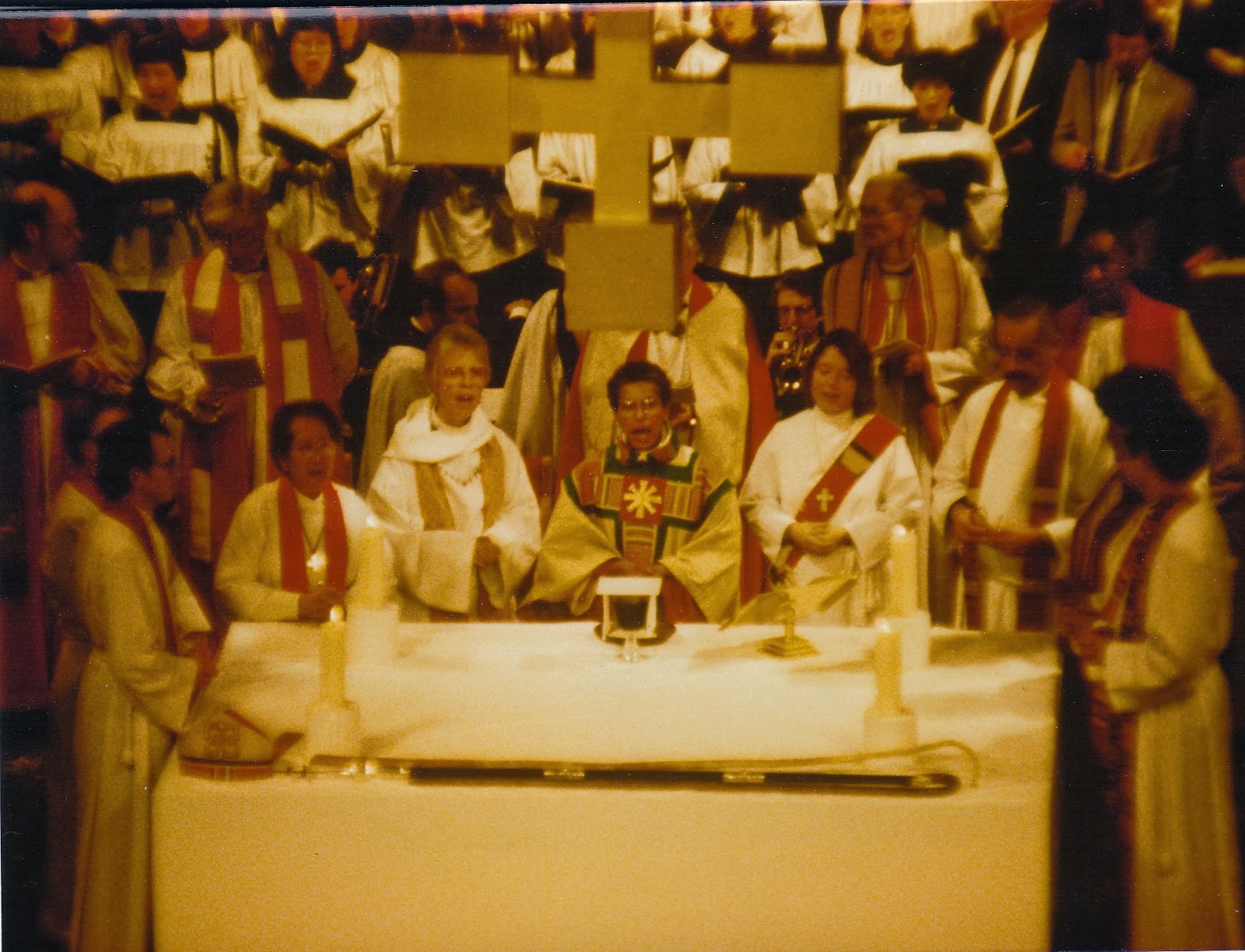
As Barbara Harris walks down the center aisle, a tiny woman whose voice and presence can fill a cathedral, over 8,000 people burst into applause. (“Not very characteristic of the Episcopal Church,” says one member of the congregation, Mary Shannon.) Throngs of priests, row upon row of beaming women and men, process down the side aisles of Boston’s Hynes Auditorium. Barbara Clementine Harris, a woman and a priest of African descent, is consecrated a bishop by the laying on of hands, according to the tradition of the apostles, by 55 men, most of them white. All through the celebration, the bishops have been purposeful, solemn, and excited, with the calm certainty that God, through them, is doing a good thing.

In describing the celebration, those who were there speak of unity. Mary Shannon repeatedly uses the term “body” to speak of the church and of her experience of this day –“finally being part of the body...” “... all of us together in one body.” She is wearing a locket with a picture of her 80-year-old mother, a member of St. Andrew’s Parish in Seattle, who “still carries her white gloves with her in church yet has rolled with the changes.” She speaks in the plural: her mother, her daughters, her husband, her women friends, all rush into the conversation. “I cried,” she says. “I just felt so happy for all of us.”

Modene Dawson of Philadelphia speaks of another unity. For her, and for many African-Americans in the assembly, the significance of the event extends beyond the church. “It’s beautiful for the country,” she says. “It shows racial harmony.” The church which conducts this celebration is not apart from the world; it is the body which proclaims to the world that God is alive in history.

Paul Matthews Washington, in his sermon, speaks about God and history. Harris’s friend and mentor, he is Rector Emeritus of the Church of the Advocate in Philadelphia, which feeds, clothes, and sanctifies the poorest of the city. In this church was held the first ordination of Episcopal women to the priesthood, in the summer of 1974, less than 15 years ago. Harris, a member of the church, led the procession, carrying the cross.

“We cannot,” says Washington, “overlook the fact that this woman being consecrated today is not just an American woman. She is a Black woman... This is a woman... who has had to struggle; she’s been despised, she’s been rejected... God has lifted up one who was at the bottom of society and has exalted her to be one of His chief pastors.”

Washington speaks of Harriet Tubman, who “nineteen times went back into the land of bondage,” thanking God for her freedom by helping to free others. He speaks of Mary, the mother of Jesus, who was raised from her lowly estate and sang of God’s power to raise up the humble and put down the mighty from their thrones: “Mary,” he says after quoting the Magnificat, “was an oppressed woman. That’s how Holy Mary Mother of God felt!” He weeps as he recalls the slavery and oppression of Black people in this country. “Only in understanding the past can we fully appreciate God’s action in this event,” he says.

The Episcopal Church, a church of power and privilege, has chosen “a have-not,” says Washington, but also one who “burns when others are offended,” a “disturbing prophet.” Harris has for years –in her public relations and policy work in the corporate world, in her parish, in her work with the Episcopal Church Publishing Company, in her pastoral ministry—advocated racial and economic justice, taken up the cause of women, spoken out against homophobia; she has, says Washington, devoted enough time to prison chaplaincy “to serve a two-year sentence herself.”

The Right Reverend Barbara Harris, newly robed in bright vestments with Ashanti designs and symbols, presides at her first Eucharist as bishop. Among the concelebrants are Carter Heyward, one of the “Philadelphia Eleven” ordained at the Church of the Advocate, and Florence Tim-Oi Li, the first woman ordained a priest in the Anglican Communion, in Hong Kong, one generation ago. At the distribution, Harris slips over to the far side of the auditorium and gives communion to the people in the hearing-impaired section, who have been singing with their hands for three hours.

A bishop is, among other things, a maker of unity. Barbara Harris has already begun to make unity; but not in the ways in which unity was previously understood or structured. Her brother bishops, Law and Methodios, fear for the health and welfare of Christian unity. But where are the real rifts in our lives today? Are they doctrinal? Where is the real, urgent need for unity? And when we say “unity,” what do we mean? Whose unity, which unity, and at what cost?

The deeper chasm today is not between Protestants and Catholics, or Greek Orthodox and Episcopalians. It is, much more, between haves and have-nots, between Blacks and whites, between men and women, between the Northern and Southern Hemispheres. These are the wounds in need of healing, in church and in society. As for denominationalism, it is no longer the principal intrachurch split. Far deeper is the gap within each of our faith communities between fundamentalists and non-fundamentalists.

Early in the service, the Presiding Bishop, Edmond L. Browning, asks if anyone knows of any reason why the consecration ought not to proceed. Two men come to the microphone. The first calls the consecration “a sacrilegious imposture,” the second “an impediment to the realization of the visible unity of the Church for which Christ prayed.” There will be a problem, they argue, with the value of any sacrament celebrated by Harris.

Bernardine Hayes, a computer systems analyst, self-described “dormant Catholic,” and veteran civil rights and peace activist (she is currently Vice President of WAND, Women’s Action for Nuclear Disarmament), had never before today “seen a woman offer the sacraments. She is so clearly affiliated with the poor,” Hayes adds. “She strikes me as a true minister.” Hayes feels something stir within her during the liturgy –“the realization that the piece of my life which is missing is the spiritual piece.”


This was, she says, "like a Pentecost."

Whose unity?

The intervention of the dissenters highlights the lack of unanimity in the church about the consecration (although Browning is quick to point out, at the post-consecration press conference, that the overwhelming majority of Episcopalians support it). But it is, in its way, a step on the road to greater unity. Perhaps the two men will change their minds; perhaps never. What is hopeful and healthy and makes a body strong is that their pain was not swept under the rug. However token, this part of the ceremony honors difference: and the unity of the Episcopal Church around this celebration –the unity behind the liturgy— is not the easy unity of unreflecting liberals. It has been hard won, tempered by prayer and struggle, and forged through the participatory process of decision-making in the Episcopal Church, a community that gave us two-thirds of the signers of the Declaration of Independence.

Elizabeth Pearson Rice-Smith, a United Church of Christ minister who witnessed both the ordination of the “Philadelphia Eleven” and Barbara Harris’s consecration, believes that “if our vision of church unity embraces diversity in God’s ministries and the human experience of faith, there is much less need to split off. I think,” she adds, “that women are willing to say things about the messy stuff that don’t condemn or blame or banish. We want to create spirited change that doesn’t mean war, that doesn’t mean people don’t talk to each other, that doesn’t mean annihilation.”

Which unity, and at what cost?

Christians do still need to speak with one another about Eucharist and ministry, about theological thought and ecclesial practice. But the context of this discussion has changed, and so have the discussion questions themselves. Unable and unwilling to hide her particularity, unlikely to temper her prophetic stance, Barbara Harris –not in spite of this but because of this—is a maker, not a breaker, of unity.


(c) Jane Redmont 1989


A few other changes – skip this if you don’t care about the minutiae: The editors also lower-cased “Black,” which I had in upper case, and made a spelling change that eliminated my metaphor “singing with their hands.” They changed it to “signing with their hands.” Of course the congregation members in question were signing –but adding “with their hands” would in that case have been unnecessary. The celebration was full of song, and part of the beauty of it was that people sang with both voice and hands. I was seated in the section next to the one using American Sign Language. The editors also deleted the paragraph with Rice-Smith’s quote.

I was still a Roman Catholic at the time I wrote this essay.

 A decade later, in 1999, a few years after I moved to California, I was invited to be on the panel of speakers at the 10th anniversary celebration of Bishop Harris’s consecration. The invitation came from the Rev. Canon Edward Rodman, with whom I had often been on the television show “In Good Faith” on WCVB-Channel 5 (then the ABC affiliate in Boston). I served as the Roman Catholic voice on the panel and offered some insights from a Catholic feminist perspective.

A few years later –12 years ago last month— I was received into the Episcopal Church. The discernment leading to this reception –and the lengthy process toward ordination to the priesthood, a vocation dating back to the 1970s– are another story for another time and place.
 
Thanks be to God for Bishop Barbara!


Thursday, April 18, 2013

On the day of the memorial service for the victims of the Boston Marathon bombing

Today, behind the mourners in public places, the rescuers, the demonstrators, the loud speakers, there are --always, still-- those who clean and scrub, those who cannot get away from work, those caring for the very young and the very old, those who cannot get easily from one place to the other, and the artists, the writers, the poets, who need the quiet solitude and the unsung space and time before the singing, and who, in their own way, hold up and reweave the world. Remember them.

(c) Jane Redmont

Sunday, June 5, 2011

Thirty Years: An AIDS Anniversary

Thirty years ago today, on June 5, 1981, the Centers for Disease Control and Prevention (CDC) reported the first cases of AIDS in the United States.

My friend Wormwood's Doxy, an HIV/AIDS education professional, has written a moving anniversary essay at her blog. Read it here.

Once you have recovered from reading it --it may take you a few hours; it is an intense and beautiful essay-- come back here and read my offering for this day, written 23 years ago, in 1988, when I was in my thirties.

This commentary, minus the three paragraphs in red brackets, was published and distributed by Religious News Service (now called Religion News Service) on July 12, 1988 under the title "The Names Project Quilt Makes Beauty Out of Horror."

At the time I wrote the essay, I was working on my first book, Generous Lives: American Catholic Women Today (William Morrow, 1992; pbk Triumph/Liguori 1993), and was employed as a program developer raising funds for The Hospice at Mission Hill, the first residential hospice for people with AIDS in Boston.

The AIDS Quilt was on its first major tour around the U.S. and was displayed in its entirety on the National Mall in Washington, DC in fall of that year. I went to see it at what was still called the Boston Armory.

I have altered only a few tiny grammar and style details and have left in the language I used back then, only seven years after the anniversary we commemorate today. (For instance, I never use "minority groups" or "minorities" to mean people of color or minoritized groups these days, but I did then. The Soviet Union was still the Soviet Union in 1988, so I left that in. What is now the U.S. Postal Service had another name.)

The pandemic is still with us, all over the world. This essay is a slice of life.

Many of the students I teach were not even born when I wrote these words.


The Quilt
Cambridge, Massachusetts
June 23, 1988

In Stockholm last week, medical researchers from around the world tracked the elusive virus and its deadly mysteries. In Boston a massive quilt unfolded for four days, stitched by thousands of Americans as a memorial to people who have died of ADS. The quilt, sponsored by the Names Project, is as different from other memorials to the dead as AIDS is different from the other diseases that have plagued us. It is not made of stone and anchored in the ground, but portable and soft, organic, making its way around the nation, still growing.

More than a week after my visit to the Quilt, its impact will not go away. The first emotional shock, for visitors, is the sheer magnitude and diversity of the project, row upon row of remembered lives, presented in sophisticated patterns and hesitant stitches, in all materials from denim to organza. Some panels show only a name and dates of birth and death. Others literally bear pieces of people's lives: articles of clothing, photographs, locks of hair. One has the ashes of the person it commemorates sewn into a corner.

The Names Project is meant, according to its founder, San Francisco gay activist Cleve Jones, to give "a glimpse of the lives behind the statistics" as it travels around the country. Men, women and children sewed for relatives and lovers and for people they had never met. There are crosses and stars of David, hearts and teddy bears and pictures of cats, insignia representing the military and the medical professions, pennants from Yale and Columbia. On one panel is the portrait of a proud, handsome Black man, with a written tribute to his character and commitments. Another, with a child's pink dress sewn onto it, says only "La Hijita de Dios," "the little daughter of God." All over the panel, serving as background design, are small diaper pins.

And then there is the second shock: youth. Over half the panels bear dates of birth and death. I stared and subtracted: twenty-five years old; thirty-nine; twenty-two; two years old. The overwhelming majority of those who have died, who are now ill, who are HIV-positive, are young. Mothers embroider love letters to lost sons on the cloth. Nothing prepares one for this, even the experience (which I share) of having young loved ones among the dead. It is like walking in an old New England cemetery and coming across a child's stone marker among the graves.

We speak a lot these days about the spread of AIDS among intravenous drug users, among heterosexuals, into minority communities, through mothers to their babies. The Quilt is beginning to show the impact of these facts. But still the names are mostly those of men --young men, gay men. I am reminded of the population charts in the Soviet Union, on which the curve dips at the males who were young adults during World War II. We have not even begun to measure the trauma and devastation which AIDS has brought to an entire generation of an entire community. "I am angry," says a friend, "that at the age of 29 I must deal constantly with multiple deaths, with friends losing their strength and the use of their bodies, with grief and hospitals and burials and loss. " "Many of us are finding it hard to plan for the future," says another: "Is there a future for me? Will my closest friends till be here in five years? Will I?"

I think of the shock after the death of a single loved one, how it leaves one numb and split open all at once, with the feeling of being both wrapped in cotton wool and bled raw. Multiply this by six and twelve and fifty in the life of one person; multiply that by hundreds. Only after doing this can one measure the emotional impact of AIDS, the massive grief of whole communities, spreading around the nation.

"Wrenching" and "healing" --in the same sentence-- are the words I have heard and used most often to describe the Names Project. This witness to multiple deaths is also about the fullness of life. Most of the panels remember people not as they were in their last days, weighting eighty pounds and unable to bathe themselves or walk to the toilet, but as they were in life, designing theatre sets and playing ball, lovers of glitz and glitter or of hikes in the mountains, speaking and singing in Spanish and English, eating and drinking. A panel dedicated to a mail carrier features the arm of his blue uniform with the "U.S. Mail" emblem, cradling a small teddy bear. The rest of the panel is an uproarious burst of color: a golden peacock, a sunflower, cloth letters of a name in rainbow colors, pictures of California life.

Still, for some of the survivors, the colors battle against bleak memories. "I can no longer remember him healthy and live," says a woman I know of the friend for whom she made a panel. "I always remember him the other way."

All the panels tug at the heart. But for each visitor there were a few that hit the core and that linger, triggering floods of anger, grief, or tenderness. For me one of these was the pink "Hijita de Dios." Another featured two men's shirts sewn on with their arms entwined. "Though lovers shall be lost love shall not," Dylan Thomas wrote in "And Death Shall Have No Dominion." The first verse of this poem is printed on the third Quilt panel that lives on inside me. Long before AIDS, before the wasted bodies and lost minds, before the dementia, Thomas wrote:
"Though they go mad they shall be sane
Though they sink through the sea they shall rise again."
"Death shall have no dominion." I cannot shake this phrase from my mind, trying to summon the stubbornness of life against the slow creep of death.

[The Vietnam Memorial changed forever our experience of monuments to the dead. Like the Vietnam Memorial, the Quilt is a live place, no lonely obelisk in the town square but a place of meeting and community. The Vietnam monument grows bits of life; the first day I went, on a wet December morning, a small flag with a spring of heather tied to it was propped up against the wall almost lost in the mud and brown oak leaves. The rain cause the black wall to shine and reflect my face back to me. There were names on my reflection, some of them familiar last names. The people I knew who bore these names were still alive; but I began to wonder. Was this a relative of the person I knew? Could it have been my friend, given a different lottery number, another set of circumstances? The boundaries crumbled. There was no barrier left between "them" and "us."

The Names Project takes this kind of memorial experience further, deeper. At the Vietnam Memorial, people talk, embrace, weep, ask questions. The dark stone brings forth stories because of the power of the names. The Quilt itself tells the stories, spells out the memories in material that almost seems made of flesh. It is also an organic reality: a whole piece of art, but an unfinished one. The epidemic has not stopped growing. Neither, until it does, will this quilt.

It is impossible to stay passive before the Quilt, even more so than before the Vietnam Memorial. This is because it tells stories directly and because live stories lead us to act and to hope, like the retelling of the Passover or the account of Harriet Tubman and the Underground Railroad. Memories like these do not mire us in the past; they move us to shape the future. But first we go down, into the grief, into the struggle, through the retelling. Without memory, there is no possibility of hope, nor of bringing about the changes that will stem the tide of death.]

As I walked into the exhibit, the first people I saw were a very pregnant woman, a man, and a child. The mother bent over and spoke to her child about a man who had "died of the bad disease." She asked the child, pointing to a panel with a basketball shirt attached and an embroidered basketball, "What do you think this person really liked?" Five years from now, will I be the woman explaining to her child about the bad disease? Fifteen years from now, will this disease still claim lives? Will the Quilt sit in a museum? How many more stories will we need to tell? "No more names!" read a tee-shirt worn by one of the visitors.

The Quilt is a wondrous work of art --colorful, homespun, soft and resilient, quintessentially American, spiritual and political, beautiful in itself and charged with moral energy. It chronicles a catastrophe, like Picasso' s "Guernica," but is crafted by a community rather than a lone genius. Like "Guernica," it makes beauty out of horror. It leaves the viewer torn: grateful for such beauty, for the redeeming power of names and memory, for the healing; and wishing that this thing of beauty had never had to exist, knowing the names will not go away.

* * * * * * * *

This was, of course, long before the internet. The Quilt is now online here. Nothing, however, replaces having seen it, walked around the panels, bumped into a colleague who wept in my arms, and heard the names of the dead read aloud, as has happened at all public showings of this work of art.


Thursday, March 25, 2010

"Photos of a Prophet" - a Romero retrospective and tribute


Andy, in the comments to the previous post, recommended this wonderful pdf-format slide show. It's actually a book available in exhibit form available in slide show form. The wonders of technology!

These are archival photos of Monseñor Romero and his people, from Romero's childhood to the days after his death. Well worth a look.

The exhibit is currently at Grace Cathedral, San Francisco. Information here.

Priests carry Archbishop Romero’s coffin out of the Metropolitam Cathedral of San Salvador, March 30, 1980. Photo: Private collection of the Photography Center of El Salvador

Wednesday, March 24, 2010

Oscar Arnulfo Romero, ¡Presente!


Today was the 30th anniversary of the martyrdom of Monseñor Romero, Archbishop of San Salvador.

I will post more when my teaching week is over, but for now, here are two links.

At this one, which is mostly in Spanish but has links to other languages, you will find a wealth of resources including a slide show in PowerPoint (click on "XXX Aniversario") with rich quotes by Romero and many other words and images to ponder.

This one is a biography in English by a U.S. poet and activist who has engaged in Central America solidarity work for many, many years and knows what she is talking about.

"A church that does not unite itself to the poor in order to denounce from the place of the poor the injustice committed against them is not truly the Church of Jesus Christ."*-San Oscar Romero de las Americas


¡Romero vive!

Saturday, March 13, 2010

Why Mexico City

Someone on Facebook asked why my parents got married in Mexico City.

Since it's too long an answer for Facebook, here goes.

My father got his master's degree at the Columbia University Journalism School. He was not yet 21 years old. He graduated at the top of his class (1939) and was one of three recipients of a Pulitzer Traveling Fellowship. This gave him the opportunity to travel and write for a year.

He headed for Europe in June. He knew by then that he wanted to be a foreign correspondent. He traveled through Western Europe, then Eastern Europe and the USSR and back to Western Europe. Well, if you remember your world history, you remember what started happening on September 1, 1939. World War II broke out.

My father had hoped to stay and find work as a war correspondent, but despite his letters of recommendation, he couldn't find a job, and he went home, not on a Cunard liner as he had on the way over, but on a freighter taking refugees back to the U.S. Among the passengers was my father's cabin-mate --not by choice-- who turned out to be, so he said and my father had no reason to doubt him, Prince Felix Yussupov. You may remember him as the man who killed Rasputin. My father notes in his memoir that he "had never before met anybody who had killed a man, let alone boasted about it. Sharing a cabin with him was fun on an otherwise tense voyage, but I didn't sleep too well thinking about my new friend, the murderer." (p.23)

FoAoH decided to finish up his fellowship in Mexico City, so off he went. There were many estadounidenses there at the time: Mexico was warm, welcoming, and inexpensive. It was also, as my father discovered, desperately poor, and the Mexico City metropolitan area was already crowded then with a population over five million. He started freelancing and stringing (working part-time) for several newspapers and news services.

After he'd been there for a while, MoAoH got sick of waiting up in Brooklyn. She'd finished college by then, so, as I like to tell it, she said to her parents "Bye-bye, I'm going to marry FoAoH!" Okay, it wasn't entirely like that. My parents had both turned 21 by then, it was now early 1940, and my father saw that they could live quite well on under $15 a week, so they decided that they would get married sooner rather than later. My father wrote a letter to my mother's father, as one did in those days, and promised he would take good care of her. They had known each other for years so my mother's parents knew my father was a trustworthy sort, and they knew my parents wanted to get married. People didn't "get engaged" in those days, at least in my parents' circles. It was the Depression and nobody was buying or showing off diamonds on their left ring fingers, and my mother's family was never terribly conventional anyway, though they certainly believed in marriage.

My parents met at James Madison High School in Brooklyn, New York. They didn't become sweethearts till college but were in the same group of friends in high school. Like many in their high school --mostly children and grandchildren of Jewish immigrants-- they attended public colleges: she went to Hunter College, which was all women at the time; he went to City College, which was all men. Both of those schools were way uptown in Manhattan, of course, and my family's version of "In my day we had to walk five miles to school in the snow, uphill in both directions!" was "It was the Depression, we lived at home, and we took the subway to school an hour and a half in each direction." Three hours of commuting a day to get an education. My mother is the one who talks about this.

My father was editor of the college newspaper and helped get a corrupt college president on the road to resignation, but that is another story and you can read it in FoAoH's memoir. He went on to a private university (Columbia) for professional journalism study. My brother also went there, years later, and I contemplated doing the same but didn't.

Back to the Mexico story. My mother took the bus down to Mexico City from New York. Yes, the bus. More like buses. I think her first stop was Indianapolis because she had an uncle there. Not sure whether or where she stopped after that, but it was a five-day trip. At any rate, she got to Mexico City safe and sound on a Friday, and the following Tuesday she and my father were married.

They married at the American Embassy because they were patriotic young people and wanted to be married on American soil. But the Ambassador wasn't empowered to officiate at weddings (unlike some other foreign diplomats) so they got a Mexican Justice of the Peace. Only civil marriages were valid in Mexico. A wedding at the JP's Registry office would cost two pesos, but they decided to splurge and go for the 32-peso wedding, which is what it cost to get married outside the Registry. 32 pesos in those days was about 8 dollars.

Foreign Service officers couldn't officiate at marriages but they could witness them (in the church that's the same thing, so I don't quite get the distinction, but there you have it) and issue a certificate of marriage so in addition to the Mexican wedding certificate, my parents got a U.S. certificate (for one dollar extra). I'm not sure whether the Consul General or the Ambassador signed the piece of paper, but they were both there. The Ambassador at the time was Josephus Daniels, a former Secretary of the Navy under President Woodrow Wilson who was a former newsman -- how appropriate. I remembered he was a Southerner, but what I had forgotten and just re-read in the Mexico chapter of the memoir is that he was the founder-editor of the Raleigh News & Observer. That's Raleigh, North Carolina.

Meanwhile, my paternal grandparents had expressed the desire for my parents to have a Jewish wedding ceremony, so several days later PoAoH located a rabbi, which in Mexico City was not so easy, and he witnessed and officiated at a religious ceremony. It was in Spanish and Hebrew and they had a sheet or a tablecloth for a chuppah (the traditional wedding canopy) and my father didn't have a kippah (yarmulke) so he used a handkerchief tied at four corners. The part of this story I love is that the rabbi lived on Jesus Maria Street. Now there's a title for a novel: The Rabbi on Jesus Maria Street.

Parents of Acts of Hope did have a little reception with a wedding cake. The cake was the work of two Greek-American pastry cooks from Manhattan who after fighting in the International Brigade in the Spanish Civil War (i.e. against Franco's forces) had settled in Mexico and opened a restaurant and bakery.

My father's memoir doesn't say and I haven't asked my parents, but it occurred to me a few years ago upon re-reading my father's description that these guys, Nick and Mike, were probably a couple. But maybe they weren't.

The cake had two white doves on top.


The big story in 1940 in Mexico was, of course, Trostsky's assassination, and my father, as a freshly minted journalist, got to cover it. There was a substantial cast of characters in the background shenanigans leading up to the assassination, including an American woman who had been one of Trotsky's aides. My father was stringing for the Jack Starr-Hunt News Service and among their clients was the N.Y. Daily News tabloid, which could care less about the politics of the story. Who cared if Stalin's arch-enemy had just been killed? The Daily News fired off to my father a cable that read "RUSH 1,500 WORDS GIRLIE ANGLE." Welcome to highfalutin foreign correspondent work.

After a few months in Mexico, with the fellowship year over, my parents returned to the U.S. and Brooklyn, where both their families lived. My father got a stop-gap editing job at the Brooklyn Academy of Music while hunting for a real job in journalism. At last, after six months, a real job materialized, and off my parents went to Herkimer, New York (for those of you who don't know, that's in the boonies, at least from a New York City perspective) where my father worked on the Evening Telegram newspaper for the magnificent sum of $35 per week.

The following year Pearl Harbor happened and my parents moved to Washington.

But that is another story.

Monday, January 4, 2010

RIP Mary Daly, feminist thinker and teacher, wild star

"There are and will be those who think I have gone overboard. Let them rest assured that this assessment is correct, probably beyond their wildest imagination, and that I will continue to do so." - Mary Daly, 1928-2010

More on this pioneering thinker here and here.

Mary Daly died this morning. Obituaries should be forthcoming in the next couple of days. Blaze on, Mary.

Photograph by Gail Bryan (c) 1992

Friday, October 23, 2009

Sölle on limits, transcendence, and the Communion of Saints

At a peace gathering

We’re not only ten thousand I said
there are more of us here
the dead of both wars
are with us

A journalist came and asked
how could I know that
haven’t you seen them
i ask the clueless guy
haven’t you heard your grandmother
groaning when they started it up again
do you live all alone
without any dead who drop in
for a drink with you
do you really think
you are only yourself

****--Dorothee Sölle
******The Mystery of Death
******2007 (posthumous book - Sölle died in 2003 with the manuscript in draft)

The English version of the poem is by the book's translators, Nancy Lukens-Rumscheidt and Martin Lukens-Rumscheidt. The German original, "Auf einer Friedensversammlung," appeared in Dorothee Sölle, Loben ohne Lugen (Berlin, Wolfgang Fietkau, 2000).
Photo by the blogger New York Portraits, 2008.

Friday, July 17, 2009

Rest in peace, Uncle Walter

**********
Walter Cronkite, journalist, 1916-2009.
******
Rest in peace. And thank you.


Obituary here.

Friday, May 29, 2009

Lost Things and the Power of Memory


My latest essay, "Lost Things and the Power of Memory," is up at the Episcopal Café today. The Café welcomes your comments. (If you don't already have a login there you'll have to get one, but it's free and easy. See here.)

I've also posted the link on Facebook.

Friday, May 15, 2009

Lost and found

I have been cooking an essay called "Lost Things" which has suddenly started flowing out of my fingers. It may or may not be my next piece for the Episcopal Café, whose editor has been extraordinarily patient with my absence from my contributor duties during this difficult year. I have been musing about the things I have lost or have had stolen from me over the course of my life and about why their absence bothers me. The essay comes straight out of those musings.

In the course of hatching a rough draft, I have remembered once again one of my favorite books from childhood, one which I reread many times as a young adult and which my parents had to give away or leave behind during a major move. I cannot hope to track down that very copy of the book but in these days of the World Wide Web it is possible to find a book that has long been out of print. Every so often I search for it on the internet.

Lo and behold, after two and a half pages of writing I began poking around for the first time in months, and I found not only copies of the book available for sale but confirmation that the book was in fact the one I loved in the form of a picture of the book cover! The first few copies I saw online had either no picture of a cover or a very different picture from the edition I remember. So here is a picture of my beloved book. At some point I will order a copy for myself, or perhaps I will wait till my next trip to France or ask a friend to get it for me. I really want to read the book again but I am just happy it still exists somewhere.


By the way, the book is full of wonderful fables and legends and tales: how certain streets in Paris got their name, what a fortune-teller said to one of the Medici queens (two Medici women married French kings), who built what when, and how the city got its start. That part is not fable but historical fact. It is through this book that I learned about the Parisii, the tribe that gave Paris its name. Paris was a city of boat people, clustered on a few islands that were later consolidated into the two islands we know at the heart of the city. The Romans, of course, took over the islands when they conquered Gaul, did a lot of building, and named the city Lutetia (Lutèce in French), though some sources say that the city's name was already Lutetia by the time the Romans conquered it in 52 BCE. Bits of Roman amphitheatre and baths survive, but the Parisii came first and it is their name that endures.

The book is also chock-full of stories of the saints, and I still remember them: Denis, martyred (on what became known as Mons Martyrium, later abridged to Montmartre) and carrying his head in his hands all the way to what is now the town of St. Denis, where a basilica commemorates him; Geneviève the shepherd girl, praying away the Huns; and others, but those two especially.

Interesting how stories pour out of us when we are ready, or sometimes long after we were ready. I should have known by the grumpy mood of the last few days that I was cooking several pieces of writing. Reports and other mundane word processing stood at the doorway and blocked them. I must get back to those duty-bound words, but now I know what was ready to come forth, and there will be no stopping it.

Monday, May 4, 2009

Remembering my grandfather

I only knew my maternal grandfather. My paternal grandfather dropped dead in his 50s, two years before I was born. He had immigrated to the U.S. in the early 1900s as a teenager, worked very hard, and raised a family here. All three of his children went to college. My maternal grandfather was born in the U.S. His parents had immigrated mid-century or mid-late century. (Mid-late 19th century, that is.)

Today is my maternal grandfather's birthday. He died two months before I turned eight years old and I still remember him fondly. We were always close and I think of him often. When my mother visited him during his dying days (we were living in different countries so it was a big trip for her, from France back to New York, leaving her husband who was working two jobs and her two children during the school year) he once said to her, during one of their conversations, "How I wish I could see Jane when she has grown into a young woman."

I like to think that he has seen me somehow and that he is with me, watching and giving me courage.

I wrote about him and posted a picture of him two years ago.

As I noted then, today is also the birthday of one of my cousins (we are almost twins; my birthday is three days after hers, same year of birth - we were our grandfather's birthday presents) and of Nephew the Elder, who is 39!!! (I can hardly believe that, but since Brother of Acts of Hope is 66, it must be true.)

My grandfather's name was William. My grandmother called him Will. Everyone else called him Bill, including his grandchildren.

I miss him.

Friday, May 1, 2009

Gratuitous JT post #3


I heard this live around the time it came out --not this particular performance, but the same year and with the same great backup singers.

Note: if anyone can figure out the meaning of this song, let me know. JT has all kinds of cryptic, poetic songs, and this is one of them. It may well be that to let them be evocative is the best approach, but sometimes there are stories behind the songs.

Gratuitous JT post #2


Another old song -- from my college years! I still love it.

Picture from now, because middle-aged men are much more sexy than younger ones.

And a bonus: JT's first appearance on network TV! Great song. Mellow out, folks, it's Friday.

Gratuitous JT post # 1


He still sings this song well -- perhaps even better than before.

P.S. He has a new album out, Covers.

Wednesday, April 15, 2009

Yahrzeit: Krister Stendahl

I have been thinking on and off of Krister Stendahl, who died a year ago today.

More later in the week when I have a breather. Just worked two 15-16 hour work days and one 12 hour work day and it is time for tax filing wrap-up and a good long sleep.

Monday, April 13, 2009

Italian Jews aid their WWII saviors hit by Abruzzi earthquake

Read this and get misty-eyed.

Cross-posted on Facebook

From left, Italia Tagliacozzo, Ester Di Segni, Emma Di Segni, earthquake survivor Nello De Bernardinis and Alberto Di Consiglio, pose for a group photo in the Casentino tent-camp, near L'Aquila, central Italy, Monday, April 13, 2009. Italian Jews and Holocaust survivors are rushing to aid communities that sheltered them during World War II and were hit by last week's devastating earthquake. Di Consiglio found Nello De Bernardinis, 74, the son of a couple who sheltered Di Consiglio's father and eight other relatives during the war.(AP Photo/Sandro Perozzi)

Saturday, April 11, 2009

Jose Hobday, Native teacher, Franciscan sister, dead at 80. Rest in peace, rise in glory!

From WATER, the Women's Alliance for Theology, Ethics, and Ritual, I have learned of the death this week of José Hobday, Seneca elder and Franciscan sister, storyteller, speaker, and teacher, at the age of 80.

NCR story here.

Frederic and Mary Anne Brussat of Spirituality & Practice picked up the NCR story and wrote their own obit here.

A great woman. I had the pleasure of hearing her speak years and years ago.

Photo: John Zeuli.

Sister José died April 5 at the Casa de la Luz Hospice in Tucson, Arizona. A memorial Mass will be held on Wednesday, April 15, at 6:30 p.m., at Our Mother of Sorrows Parish in Tucson.

(Couldn't find the photo credit for this one.)

Thursday, April 9, 2009

April 9: Dietrich Bonhoeffer, pastor, theologian, friend, educator, ecumenist, community-builder, resister, martyr


On this day in 1945, German pastor, theologian, and resister Dietrich Bonhoeffer was hanged by the Nazis.

More than ever, we need to read his words and study his life.

We also need to learn about the context of his life and work.
A couple of resources:

A timeline of Bonhoeffer's life and some of the events in and around it.

Last year's post, with links.