Showing posts with label Anglicans. Show all posts

Friday, February 14, 2014

Barbara Harris, Bishop: Silver Anniversary and Ecumenical Reflection

The following essay appeared in the March 10, 1989 issue of the Catholic lay-edited magazine Commonweal under the title "When the Spirit Leads: Barbara Harris, Bishop." The editors cut out the last sentence without consulting me. They made a few less drastic changes which I note below the text of the essay. This text, with some minor copyediting, is my original version.

Barbara Harris was consecrated bishop on February 11, 1989 and served as Bishop Suffragan of the Episcopal Diocese of Massachusetts (1989-2003). She served as Assisting Bishop in the Diocese of Washington (2003-2007). Happily, she is back among us in Massachusetts. We will celebrate the 25th anniversary of her consecration this Sunday, February 16, 2014, with a Gospel Vesper Service.


[February, 1989]

A day or two before the consecration of Barbara Clementine Harris as Suffragan Bishop of the Episcopal Diocese of Massachusetts, Cardinal Bernard Law and Greek Orthodox Bishop Methodios issue written statements of welcome. The statements are cordial. They also speak of the danger Harris’s consecration presents for reconciliation among Christian churches, or what has become commonly known as “Christian unity.”

At the consecration, the gospel music of St. Paul’s African Methodist Episcopal Church choir alternates with the delicate melodies of the Chinese Congregation and classical European harmonies of Trinity Church choir. The stately cadence of the Book of Common Prayer moves us forward, but in the musical realm there is a preferential option in the air: clearly, the day belongs less to Mozart and more to the music of the Black church. The celebration flows. This is no Tower of Babel: we each hear God speaking in our own tongue.

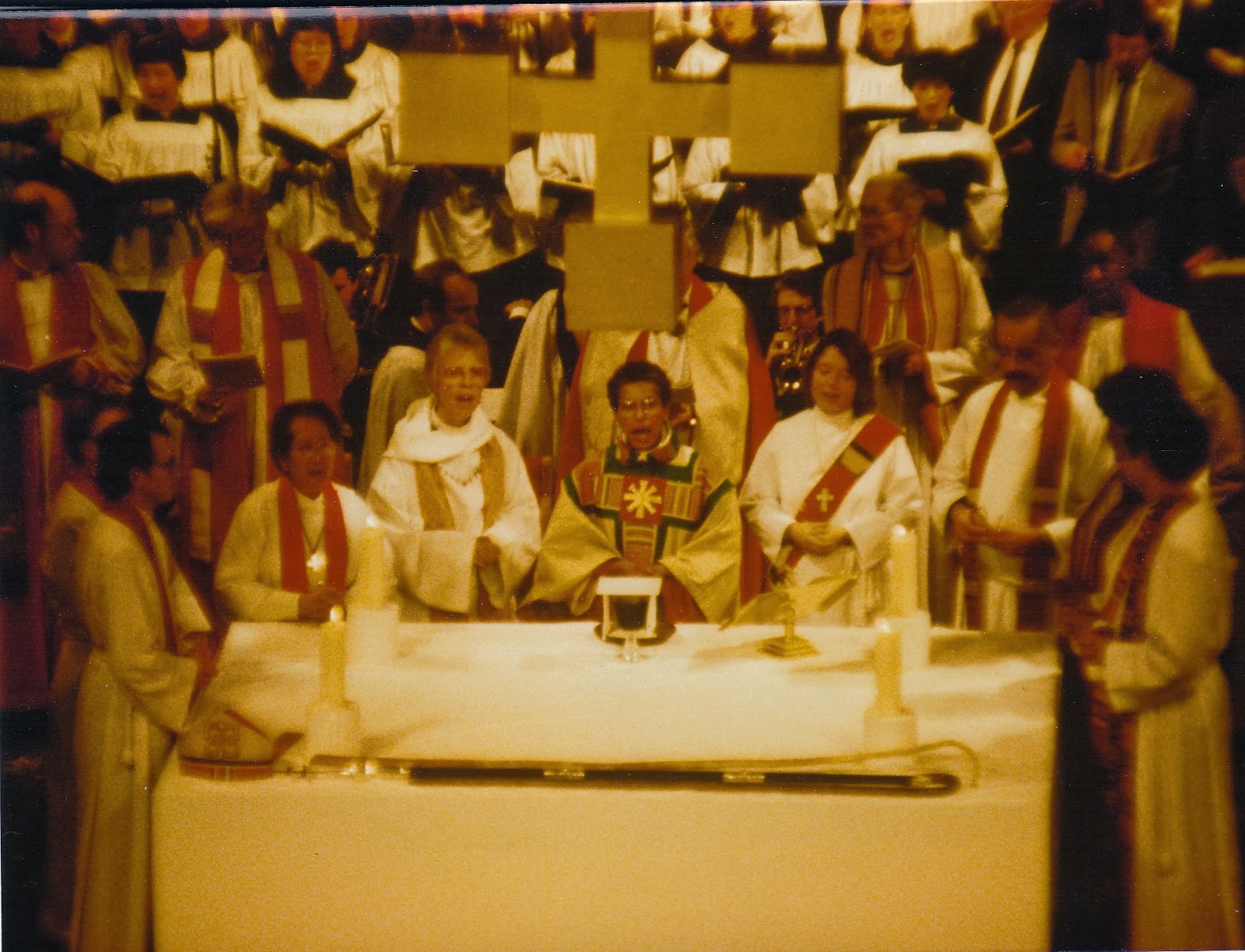
As Barbara Harris walks down the center aisle, a tiny woman whose voice and presence can fill a cathedral, over 8,000 people burst into applause. (“Not very characteristic of the Episcopal Church,” says one member of the congregation, Mary Shannon.) Throngs of priests, row upon row of beaming women and men, process down the side aisles of Boston’s Hynes Auditorium. Barbara Clementine Harris, a woman and a priest of African descent, is consecrated a bishop by the laying on of hands, according to the tradition of the apostles, by 55 men, most of them white. All through the celebration, the bishops have been purposeful, solemn, and excited, with the calm certainty that God, through them, is doing a good thing.

In describing the celebration, those who were there speak of unity. Mary Shannon repeatedly uses the term “body” to speak of the church and of her experience of this day –“finally being part of the body...” “... all of us together in one body.” She is wearing a locket with a picture of her 80-year-old mother, a member of St. Andrew’s Parish in Seattle, who “still carries her white gloves with her in church yet has rolled with the changes.” She speaks in the plural: her mother, her daughters, her husband, her women friends, all rush into the conversation. “I cried,” she says. “I just felt so happy for all of us.”

Modene Dawson of Philadelphia speaks of another unity. For her, and for many African-Americans in the assembly, the significance of the event extends beyond the church. “It’s beautiful for the country,” she says. “It shows racial harmony.” The church which conducts this celebration is not apart from the world; it is the body which proclaims to the world that God is alive in history.

Paul Matthews Washington, in his sermon, speaks about God and history. Harris’s friend and mentor, he is Rector Emeritus of the Church of the Advocate in Philadelphia, which feeds, clothes, and sanctifies the poorest of the city. In this church was held the first ordination of Episcopal women to the priesthood, in the summer of 1974, less than 15 years ago. Harris, a member of the church, led the procession, carrying the cross.

“We cannot,” says Washington, “overlook the fact that this woman being consecrated today is not just an American woman. She is a Black woman... This is a woman... who has had to struggle; she’s been despised, she’s been rejected... God has lifted up one who was at the bottom of society and has exalted her to be one of His chief pastors.”

Washington speaks of Harriet Tubman, who “nineteen times went back into the land of bondage,” thanking God for her freedom by helping to free others. He speaks of Mary, the mother of Jesus, who was raised from her lowly estate and sang of God’s power to raise up the humble and put down the mighty from their thrones: “Mary,” he says after quoting the Magnificat, “was an oppressed woman. That’s how Holy Mary Mother of God felt!” He weeps as he recalls the slavery and oppression of Black people in this country. “Only in understanding the past can we fully appreciate God’s action in this event,” he says.

The Episcopal Church, a church of power and privilege, has chosen “a have-not,” says Washington, but also one who “burns when others are offended,” a “disturbing prophet.” Harris has for years –in her public relations and policy work in the corporate world, in her parish, in her work with the Episcopal Church Publishing Company, in her pastoral ministry—advocated racial and economic justice, taken up the cause of women, spoken out against homophobia; she has, says Washington, devoted enough time to prison chaplaincy “to serve a two-year sentence herself.”

The Right Reverend Barbara Harris, newly robed in bright vestments with Ashanti designs and symbols, presides at her first Eucharist as bishop. Among the concelebrants are Carter Heyward, one of the “Philadelphia Eleven” ordained at the Church of the Advocate, and Florence Tim-Oi Li, the first woman ordained a priest in the Anglican Communion, in Hong Kong, one generation ago. At the distribution, Harris slips over to the far side of the auditorium and gives communion to the people in the hearing-impaired section, who have been singing with their hands for three hours.

A bishop is, among other things, a maker of unity. Barbara Harris has already begun to make unity; but not in the ways in which unity was previously understood or structured. Her brother bishops, Law and Methodios, fear for the health and welfare of Christian unity. But where are the real rifts in our lives today? Are they doctrinal? Where is the real, urgent need for unity? And when we say “unity,” what do we mean? Whose unity, which unity, and at what cost?

The deeper chasm today is not between Protestants and Catholics, or Greek Orthodox and Episcopalians. It is, much more, between haves and have-nots, between Blacks and whites, between men and women, between the Northern and Southern Hemispheres. These are the wounds in need of healing, in church and in society. As for denominationalism, it is no longer the principal intrachurch split. Far deeper is the gap within each of our faith communities between fundamentalists and non-fundamentalists.

Early in the service, the Presiding Bishop, Edmond L. Browning, asks if anyone knows of any reason why the consecration ought not to proceed. Two men come to the microphone. The first calls the consecration “a sacrilegious imposture,” the second “an impediment to the realization of the visible unity of the Church for which Christ prayed.” There will be a problem, they argue, with the value of any sacrament celebrated by Harris.

Bernardine Hayes, a computer systems analyst, self-described “dormant Catholic,” and veteran civil rights and peace activist (she is currently Vice President of WAND, Women’s Action for Nuclear Disarmament), had never before today “seen a woman offer the sacraments. She is so clearly affiliated with the poor,” Hayes adds. “She strikes me as a true minister.” Hayes feels something stir within her during the liturgy –“the realization that the piece of my life which is missing is the spiritual piece.”


This was, she says, "like a Pentecost."

Whose unity?

The intervention of the dissenters highlights the lack of unanimity in the church about the consecration (although Browning is quick to point out, at the post-consecration press conference, that the overwhelming majority of Episcopalians support it). But it is, in its way, a step on the road to greater unity. Perhaps the two men will change their minds; perhaps never. What is hopeful and healthy and makes a body strong is that their pain was not swept under the rug. However token, this part of the ceremony honors difference: and the unity of the Episcopal Church around this celebration –the unity behind the liturgy— is not the easy unity of unreflecting liberals. It has been hard won, tempered by prayer and struggle, and forged through the participatory process of decision-making in the Episcopal Church, a community that gave us two-thirds of the signers of the Declaration of Independence.

Elizabeth Pearson Rice-Smith, a United Church of Christ minister who witnessed both the ordination of the “Philadelphia Eleven” and Barbara Harris’s consecration, believes that “if our vision of church unity embraces diversity in God’s ministries and the human experience of faith, there is much less need to split off. I think,” she adds, “that women are willing to say things about the messy stuff that don’t condemn or blame or banish. We want to create spirited change that doesn’t mean war, that doesn’t mean people don’t talk to each other, that doesn’t mean annihilation.”

Which unity, and at what cost?

Christians do still need to speak with one another about Eucharist and ministry, about theological thought and ecclesial practice. But the context of this discussion has changed, and so have the discussion questions themselves. Unable and unwilling to hide her particularity, unlikely to temper her prophetic stance, Barbara Harris –not in spite of this but because of this—is a maker, not a breaker, of unity.


(c) Jane Redmont 1989


A few other changes – skip this if you don’t care about the minutiae: The editors also lower-cased “Black,” which I had in upper case, and made a spelling change that eliminated my metaphor “singing with their hands.” They changed it to “signing with their hands.” Of course the congregation members in question were signing –but adding “with their hands” would in that case have been unnecessary. The celebration was full of song, and part of the beauty of it was that people sang with both voice and hands. I was seated in the section next to the one using American Sign Language. The editors also deleted the paragraph with Rice-Smith’s quote.

I was still a Roman Catholic at the time I wrote this essay.

 A decade later, in 1999, a few years after I moved to California, I was invited to be on the panel of speakers at the 10th anniversary celebration of Bishop Harris’s consecration. The invitation came from the Rev. Canon Edward Rodman, with whom I had often been on the television show “In Good Faith” on WCVB-Channel 5 (then the ABC affiliate in Boston). I served as the Roman Catholic voice on the panel and offered some insights from a Catholic feminist perspective.

A few years later –12 years ago last month— I was received into the Episcopal Church. The discernment leading to this reception –and the lengthy process toward ordination to the priesthood, a vocation dating back to the 1970s– are another story for another time and place.
 
Thanks be to God for Bishop Barbara!


Thursday, January 20, 2011

Wulfstan of Worcester: Anniversary

Today is the 9th anniversary of my formal reception into the Episcopal Church and the feast of Wulfstan of Worcester, about whom I wrote at some length two years ago.

Bishop Wulfstan's Crypt, Worcester Cathedral, England

Friday, October 23, 2009

Quoted in The Tablet

The Tablet, whose articles you can't read online unless you subscribe, is probably the best Catholic periodical on the planet, or one of the best. It is certainly one of the most respected in the Northern Hemisphere and perhaps beyond. Published in England, weekly, thoughtful, thorough, independent.

Like all periodicals I'm sure they are struggling to stay afloat, so that may be the reason for the Web gatekeeping. Either that or the spammers and trolls.


At any rate, a dear friend wrote me yesterday morning with the news that I had achieved fame: The Tablet quoted me! More precisely, it quoted a passage from When in Doubt, Sing. Even more amazingly, the passage in question was in the good company of the Psalmist, Meister Eckhart, and Thomas Dorsey!

Ad majorem Dei gloriam!

(But good for the ego too during a hard week.)

Oh - it was in last week's issue.

(A new issue is just out with comment and analysis on the latest Catholic/Anglican brouhaha.)


Here are the quotes as they appeared:

The living Spirit [name of the feature / column]

[and an image of a dove which I can't seem to transfer here]

Both perfectionism and self-forgiveness bear a direct relation to our understanding of God. The first step of prayer is telling the truth about who and where we are. It is also, at the same time, learning the truth about who and where God is. We are the ones who tend to place limits on the mercy of God. Prayer involves a capacity to stretch our imagination, to imagine and therefore to begin knowing a God who is not a projection of our own self-condemnation … The idea that prayer is somehow a production (in the economic or in the theatrical sense – both are destructive) will take us away from prayer.

Jane Redmont
When in Doubt, Sing
(Sorin, 2008)


Our steps are
made firm by the Lord,
when he delights in our way;
though we stumble, we
shall not fall headlong,
for the Lord holds us by the hand.

Psalm 37: 23-24


If you have failings, then ask God frequently in prayer if it may not be to his honour and pleasure to take them from you, for you can do nothing without his help. He gives to each according to what is best for them and most suitable. If we are to make new clothes for someone, then we must make them according to their dimensions, and those which fit one will not fit another. We measure everyone to see what fits them. So too God gives everyone the best thing of all according to his knowledge of what is most suitable for them. Indeed, whoever trusts him entirely in this, receives and possesses in the least of things as much as they do in the greatest.

Meister Eckhart: selected writings
(Penguin Classics, 1994)


When the darkness appears and the night draws near,
And the day is past and gone,
At the river I stand,
Guide my feet,
hold my hand;
Take my hand, Precious Lord,
Lead me home.

Thomas Andrew Dorsey
(1899-1993)

Tuesday, June 16, 2009

Love's Trinity

It's always like this: I pop in to say I'm not blogging and then I blog.

I ordered John-Julian, OJN's translation of Julian of Norwich, with commentary by an Associate of the Order of Julian of Norwich named Frederick Roden, and today the book, Love's Trinity, arrived from Liturgical Press. Info and lavish praise here.

For those of you who don't know, OJN is the Order of Julian of Norwich. Yes, we have our very own contemplative order inspired by Julian in the Episcopal Church. Fr. John-Julian founded it in 1985 in Greenwich, Connecticut. Its monastery is now in Waukesha, Wisconsin. Both monks and nuns live there.

On a related note, this week I rejoice in the ordination to the transitional diaconate of my friend Deborah Brown in the Episcopal Diocese of Rochester, New York. She is a former Diocese of North Carolina resident (canonically and otherwise) now living with her beloved up there in the snow belt, where said beloved got a professor job a year ago. Deborah is an Oblate of the Order of Julian of Norwich and as such is committed to a regular practice of silent contemplative prayer as well as daily Morning and Evening Prayer.

I have no time to "read for fun" right now, but I will make time to savor a little bit of Julian every day now that the book has arrived. I am looking forward to this spiritual nourishment and happy that John-Julian, OJN has helped to provide it, and that Dame Julian's words have survived into our day.


At this same time that I saw this sight of the head bleeding, our good Lord
**showed to me a spiritual vision of his simple loving.

I saw that He is to us everything that is good and comfortable for us.

***He is our clothing which for love enwraps us,
*********holds us,
****and all encloses us because of His tender love,
************so that He may never leave us.

* * * * * * * * * * * * * * * * * *

* *** * * * * * * * * * * He showed a little thing,
****the size of an hazel nut
***in the palm of my hand,
***and it was as round as a ball.

I looked at it with the eye of my understanding and thought:
***"What can this be?"

And it was generally answered thus: "It is all that is made."

I marveled how it could continue,
***because it seemed to me it could suddenly have sunk into nothingness
*******because of its littleness.
And I was answered in my understanding:
****"It continueth and always shall, because God loveth it;
****and in this way everything hath its being by the love of God."
In this little thing I saw three characteristics:
***the first is that God made it,
***the second is that God loves it,
***the third, that God keeps it.
****************************************from Chapter 5

Tuesday, April 21, 2009

Dave Walker nails it

We don't report or comment much on "As the Anglican World Turns" here since plenty of other bloggers do, but the one and only Dave Walker has deftly sketched the latest GAFCON public event for the Church Times. Enjoy. Read Dave's accompanying text here.

Sunday, March 29, 2009

Let's not forget to play

+Rowan, Bishop of Playing and colleague and friend of +Maya Pavlova, FBE, has a new post up. You can see his latest message there as well as handsome photos. My, he's a fine dog. If you click on the picture of him in the back yard you can see him really large and close up too. We love +Rowan.

Saturday, March 7, 2009

More on inclusive language and public prayer

Re: the post below and its many comments (read it and them first), it turns out I had posted a little piece of the Jaci Maraschin essay a little over a year ago.

You can read that post here.

For another Brazilian perspective, from Silvia Regina de Lima Silva, posted around the same time, see here. (Tracie, this may speak to you, though Silvia doesn't use "Goddess." But she is a radical woman after your own heart, and full of passion and fire.) It is important to listen to this voice from a Black woman of the Southern Hemisphere.

For the struggle to come to words we barely know are within us, especially if we are women, see here. (Nelle Morton's classic essay on "Hearing to Speech.")

One among many examples of the beautiful Anglican, inclusive prayers by Janet Morley of England.

I've got a chapter on language in When in Doubt, Sing: Prayer in Daily Life, as I mentioned in the Comments section of the post below. Thought I had posted part of it once to this blog, but perhaps not. It's not showing up in two searches I just did in the archives. I'll look again later. Some of you have the book, anyway. (The rest of you should buy it ;-) - just sayin'. And thank you.)

Lots more on language, prayer, and gender in the church in the archives of Acts of Hope.

For instance, Julian of Norwich (14th century) on the Trinity. Today some of us would find the language less than satisfying but in the context of the 14th century, it's marvelous. So, as many pointed out when our Presiding Bishop began to use mothering language for Jesus and some got their knickers in a knot about it, this is not exactly a newfangled idea. Even earlier in Christian history, there were maternal images for Godde. There are also such images in the Hebrew Bible, though the patriarchal images dominate.

I thank you all for your courtesy and honesty in this conversation. Let it continue, and do share resources with us.

Saturday, February 28, 2009

Anglican churches of the Americas and the Caribbean: responsible, accountable, in mission, in communion

News of the demise of communion and the (Anglican) Communion is, as always, exaggerated.

More than this, there is good news coming out of the recent meeting in Costa Rica of the Anglican Churches of the Americas and the Caribbean.

Caminante and Padre Mickey have both posted the text of the communique from the meeting.

The Episcopal News Service story is here.

I am sure that we owe to the participants from the Global Center much of the credit for this heartfelt, outer-directed, and harmonious gathering.

¡Demos gracias a Dios!

Saturday, February 21, 2009

Some notes on intercessory prayer, part I (keeping you guessing)

I gave a presentation to the Society of the Companions of the Holy Cross in Hillsborough, NC this afternoon. The topic was intercessory prayer, which is one of the ministries of the Companions. They also have a strong concern for social justice.

More information on the Companions here.

Christian Socialist Vida Dutton Scudder (1861-1954), an Anglo-Catholic, was a member. There is a link to information on her at the bottom of the page to which I linked above. That's a picture of the young Vida above, from Smith College, 1884.

I brought a handout so people would have something on which to scribble. It had only a set of words which I had used as anchors for my talk and for our conversation. All of these words point to anchors for or entryways into intercessory prayer. Have fun guessing, and I will post a Part II at some point in the next few days to fill in the blanks for you.

Here's the handout:

Suggestions and Opportunities for the Practice of Intercessory Prayer

1. Faces

2. Hands

3. Hearts

4. Circles

5. Maps

6. Photos

7. News

Sunday, February 1, 2009

Xico on the World Social Forum

The ever thoughtful Francisco Silva, a.k.a. Francisco de Assis da Silva, a.k.a. Xico, at Kantinho do Rev (in Brazilian-accented English) has a post on the World Social Forum and why Anglicans should be there.

For those who don't know what the World Social Forum is, here is a website. (Not a sexy one, but an informative one.)

The Episcopal Anglican Church of Brazil is at the World Social Forum. The rest of the Anglican Communion is not.

I hear from one of my students (from three years ago) who was there last time that many Forum participants tend not to have a positive view of religious organizations. Not surprising, but I'm curious to learn more. I do know religious activists who have attended and been involved, and the World Council of Churches is present.

And right before the World Social Forum, there was a World Forum on Theology and Liberation. Theme: water / earth / theology / for another possible world. The World Social Forum's motto is "Another world is possible."


Indigenous people at a march on the first day of the 2009 World Social Forum in Belem, Brazil. Photo by Reuters.

Saturday, January 24, 2009

January 24: Li Tim Oi

On this day, January 24, we commemorate Li Tim Oi, first woman ordained priest in the Anglican Communion. She was ordained on this day in 1944.

The Episcopal Women's Caucus has an informative essay about her here.

Grandmère Mimi of Wounded Bird has written about her here.

I honor also one of Li Tim Oi's spiritual descendants, who is very much alive, my friend the Rev. Dorothy Lau, Director of the Hong Kong Sheng Kung Hui Welfare Council. Here's an article Dorothy wrote about five years ago for the online arm of the late lamented magazine The Witness.

Friday cat blogging on Saturday

Speaking of clergywomen who rock, Caminante has a great set of kitteh photos today, a Saturday-posting of Friday cat blogging. I am following suit with this photo I've been saving from the series I took and had developed some weeks ago. The animal cushion was a gift from a friend 15 or 20 years ago.

Click to enlarge and see detail.

Friday, January 23, 2009

Quick Convention highlights

It's that time of year again, as posts from my neighbor to the north, It's Margaret, attest. Diocesan Convention is this weekend in both her diocese and mine, except that Convention isn't called Convention in her neck of the woods.

But I digress.

Highlights so far in our diocese (North Carolina):

- Bishop Curry's address, as always. He rocks the house.

- Smart move by the diocese: in an effort to encourage the singing of the hymn "All Are Welcome" (by Marty Haugen, a Lutheran hugely popular in Catholic circles whom Episcopalians seem just to be discovering), the diocese bought a year-long permission to reproduce from the GIA copyright people and stuck a form with the precise info and wording on all our Convention packets. (Apparently it's made it over the pond to the Methodists in England, too.)

- This is my 3d Convention here and for the first time, I truly did not have to worry about the table for the diocesan committee I chair, now named the Bishop's Committee for Racial Justice and Reconciliation (we used to be called the Anti-Racism Committee). Two years ago it was I alone at half a table (happily shared with the Hispanic Ministry Committee) doing everything. Last year we had our part-time staff person (who got sick the second day and couldn't be there), one hugely dedicated volunteer, and I. With a makeshift flyer, though it wasn't a bad one. This year our (new) part-time staff person was there along with so many volunteers working in shifts that I didn't even know all of them (some were from a couple of congregations to which committee members belong and which are in the city where the Convention is meeting) and one of our subcommittee chairs and brochures and flyers and plans and invitations. Mostly, I wasn't needed -- a true mark of success. What a wonderful group of people. It's a great committee.

- Once again I'd asked the exhibit people to put us next to the other social justice groups. So our table is between the PFLAG table and the Hispanic Ministry table. That group, by the way, is growing and doing great work with excellent participation and leadership. The Latin@ population is growing in North Carolina and we have a couple of Latin@ Episcopal congregations. There are also immigration-related concerns around the state. We passed a good resolution on immigration at last year's Convention, but there's more action needed. I'm going to learn more about this from one of my committee chair colleagues within the next weeks and months when we meet. We're trying to see where we can do some common work.

(Note: my Latina and Latino friends and colleagues use "Latin@" rather than "Latino/a" as a shorthand.)

- The annual bishop's award --accompanied by a moving video-- went to St. Mark's and Guadalupana, two small congregations --the first African American, the second Latin@-- with a common building, common vision, and common pastor, a retired priest (well, allegedly retired) who is white and Anglo and speaks Spanish and loves his double congregation. In 2007 an arsonist burned down the church building. The community center / church hall whose groundbreaking took place in 2005 was almost completed, so everything, in the midst of tragedy, started up again in that one little building. The congregations have a tutoring program with neighborhood children and the video we saw showed retired African American teachers tutoring young Latin@ children and loving it. The building is also the worship space now. Episcopal Church Women got involved both before and after the fire with contributions. The congregations received their award at the liturgy, but we had seen the video earlier in the convention center. These are tiny congregations, but together they have become (this sounds like a cliché but it's true) a beacon of hope in their neighborhood. I get all weepy at these awards.

- Saw Doxy's Dear Friend and had a nice chat. Eat your hearts out.

- One of my favorite bishops in the entire world who is also one of my role models (though it's possible she is a bit younger than I) and whom I knew when she was a priest in San Francisco, The Right Reverend Nedi Rivera, was our guest preacher tonight and is giving a keynote address tomorrow. That's +Nedi below. She's Bishop Suffragan in the Diocese of Olympia.

-Shoutout to the Quadriped Bishops: at the end of Morning Prayer, after our final petition, which had to do with creation and God's creatures, the screen from which we were reading (this saved paper and we could all see) there was a lovely photo of a wolf and a lamb lying down together. I went home early this afternoon and told +Maya Pavlova.

(Then returned this p.m. for the liturgy. I am not a delegate this year and am stewarding my time carefully given the multiple demands in my life right now, so I had decided to skip the afternoon sessions. No legislation for me. I'll read about it and get the scoop from my friends.)

Stay tuned. I'm headed for the decaf Earl Grey and the church of Our Lady of the Slumbers.

+Maya Pavlova, on the other hand, is playing soccer. She recently rediscovered an old soccer ball of hers --a ball of aluminum foil. Heaven knows where it had been all this time, but it is back in circulation since three days ago and +Maya can't get enough of it when she is awake. +Rowan the Dog's good influence, no doubt. He's Bishop of Playing, you know.

Monday, January 19, 2009

Wulfstan of Worcester

Who is he???

Wulfstan of Worcester is the saint of the day in our Episcopal calendar today, January 19. (I know, this year the feast of Confession of Peter was moved to this day, but Wulfstan is still there as well.)

Wulfstan was the only Saxon bishop who survived, administratively speaking, after William the Conqueror showed up.

He is also known for his opposition to the slave trade in Western England.

He was a Benedictine monk.

Today, January 19, is the 7th anniversary of my formal reception into the Episcopal Church.

It is also the second day of the annual Week of Prayer for Christian Unity, which begins the day of the Confession of Peter and ends the day of the Conversion of Paul. (See also here for more info on the Week.) As an ecumenist, I love this holy coincidence.

We are, of course, still in Epiphanytide, so Wulfstan is an Epiphany saint, though we do not always make that connection and "work it."

Thanks be to Godde, and thank you to all those who continue to be witnesses to me and to accompany me as sisters and brothers in faith.


You can see Wulfstan's crypt and some explanatory notes at Worcester Cathedral here.

A bit more on Saint Wulfstan
here. Note the foodie episode with the roast goose and the resolution about vegetarianism.

I used to wonder why this 11th century Saxon guy ended up as my patron saint, but the more I read about him, the more inspiring I find him. Not least among his interesting traits is his political and ecclesiastical survival among a powerful majority of clerics (and others) who were culturally alien to him. And of course there is "the simplicity, earnestness, and incessant labour of Wulfstan's pastoral life."


The Wulfstan birth-millennium website is here. Lots of bio about him on one of the site's pages here.

Perhaps one of our English friends can try the
St. Wulfstan Ale for me.

Here's what HBO did not carry: Bishop Gene's prayer, loud and clear

Post this widely, friends.

Here is a YouTube of Bishop Gene Robinson's prayer yesterday at the Lincoln Memorial, with related reporting by various media.

Tip of the warm winter hat to the Episcopal Café.

Since it's not a YouTube of HBO's show, it will stay up. HBO has already challenged copyright on the Pete Seeger YouTube, so YouTube had to take that down. Speaking of that verse on "private property" in "This Land Is Your Land..."

Sunday, January 11, 2009

Quote of the day

It was a lovely day at All Saints. Baptism in the morning, Gathering of the Clan All Saints in the afternoon -- that's what they call their Annual Meeting there. (Reminder: I am at All Saints three Sundays a months and home at St. Mary's House one Sunday a month till May or so.) Potluck supper, election of vestry members, informal conversational reports on various areas of mission and ministry, and a bit of prayer. Not your long boring Annual Meeting.

In the spirit of Clan All Saints (someone or several someones have some Scots in them) there was a tartan theme, and lo and behold, there was a bagpiper. He was good, too. And he wore the kilt well. He's a parishioner of recent vintage, about two years, and I think this may have been his first time playing at the annual gathering, because All Saints' rector, thanking him formally (as formally as it gets there), expressed delight that All Saints now had its very own bagpiper in the congregation, since this meant, and here comes the quote, that

... now we don't have to borrow one from the Presbyterians!

And that's the news from Episco-land in the Southland.

The baby at the baptism was an angel and had a round face, big solemn eyes, and beautiful hands which he moved gracefully during the reciting of the Baptismal Covenant.

Me, I was especially struck today by this sentence during the "renouncing" part of the baptismal liturgy:
*******Do you renounce the evil powers of this world
*******(which corrupt and destroy the creatures of God?


We tend to notice the question before about renouncing Satan and the one after about sinful desires, but not this one. It struck me today in a William Stringfellow sort of way -- as in, the evil powers that are corrupt institutions and systemic evils that do indeed corrupt and destroy human persons (and other creatures!). See the writings of Stringfellow for more.

Oops, I digressed from the bagpiper. Told you there was a lot to talk about.

But I must get to bed. I also spent six hours at the office (yup, twice at church and twice at the office at school, a long Sunday) because tomorrow the semester begins at the college and my first class is at 8:30 a.m.

+Maya Pavlova sits under the desk lamp, warming the top of her head.

Wednesday, December 24, 2008

From El Salvador, Christmas justice and joy

Caminante has posted this Christmas message from Reverendisimo Martín Barahona of El Salvador and the Anglican Region of Central America.

Once again, our sisters and brothers of the Global Center have spoken with love, faith, clarity, and courage.

Glory to Godde, and on this fragile earth, peace.

Friday, December 12, 2008

Greensboro book party (and a cat blogging bonus)


I should have posted this before today, but between Finals Week and everything else including waiting for books to arrive (thank you, Publicist of Acts of Hope who chased down errant UPS for two days), I neglected to do so. At least I got invitations out to all of you who are in the area, at least I hope so. If I did not, write me at widsauthor at earthlink dot net: it's time for the Greensboro Book Party for When in Doubt, Sing!

The party is this Sunday evening, December 14 and it is a joint party with a member of my congregation, Sarah Lindsay, who also has a book out. She is a very good poet and we are holding the party at our church (or rather, our church is hosting the party, thank you, church) and thought it would be fun to have our respective crews of friends and colleagues be in the same place. Sarah will read some of her poetry, I will read bits of the book on prayer, and we will sell and sign books when asked (that's why I needed to get 50 books here pronto) and generally eat, drink, and be merry.

Grades are due first thing in the morning Monday (I'm aiming for sooner, but as usual, good luck to me) and I teach the deacon candidates a double session tomorrow an hour away from here. On Monday things slow down. We hope.

Again, please let me know if you are interested in attending the book event. You don't have to be bookish to show up.


+Maya Pavlova, Feline Bishop Extraordinaire, will not be present. She has other things to do and much as I tried to interest her in the book the day the first copy arrived (when I took these photos), she only wanted to groom herself. Her Grace has her priorities.


Bird? What bird? I only pay attention to the real thing.


A truly virtuous bishop, not swayed by the lure of literary fame.

Monday, December 1, 2008

December 1: Nicholas Ferrar, deacon

I know we have transferred the feast of St. Andrew to December 1 this year, but December 1 to me means Nicholas Ferrar, and I don't want him forgotten, especially since I am teaching deacon candidates (and one deacon postulant) this fall and I love T.S. Eliot's Four Quartets.


I also have a beautiful sermon (not by me) on Ferrer and the community at Little Gidding somewhere, and when I dig it out I will copy it here. Till then , have a look at James Kiefer's bio of Nicholas Ferrar and at the links at the site.

Wednesday, November 19, 2008

Oh Hild(a), I did remember you

but it was late in the day. Godde bless Padre Mickey for his saints' posts. Here is his post about you on your feast, November 18. And I found an icon which I posted to the Deacon Theology Blog (not open to the public) and then neglected to post here.

Honoring you late is better than not honoring you at all!