Showing posts with label poverty. Show all posts

Thursday, July 17, 2014

The children

Children, children, children. Children running away from violence and poverty in Central America, children sent back to violence and poverty in Central America, children killed on a beach in Gaza, children hungry and unsafe on the streets of these United States, children deathly ill with cholera in South Sudan. Cry out, o stones.

I first posted this lament on Facebook about 12 hours ago, Wednesday July 16, 2014.

Photo: Reuters, Gaza, July 16, 2014

Monday, May 19, 2014

In the sanctuary and on the streets, alleluias and shared bread

Text posted first on Facebook last night.

 
Brewer Fountain, Boston Common


Two profoundly beautiful worship experiences today.

The first in the morning at Emmanuel Church in the City of Boston with Mendelssohn anthem; let's-tackle-this-one sermon with focused biblical analysis by the Rev. Pam Werntz; three baptisms; thanksgiving for 10 years of marriage equality; bread and wine blessed and shared; the final Bach cantata of Emmanuel Music's 2013-14 cantata season, glorious in praise and beauty. Candles and the play of light. Alleluias in hearts and voices.

The second, also with alleluias, a bit later in a very different setting: on Boston Common with Common Cathedral (often spelled common cathedral w/ no caps) in a congregation of mostly homeless men and women with some housed people as well, a dynamic young woman leading worship, and a youth group serving sandwich lunch before the service. A message of God's unconditional love for all and of God's very presence in our midst, a highly participatory service, with a structure but a lot of spontaneity (same structure as the other Sunday Eucharist but much simpler, pared down), and heartfelt Prayers of the People. Ragged at the edges in all the right ways, reverent, raw, with much assurance of forgiveness and comfort. Bread and grape juice blessed and shared. Sunlight, clouds, wind, the play of light.

Communion and contemplation in both places. And welcome. And song. And healing.

Not either/or. Both/and. The Church is a wide, deep, and diverse reality. Alleluia.


Emmanuel Church before the liturgy, 5th Sunday of Easter
Photos here are of parts of the worship space, the physical context. I don't take photos during worship; we do have photographers at Emmanuel who document some of our celebrations;  photographers and writers about common cathedral respect the anonymity and privacy of participants.

Friday, February 14, 2014

Barbara Harris, Bishop: Silver Anniversary and Ecumenical Reflection

The following essay appeared in the March 10, 1989 issue of the Catholic lay-edited magazine Commonweal under the title "When the Spirit Leads: Barbara Harris, Bishop." The editors cut out the last sentence without consulting me. They made a few less drastic changes which I note below the text of the essay. This text, with some minor copyediting, is my original version.

Barbara Harris was consecrated bishop on February 11, 1989 and served as Bishop Suffragan of the Episcopal Diocese of Massachusetts (1989-2003). She served as Assisting Bishop in the Diocese of Washington (2003-2007). Happily, she is back among us in Massachusetts. We will celebrate the 25th anniversary of her consecration this Sunday, February 16, 2014, with a Gospel Vesper Service.


[February, 1989]

A day or two before the consecration of Barbara Clementine Harris as Suffragan Bishop of the Episcopal Diocese of Massachusetts, Cardinal Bernard Law and Greek Orthodox Bishop Methodios issue written statements of welcome. The statements are cordial. They also speak of the danger Harris’s consecration presents for reconciliation among Christian churches, or what has become commonly known as “Christian unity.”

At the consecration, the gospel music of St. Paul’s African Methodist Episcopal Church choir alternates with the delicate melodies of the Chinese Congregation and classical European harmonies of Trinity Church choir. The stately cadence of the Book of Common Prayer moves us forward, but in the musical realm there is a preferential option in the air: clearly, the day belongs less to Mozart and more to the music of the Black church. The celebration flows. This is no Tower of Babel: we each hear God speaking in our own tongue.

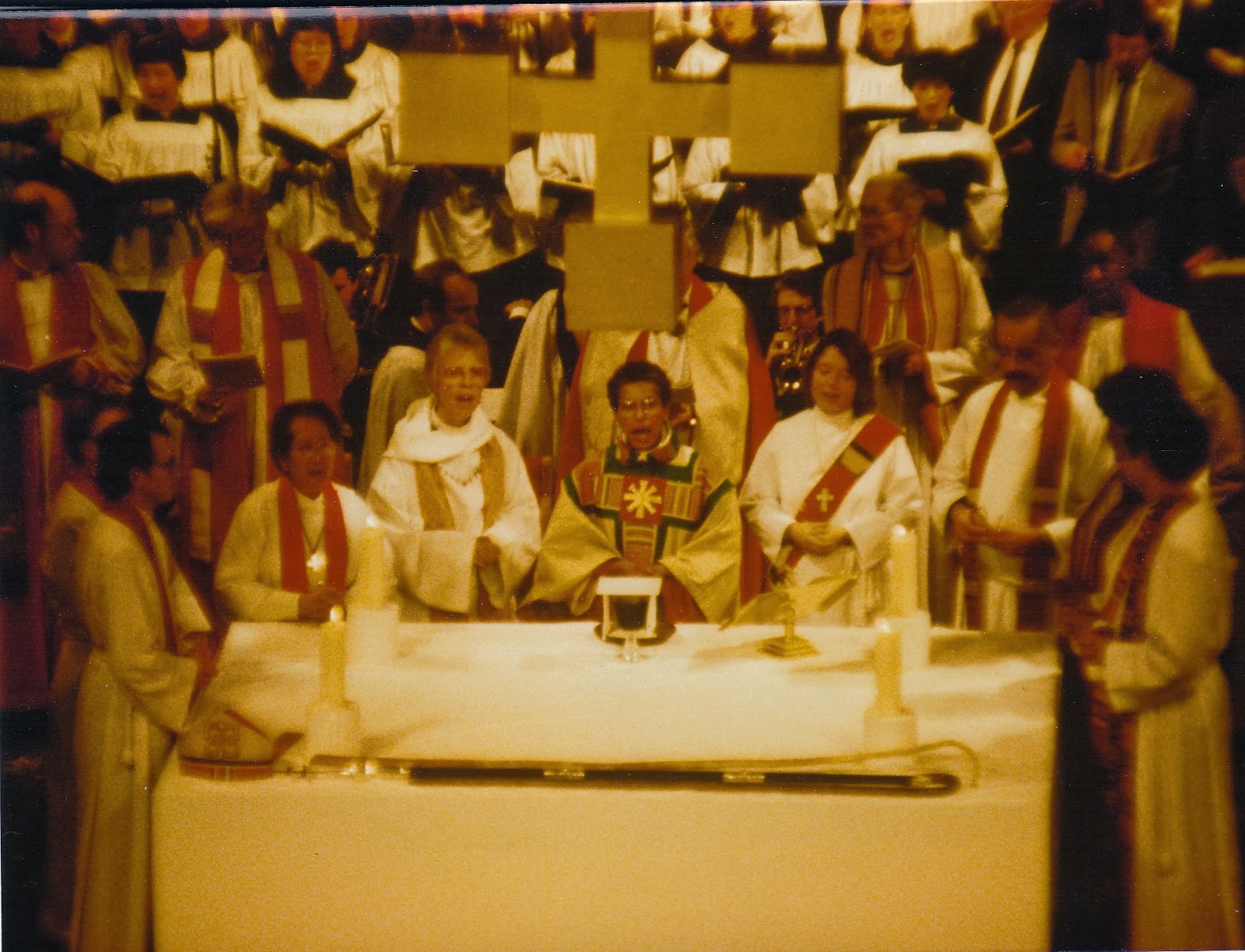
As Barbara Harris walks down the center aisle, a tiny woman whose voice and presence can fill a cathedral, over 8,000 people burst into applause. (“Not very characteristic of the Episcopal Church,” says one member of the congregation, Mary Shannon.) Throngs of priests, row upon row of beaming women and men, process down the side aisles of Boston’s Hynes Auditorium. Barbara Clementine Harris, a woman and a priest of African descent, is consecrated a bishop by the laying on of hands, according to the tradition of the apostles, by 55 men, most of them white. All through the celebration, the bishops have been purposeful, solemn, and excited, with the calm certainty that God, through them, is doing a good thing.

In describing the celebration, those who were there speak of unity. Mary Shannon repeatedly uses the term “body” to speak of the church and of her experience of this day –“finally being part of the body...” “... all of us together in one body.” She is wearing a locket with a picture of her 80-year-old mother, a member of St. Andrew’s Parish in Seattle, who “still carries her white gloves with her in church yet has rolled with the changes.” She speaks in the plural: her mother, her daughters, her husband, her women friends, all rush into the conversation. “I cried,” she says. “I just felt so happy for all of us.”

Modene Dawson of Philadelphia speaks of another unity. For her, and for many African-Americans in the assembly, the significance of the event extends beyond the church. “It’s beautiful for the country,” she says. “It shows racial harmony.” The church which conducts this celebration is not apart from the world; it is the body which proclaims to the world that God is alive in history.

Paul Matthews Washington, in his sermon, speaks about God and history. Harris’s friend and mentor, he is Rector Emeritus of the Church of the Advocate in Philadelphia, which feeds, clothes, and sanctifies the poorest of the city. In this church was held the first ordination of Episcopal women to the priesthood, in the summer of 1974, less than 15 years ago. Harris, a member of the church, led the procession, carrying the cross.

“We cannot,” says Washington, “overlook the fact that this woman being consecrated today is not just an American woman. She is a Black woman... This is a woman... who has had to struggle; she’s been despised, she’s been rejected... God has lifted up one who was at the bottom of society and has exalted her to be one of His chief pastors.”

Washington speaks of Harriet Tubman, who “nineteen times went back into the land of bondage,” thanking God for her freedom by helping to free others. He speaks of Mary, the mother of Jesus, who was raised from her lowly estate and sang of God’s power to raise up the humble and put down the mighty from their thrones: “Mary,” he says after quoting the Magnificat, “was an oppressed woman. That’s how Holy Mary Mother of God felt!” He weeps as he recalls the slavery and oppression of Black people in this country. “Only in understanding the past can we fully appreciate God’s action in this event,” he says.

The Episcopal Church, a church of power and privilege, has chosen “a have-not,” says Washington, but also one who “burns when others are offended,” a “disturbing prophet.” Harris has for years –in her public relations and policy work in the corporate world, in her parish, in her work with the Episcopal Church Publishing Company, in her pastoral ministry—advocated racial and economic justice, taken up the cause of women, spoken out against homophobia; she has, says Washington, devoted enough time to prison chaplaincy “to serve a two-year sentence herself.”

The Right Reverend Barbara Harris, newly robed in bright vestments with Ashanti designs and symbols, presides at her first Eucharist as bishop. Among the concelebrants are Carter Heyward, one of the “Philadelphia Eleven” ordained at the Church of the Advocate, and Florence Tim-Oi Li, the first woman ordained a priest in the Anglican Communion, in Hong Kong, one generation ago. At the distribution, Harris slips over to the far side of the auditorium and gives communion to the people in the hearing-impaired section, who have been singing with their hands for three hours.

A bishop is, among other things, a maker of unity. Barbara Harris has already begun to make unity; but not in the ways in which unity was previously understood or structured. Her brother bishops, Law and Methodios, fear for the health and welfare of Christian unity. But where are the real rifts in our lives today? Are they doctrinal? Where is the real, urgent need for unity? And when we say “unity,” what do we mean? Whose unity, which unity, and at what cost?

The deeper chasm today is not between Protestants and Catholics, or Greek Orthodox and Episcopalians. It is, much more, between haves and have-nots, between Blacks and whites, between men and women, between the Northern and Southern Hemispheres. These are the wounds in need of healing, in church and in society. As for denominationalism, it is no longer the principal intrachurch split. Far deeper is the gap within each of our faith communities between fundamentalists and non-fundamentalists.

Early in the service, the Presiding Bishop, Edmond L. Browning, asks if anyone knows of any reason why the consecration ought not to proceed. Two men come to the microphone. The first calls the consecration “a sacrilegious imposture,” the second “an impediment to the realization of the visible unity of the Church for which Christ prayed.” There will be a problem, they argue, with the value of any sacrament celebrated by Harris.

Bernardine Hayes, a computer systems analyst, self-described “dormant Catholic,” and veteran civil rights and peace activist (she is currently Vice President of WAND, Women’s Action for Nuclear Disarmament), had never before today “seen a woman offer the sacraments. She is so clearly affiliated with the poor,” Hayes adds. “She strikes me as a true minister.” Hayes feels something stir within her during the liturgy –“the realization that the piece of my life which is missing is the spiritual piece.”


This was, she says, "like a Pentecost."

Whose unity?

The intervention of the dissenters highlights the lack of unanimity in the church about the consecration (although Browning is quick to point out, at the post-consecration press conference, that the overwhelming majority of Episcopalians support it). But it is, in its way, a step on the road to greater unity. Perhaps the two men will change their minds; perhaps never. What is hopeful and healthy and makes a body strong is that their pain was not swept under the rug. However token, this part of the ceremony honors difference: and the unity of the Episcopal Church around this celebration –the unity behind the liturgy— is not the easy unity of unreflecting liberals. It has been hard won, tempered by prayer and struggle, and forged through the participatory process of decision-making in the Episcopal Church, a community that gave us two-thirds of the signers of the Declaration of Independence.

Elizabeth Pearson Rice-Smith, a United Church of Christ minister who witnessed both the ordination of the “Philadelphia Eleven” and Barbara Harris’s consecration, believes that “if our vision of church unity embraces diversity in God’s ministries and the human experience of faith, there is much less need to split off. I think,” she adds, “that women are willing to say things about the messy stuff that don’t condemn or blame or banish. We want to create spirited change that doesn’t mean war, that doesn’t mean people don’t talk to each other, that doesn’t mean annihilation.”

Which unity, and at what cost?

Christians do still need to speak with one another about Eucharist and ministry, about theological thought and ecclesial practice. But the context of this discussion has changed, and so have the discussion questions themselves. Unable and unwilling to hide her particularity, unlikely to temper her prophetic stance, Barbara Harris –not in spite of this but because of this—is a maker, not a breaker, of unity.


(c) Jane Redmont 1989


A few other changes – skip this if you don’t care about the minutiae: The editors also lower-cased “Black,” which I had in upper case, and made a spelling change that eliminated my metaphor “singing with their hands.” They changed it to “signing with their hands.” Of course the congregation members in question were signing –but adding “with their hands” would in that case have been unnecessary. The celebration was full of song, and part of the beauty of it was that people sang with both voice and hands. I was seated in the section next to the one using American Sign Language. The editors also deleted the paragraph with Rice-Smith’s quote.

I was still a Roman Catholic at the time I wrote this essay.

 A decade later, in 1999, a few years after I moved to California, I was invited to be on the panel of speakers at the 10th anniversary celebration of Bishop Harris’s consecration. The invitation came from the Rev. Canon Edward Rodman, with whom I had often been on the television show “In Good Faith” on WCVB-Channel 5 (then the ABC affiliate in Boston). I served as the Roman Catholic voice on the panel and offered some insights from a Catholic feminist perspective.

A few years later –12 years ago last month— I was received into the Episcopal Church. The discernment leading to this reception –and the lengthy process toward ordination to the priesthood, a vocation dating back to the 1970s– are another story for another time and place.
 
Thanks be to God for Bishop Barbara!


Saturday, May 4, 2013

Donating from retreat registrations to the Walk for Hunger

As some readers know, I moved back to my beloved Boston just four months ago. Tomorrow, May 5,  is the annual Walk for Hunger. It will be the first large outdoor public gathering since the Boston Marathon. It usually draws about 40,000 people. 


The Walk was started by a group of people connected with my old church over four decades ago. It funds hundreds of emergency food programs (750,000-plus people in this Commonwealth do not have enough to eat) and its parent agency, Project Bread, also does advocacy and prevention work addressing the long-term causes of hunger. 

The last time I lived here, I did the Walk every year and then, when my feet gave out and I couldn't walk the 20 miles on concrete any more, volunteered as a Marshal. (Note: I also had Project Bread as a client for several of the years I was doing development consulting here, working for agencies addressing the causes and consequences of urban poverty.) 

So here's the deal: I'm not walking this year, but if you register for my "Hurry Up and Slow Down: Spiritual Practice in Daily Life" online retreat which begins on Monday May 6 (see here for full information) any time between this very minute and the end of Sunday (tomorrow May 5) in whatever time zone you are in, I will give $20 out of each registration fee to the Walk instead of keeping the whole fee.* Because I often scramble to pay the rent each month, but there are people far worse off than I, and we are all part of one another.

*I'd be happy to send you proof of the donation if you wish.

Here is an interesting interview with Project Bread Executive Director Ellen Parker.


Cross-posted on my professional website.

Saturday, December 25, 2010

Christmas, a year ago

I have been reading a lot of Merton during Advent.

Coincidentally (or not), I put together this post exactly a year ago. My friend Ann Fontaine just posted the same quotation* on Facebook tonight. Friends think alike.

*Into this world, this demented inn, in which there is absolutely no room for Him at all, Christ has come uninvited... [More at the link "this post" above.]

Friday, September 4, 2009

DO SOMETHING for health care reform every day: a series begins

Occasionally we have a series here at Acts of Hope, a mix of information, inspiration, and advocacy. We seem to do this roughly once a year, though not by design.

There was the fund-raising and Latin American theologies series. The beneficiary of our (and other blogs' - this was a group project) fund-raising was an Anglican parish in a very poor neighborhood of Rio de Janeiro. By the way, I have an update on the parish of Cristo Rei from our friend Luiz which I have been meaning to post and which will go up this weekend.

Then there was the Obama election series.

I'm doing it again.


Some of you may have been involved, the last 48 hours, in the Facebook series that asked you to post to your daily updates the following message: No one should die because they cannot afford health care, and no one should go broke because they get sick. If you agree, please post this as your status for the rest of the day.

I didn't do it.

Not because I don't agree --I do and then some-- but because I felt that for the most part it would be preaching to the converted and that if my eyes were starting to glaze over from the message, other people's would. And mostly, because I think we need to DO something.

Like my other friends and colleague who want health care reform and who prefer either a public option or plain ol' single payer health care, I rant and complain, but more than half the time, I don't do anything. Meanwhile, there are lies and distortions all over the place, our local and national media don't get complaint letters when they spread those lies or when they fail to do their job as public educators, the noisy rude folk dominate the public forums (or maybe they don't, but they sure get the coverage), and our Congressfolk don't hear from us. A few of them have spines, but the others will not develop them till we remind them that we are the ones who will re-elect them -- or not. And that they work for us.

And we bitch and moan (pardon my language) about the President we worked hard to elect when he doesn't change massive systems with the wave of a magic wand. Then, of course, we will blame him for everything.

How do you think we got him elected?

HARD. WORK.

PUBLIC. INVOLVEMENT.

TIME. ENERGY.

It's our country, these are our bodies, this is our health care system we want to change. And we have no right to complain unless we act.

Thus, I am starting a series here. It's partly to get myself off my duff and have a place to be accountable and partly because besides I am at heart several things --artist, priest, and yes, organizer.

I don't have time for this either, but it's too important to leave alone.

I don't fully know what will be in this series, but I pledge to put something useful here every day. Information, education, ways to act, analysis, commentary, reporting. It won't all be mine. There is no need to reinvent the wheel. I will link to other sources and to people who know more than I.

And yes, I will write, this weekend, a short report on our Greensboro public forum on health care, with a little something on Teddy Kennedy.

I am also doing this in part in memory of Kennedy, who was my Senator for many years and was still, at the time of his death, my parents' Senator.

Feel free to send me (in the comments or via e-mail) information and links and suggestions.

Uncivil speech is not welcome; I will delete it; don't even try. Conversation is another matter. Conversation is good. Disagreement is fine if it is reasoned and polite. And lament is fine too: there is plenty to lament. But lament is the beginning of resistance and healing. Or can be.

Stay tuned. And thank you for reading this and for caring for the common good.

If you haven't see this video about the why of government-run health insurance, have a look.

P.S. I'll still post other things, too. This isn't turning into The Health Care Blog.

Mural "Community Caring, Community Healing" by David Fichter. Martha Eliot Health Center, Jamaica Plain, MA.

Tuesday, May 26, 2009

Killed by the health care system

Doxy, of recent fabulous wedding fame, has a post up this evening about a friend who just died of uninsured causes. I phrase the cause of death this way because if Terri-Lynn had had health insurance she would be alive today. Do not "individualize" her case. The loss and grief we feel are for a unique person, but the problem is a systemic one. If we had a decent national health system, Terri-Lynn would have been insured.

Terri-Lynn leaves a ten-year-old child with a chronic illness.

Read Doxy's post, "Elegy."

Once we have wept and prayed, or perhaps while we still weep, let's act. Stay tuned. Doxy has one suggestion, but I am sure she and others will follow up.

Here is a clear, persuasive, factual presentation from 1999 on "The Case for Universal Health Care." More recent, and unconnected with the Green Party (to which you will see a reference in the presentation) is the national association Physicians for a National Health Program.* Tolle lege.

* Physicians for a National Health Program is a non-profit research and education organization of 16,000 physicians, medical students and health professionals who support single-payer national health insurance.

Health care is a human right.

Saturday, April 4, 2009

April 4: two MLK anniversaries and a third, with the Freedom Seder

The Revs. Jesse Jackson and Martin Luther King, Jr. on April 3, 1968, before MLK gave the last speech of his life. Photo: Ken Ross via American RadioWorks. He was assassinated the following day.


Today is the anniversary of the 1968 assassination of the Rev. Dr. Martin Luther King, Jr. in Memphis, Tennessee.

It is also the anniversary of the "Beyond Vietnam: A Time to Break Silence" speech which he gave exactly a year before, on April 4, 1967, at the Riverside Church in New York City.

Although I have posted the speech before, I post it here again for those who have not read or hear it. The link includes audio as well as transcript text. The speech is long but well worth pondering.

A good feature on the last year of King's life (the "Beyond Vietnam" speech, the Memphis sanitation workers' strike, et al.) is here, courtesy of American RadioWorks. It includes both text and audio.

And, with thanks to my colleague the Rev. Susan Redfern Spencer (also here), via Facebook, the note below from the Shalom Center and YouTube video:

On April 4, 1969, the first anniversary of the death of Dr. Martin Luther King, the third night of Passover, hundreds of people of varied racial and religious communities gathered in a Black church in the heart of Washington DC to celebrate the original Freedom Seder. For the first time, it intertwined the ancient story of liberation from Pharaoh with the story of Black America's struggle for liberation, and the liberation of other peoples as well.

To celebrate the 40th anniversary of the Freedom Seder and to address one of the greatest dangers ever to face the human race --the danger of "global scorching" worse than the traditional "Ten Plagues"-- The Shalom Center has initiated a New Freedom Seder for the Earth was scheduled to sponsor it in Washington DC on March 29, 2009. Here is more information on
the original Freedom Seder and the New Freedom Seder for the Earth. (You can download the text of the Seder for the Earth at that last link.)

Friday, January 30, 2009

Two days ago, women; today, labor unions, the middle class, and the poor

U.S. President Barack Obama shakes hands after signing an executive order at the Middle Class Working Families Task Force event in the East Room of the White House in Washington, January 30, 2009. Photo: Larry Downing, Reuters.

It really is a new presidential era. Today President Obama signed executive orders that, in his words, "level the playing field" and do not view unions as an evil force in U.S. society. He also spoke of the poor and not just the middle class; as you may recall the poor were largely invisible in election campaign rhetoric.

For this, for the President's action yesterday signing the Lily Ledbetter Fair Pay Act into law, and for yesterday's denouncing of huge bonuses to Wall Street executives, many of us are thankful. And, make no mistake, many will be angry. I don't mean to go all Manichean on you, but the opposition to this is not going to be pretty.

So, I rejoice, and I pray.

And I pray that those of us who, moved by our faith, our humanism, our experience, or our principles, support the rights of workers to organize, the dignity of the most poor, the equality of women and men, and fairness in finance, will be active as citizens.

Below, because we like him, Vice-President Joe Biden. He will head White House Task Force on Middle Class Working Families . Photo: Ron Edmonds, AP.

Saturday, January 24, 2009

Episco-crats in shelter-land

Doxy's pal UT from Under the Overpasses has a new blog under his real name. Turns out he is Tim, an Episcopalian from Western North Carolina. His blogging continues to be eloquent, informative, and challenging.

When +Nedi Rivera spoke to us today about becoming welcoming congregations she slid into her talk, briefly put pointedly --I didn't miss it-- a little comment about how, make no mistake, this is not just about ethnicity and culture and race but also about class.

After that, I was also glad to read this over at Tim's. Well, glad that he wrote about it, but it made me shudder. This class issue is part of what kept me away from the Episcopal Church for years (that and the dominant Anglo culture) and Tim notes how this class privilege affects even life in shelters.

As some of you know, Tim directs a shelter for homeless people. His new blog is called "Caught a glimpse of Jesus down by the railroad tracks..."

Friday, December 12, 2008

Automobiles vs. derivative paper transfers: Jon Stewart's perspective on bailouts

What do I know? I am just a simple country theologian, not a financial wizard, but I do think Jon Stewart had a point the other night.

Wednesday, October 15, 2008

Be prepared...

... be prepared, always, to be part of God's answer to your own prayers ...

That beautiful piece of wisdom is from MikeF at The Mercy Blog. It comes toward the end of his post for Blog Action Day, a bloggers' day on world poverty. FranIAm has also posted for this action.

I am a little low-energy today and looking at four (or is it five?) unfinished projects, none of them optional, so I am re-learning the lesson of the Body of Christ, and remembering to be grateful for my friends whose prayers carry me and who also act when I cannot.

As I write, I am especially grateful for Mike's wisdom.

By the way, Mike just made his Life Profession as a Third Order Franciscan. Read about the fine day at Hifield Friary here, and if you want to know more about what it means to be a Tertiary as opposed to a Brother, don't be afraid to ask Mike! P.S. Mike is also a grandfather and a cat person. +Maya wanted me to write that.


Art: "Communion of Saints," by Ira Thomas. Tip of the fedora to ConcordPastor. (Fran, note, I just found this via a Web search for art on the Communion of Saints!)

Sunday, October 12, 2008

Two signs of the times in France


Two interesting stories on French culture and society. Warning: they are in French. I will be happy to provide a short summary in the late evening today; just leave a request in the Comments section.

1. Twelfth transpeople's march in Paris yesterday (Saturday) draws nearly 400 people. The annual Pride march in Paris, which is much larger, has not highlighted transpeople, who felt they needed their own public presence.

2. A former trader on the stock exchange became a monk two decades ago. Still under vows and living in a small community of brothers, he now teaches in a poor immigrant neighborhood of the Southern port city of Marseille.


Wednesday, June 25, 2008

"Unequal America"

Meanwhile, Harvard Magazine has discovered the gap between the rich and the poor...

Worth the read, though, in the July issue. Here.

Friday, June 6, 2008

Bishop Tom Shaw's trip to Zimbabwe

Bishop M. Thomas Shaw of Massachusetts, who is a member of the Society of St. John the Evangelist, has just returned from a trip to Zimbabwe, where he traveled alone and visited Anglican congregations and clergy at the request of Presiding Bishop Katharine Jefferts Schori.

Read about it, and see a bit of video and a few photos, in the Boston Globe here.

Saturday, May 31, 2008

More politics, from the thoughtful janinsanfran

My friend Jan of janinsanfran is a much more sophisticated political observer and activist than I. She does it for a living, but also, she is just plain better at it than I am. She has a good post up on feminism, the Democrats, H. Clinton, Obama, and related matters which I commend to you and am going to re-read.

You can get your McCain comments there too -- and not just comments, but facts. Jan is a reality-based blogger, and not reality as in reality show, but reality as in facts and good reporting.

Here endeth (for now) the political update. Go in peace and remember the standard: What is the impact of my political and civic decisions on the most poor and marginalized members of society? That is all.*

*As PJ would say.

Sunday, May 11, 2008

Mothers' Day

As you may have noticed a couple of posts below, we have a new feature at Acts of Hope, "blog flashback." I was inspired by my friendly colleague Jennifer, she of the fine food blog and priestly ministry. She calls her flashbacks "archive alerts."

Usually I will post these flashbacks at the bottom of posts and not devote a full post to them, but occasionally I will just post a flashback, as I am doing here. I had more wisdom to share a year ago than I do now!

This evening we bring you a couple of Mothers' Day flashbacks.

Blog flashback: Last year at this time:

Mothers' Day: Peace, Not Hallmark

A little late with your Mom's Day greetings?


Friday, April 18, 2008

Friday cat blogging: Maya Pavlova does postcolonial feminist biblical interpretation

Regular readers may remember that many weeks ago I (and we at Guilford College) had the honor of hosting the Botswanan biblical scholar Musa Dube, who came to speak here on her way from and to other, larger speaking engagements in the U.S. South. She spoke about African women's biblical perspectives and feminist postcolonial biblical interpretation in the age of HIV/AIDS in a session of my Liberation Theologies seminar which I opened to anyone who wanted to come. She also gave a lecture in a more formal venue on campus later the same day.

Because the number of students in the seminar is small, I teach it at home and Miss Maya Pavlova is a regular participant. Being a heterosexual girlcat, she favors the one young man in the class and always ends up settling on his lap, but this time she went to a woman, and she loooooved our esteemed scholarly visitor. So much so that I had to fetch a towel to put on the visitor's lap, because said visitor was of course wearing a beautiful black pantsuit, and you know what cats with white bellies do to black pantsuits.

Maya Pavlova sat on that scholarly lap for over an hour and listened to the whole talk and the questions and answers.

So here, in memory of beloved Krister Stendahl, whose funeral was today (I was not able to go to Cambridge for it, sadly, but hope to make it to the humongous memorial service up there on May 16) and in honor of the new generation of biblical scholars, of whom Musa Dube is a worthy and wonderful representative, we bring you Maya Pavlova, intercultural ambassador and intellectual cat. And, as always, world-class flirt.