Sunday, November 27, 2022

Awake in Advent: Living God's Patience and God's Impatience. A sermon for the first Sunday of Advent.

The season of Advent began today, Sunday November 27, in the Western Christian liturgical calendar. Here's a meditation for those of you who observe this season, which marks the beginning of the Christian year.


I preached this sermon at the Parish of St. Paul in Newton Highlands, a small congregation in one of Boston's nearby suburbs. I'm grateful to the Priest-in-Charge, the Rev. Cara Rockhill, and the lay leaders and members of the parish, for their invitation and hospitality. I'm a great believer in offering apologies when they are needed and appropriate, and you will see at the beginning of the sermon an apology for the length of my sermon of a few weeks ago. This is my third or fourth time preaching in this parish, which I serve as a consultant on behalf of the Episcopal Diocese of Massachusetts.

The sermon is new, written and spoken for a particular time and place,
but some of you will recognize both the title of the sermon and some of its content from retreats and meditations I have offered in the past.

In the name of the One
Who made us 
Who saves us 
and Who walks with us always, 
Amen.

It’s good to be back here with you.

Thank you for your hospitality.

I owe you an apology.
That sermon I preached a few Sundays ago was
Much. Too. Long.
I promise you today’s will not go on and on.
 
Lend me your ear, though,
for a different mood from Sundays past. 
We are entering Advent.

 Do you have an Advent wreath at home?
Do you light Advent candles?
When did you light the first candle?
On the vigil of the first Sunday, last night?
Or do you plan to light it tonight?
Or perhaps, as has happened to me more than once in the past, 
Will you begin your daily lighting of the Advent calendar 
midweek, 
because you haven’t made or bought your Advent wreath before then 
and the dining room table is a mess?

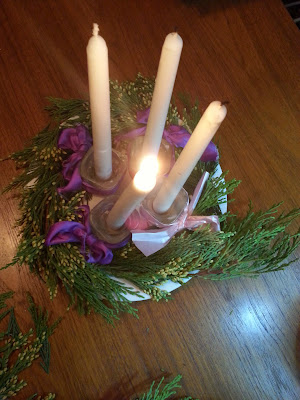
We have an Advent wreath here.

Take a moment (or two) to gaze at the flame of that first candle,
the one we have lit in our communal space
in this sanctuary.
Simply gaze.
Take a long slow breath or two

and look at that one light.

        (Silence.)

* * *

Advent and Christmas are in some ways
the ultimate celebration of space,
the celebration of God entering human space
in the most intimate way possible:
by becoming human.

The celebration of word become flesh,
of word becoming flesh
the discovery that God-the-other
is also God-with-us[1]:
That is the good news of Advent.

We celebrate in Advent
God's invitation
for us to view our space
—our society,
our environment,
our neighbor,
our own flesh—
    as sacred,
    pregnant with justice and hope,
    filled with hidden treasure.

But Advent is also a celebration
of time
and a celebration in time.

God enters
not just our space
but our time:
our history,
our present moment,
our human future.

Advent
challenges
our very relationship to time.

Advent challenges our impatience
and invites us to enter God's patience.

It is the season
of taking the long view,
the view beyond
our own small range of vision.

If we are to hear the good news
that God is
Emmanuel, God-with-us,
we may have to slow down.
        To slow down externally, bodily,
        But also to slow down inside
        —which can be even harder than slowing down with our body
    or slowing down our behavior.
Often God speaks very softly,
in ordinary ways and places,
in the daily events of our lives.

If the good news
is to take root in us,
we need to enter God's time,
God's timetable.

Advent
is not a flashy season.
It takes time for good news to sink in,
for love to grow,
for wisdom to ripen,
for lives to be transformed,
for truth to dawn in us,
for hope to take shape.

So in Advent, season of waiting for Christ,
we take in the good news slowly,
steadily,
lighting candles one at a time,
adding a new insight,
a layer of understanding,
every day
and every week.

(and) Yet

Advent is also a time to enter
God's impatience,
a time of righteous anger,
a time when prophets
challenge our apathy and paralysis
and urge us forward.

It is a season of visions and yearnings,
in which the stories and songs in the scriptures
speak of a God
who longs to transform
our hearts,
our society,
and creation itself –
soon, now, urgently.

***

One of these visions
is in the text from the prophetic book of Isaiah
for this first Sunday of Advent.[2]

Did you notice
how much this reading,
in addition to its images taken from nature,
addresses our life in human community,
including the community of nations?

God's righteousness and wisdom
and our human responses to them
are, in the text, directly related
to whether and how humans make peace or war,
whether we make the land into a battleground
or cultivate it.

The "swords into plowshares" passage[3]
is so well known
that we can gloss over it,
or in some way romanticize it.
Or perhaps more likely,
think it is nothing but a vision or a dream.

That metaphor has, however, been used in recent history
to describe something concrete:
what in the late 1970s we began calling "economic conversion"—
—the shifting of industrial, manufacturing, and scientific priorities
from military to civilian.
The movement continued for a couple of decades
and found its way into policy conversations:
there was even a bill
introduced in 1977 by bipartisan sponsors in the Senate
and then in the House of Representatives.
It was called the National Economic Conversion Act
and was repeatedly reintroduced through the years
but never became law.

Nowadays we speak more often
Of another kind of economic and environmental conversion:
Away from over-use of fossil fuels
and over-production of carbon emissions
that threaten us and God’s earth on which we live
with a greater danger than swords
and toward forms of energy
that can keep us and our children
and our companion plants and animals
and soil and water and sky
healthy and full of life.

Swords into plowshares.

It is up to us to take up the vision
and turn it into reality,
wherever we can.

Swords into plowshares.

* * *

So here we are:
smack in the middle
of cosmic,
personal, political,
ecclesial,
social, and economic
issues and upheavals,
all at once.

We are also
in the realm of visions of the messianic age,
which both Jews and Christians cultivate,
though in different ways.

The characteristics of that age,
of that kin-dom,
are the same, though:
peace among humans,
harmony in nature,
and the transformation
—some of it subtle, some of it dramatic—
that makes these possible.

* * *

Meanwhile, Jesus,
as the Gospel of Matthew presents him,
is far from meek and mild.
He warns us, puts us on alert,
shakes us up.

"Keep awake!"

Advent may be the slow and gentle season,
but it is—equally—
also the shake-up season.

God enters time,
but
the end of time is looming.

Jesus
grabs his companions by the collar.

No gentleness in this Gospel.

But no hypervigilance either.
By which I mean no jitters,
no super-speedy-overwrought reflexes.

Rather, we can read the Gospel as an invitation
to be awake and alert in a centered way.
It may be useful to read this Gospel in tandem
with a good dose of Buddhist mindfulness practice:

Can we be alert
but not reactive,
ready for the storm
but not overwhelmed
by its presence?

Can we spend Advent mindfully,
letting go of some of the reactivity
that has characterized so many of our conversations and responses
this election season
and the two preceding election cycles?

Can we spend Advent mindfully,
letting go of the reactivity that rises from us
not just in political conversations
but in many of our circumstances
today?

Can we spend Advent
mindfully, gently,
in the present
despite all the uncertainty and anxiety we are carrying
–in our work lives,
our relationships,
our family lives—
and yes, our church lives?

* * *

One of the challenges of this season
is to readjust our sense of time:
to discern when it is appropriate
to enter into God's patience
and when it is time to enter into God's impatience.

Perhaps it is also, then,
a time to learn mindfulness in a new way.

It is helpful to do this in community.
That's why we have the seasons of the church year.
That's why we have each other.

* * *

Today, on this first Sunday of Advent,
this first day of the new year[4]
and in the next few days,
before you do anything else,
take time.

Rest
in the patience of God.
All else will unfold,
in God's time.

        Amen.



[1] Emmanuel = “God with us” in Hebrew.
[2] The Revised Common Lectionary texts are here.
[3] A similar use of this image exists in chapter 4 of Micah, another prophetic book of the Bible.
[4] The new liturgical year.


Thursday, March 10, 2022

Half the population of Kyiv now refugees

Refugees in large numbers are not new --hello Syria, hello, Afghanistan, hello, South Sudan, hello, DRC-- but the speed at which the number of Ukrainian refugees has risen is devastating. Two million people as of last night's NPR news, half of them children. And this morning in the newspapers and their websites, the news that half the population of Kyiv is now displaced. That's half of the capital city, a city of close to three million inhabitants. Think of the most populous city of your state (or country if you are not a continent-wide country like the US or Canada or Australia) and half the population fleeing on short notice, in less than two weeks. The other half in a makeshift fortress city watching for enemy armies. The mind boggles. The heart races, or nearly stops.

From The Guardian today:

Russia-Ukraine war latest news: half of Kyiv population has fled, mayor says; Turkey talks end without progress on ceasefire

I will shortly post in the comments to this post the names and website info of reliable aid organizations. 

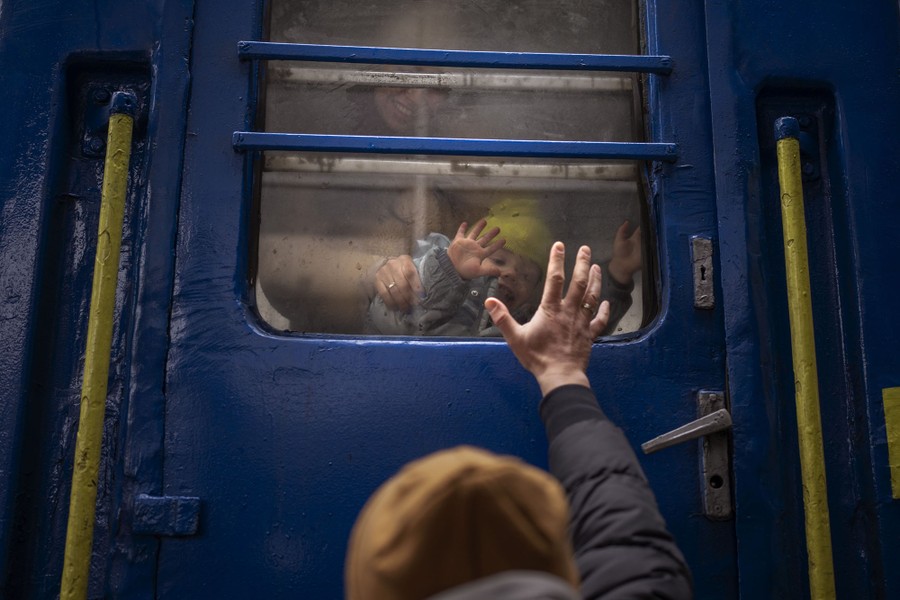
A child, held by his mother, waves from a train window to his father outside, directly below the window.

Stanislav, 40, says goodbye to his son David, 2, and his wife Anna, 35, on a train to Lviv at Kyiv's railway station in Ukraine on March 3, 2022. Stanislav is staying to fight while his family is leaving to seek refuge in a neighboring country.

Emilio Morenatti / AP

Tuesday, February 23, 2021

Lenten online retreats for you!

 Dear friends,

Here is an announcement from my "website" (in quotes because it's really a blog that functions as a website janeredmont.blogspot.com) about some online retreats I am offering this Lent. As you will see below, there are links to further information and registration.

Do join us for one of the retreats! There is a fee for the retreat, but on a sliding scale, and we can accommodate you, whether you can afford the "benefactor" level or you are in a situation of financial hardship.

art by Thomas Merton

What, you say? A second pandemic Lent?

Can Lent be life-giving, faith-deepening, full of meaning when, for many, the entire past year has felt like Lent?

How will we live Lent in 2021?

Ash Wednesday
, the first day of Lent in Christian churches of the Western traditions, was last week. Today is the first Sunday of Lent. Here we are.

Lent, the 40-day season preceding Easter, is the Christian church's annual long retreat.

We go on this retreat, not necessarily to a different geographical place, especially this year, but to a zone of mindfulness and practice that reorients our hearts and helps us to reconnect, deeply, with God, with Jesus Christ, with the Spirit at the heart of God's life and the life of the world.

We clear some space and time --even a little bit of each-- to  to make room for the God of comfort and surprises and to remember what is deepest and truest in our lives. Lent is for the sake of Easter. It is a time of renewal. It is a sober time, but not a gloomy time. It is a time of self-examination, but not a time of cruelty. It is a time of attentiveness and a time of turning --of conversion.  Transformation is not always easy, but it is possible. Grace is present. Always.

Will you join us on one of three online retreats this Lent?

The two longer retreats, which run for all six weeks of Lent, begin this week. The shorter one, which is three weeks long, begins in the middle of next week.

THOMAS MERTON, COMPANION ON THE WAY
This six-week online retreat examines contemplation and struggle in the life, writings, and prayer of Thomas Merton, with guidance and opportunity for prayer and practice. Merton, a 20th century Trappist monk, was also a writer, poet, spiritual teacher, artist, social critic, and pioneer in interreligious and intermonastic dialogue. I have offered versions of this retreat before. For more detailed information and to register, click here.

LENT FOR LIFE: RENEWING BODY AND SPIRIT
A six-week retreat of prayer, practice, and reflection on the life-giving dimensions of this second Lent of the coronavirus pandemic. It will include a lot of  focus on the body and bodies: our own bodies, Earth's body, our neighbors' bodies, the body of Christ
. For more detailed information and to register, click here.

LENT FOR LAGGARDS: (Re)DISCOVERING THE MERCY OF GOD
This one's for you who are struggling, or feeling overwhelmed, and who never quite got started on Lent on either Ash Wednesday or the First Sunday in Lent. Begins in the middle of next week, the second week of Lent. No guilt-trips, just reminders of grace abundant and of the Holy One's love for us as we amble or stumble along. For more detailed information and to register, click here.

All of the retreats have a structure and a schedule, but they are flexible enough to integrate into your daily life: you are the one who decides when and where to read and pray with the materials offered on the retreat and how to apply the invitations to practice.

All three online retreats will be operate on a hybrid model, by which I mean:

1) As in the past, all the retreats will include online resources you can tap into at any time of the day or night, on a private blog to which you will have access once you are registered for the retreat. Among the resources will be readings, meditations, images, a little music, and spiritual exercises to practice in your own time and in the context of your life.

2) Since many of us now have experience with video conversations, each retreat will also include some live online conversation in one or two specific time slots each week -- enough for you to touch base in person (with me and with your companions on the retreat) for some inspiration and support, but not so much that you will get "Zoom fatigue."

All of these online retreats call us to simplicity, mindfulness, and holiness. Like the season of Lent itself, they invite us to repentance and conversion, but also to joy. 

Peace be with you. Please join us on the journey of Lent.

Wednesday, December 2, 2020


Dec. 2020 Photo by David Ames
 

Tuesday, December 1, 2020

For the Darkness of Waiting: Advent 2 resource for Emmanuel Church and friends

 Here is the full litany whose first two verses were quoted in This Week at Emmanuel Church's "Advent at Home." 
 
Read it slowly. Read it aloud. If you are observing Advent at home with one or more companions, read it responsively.


FOR THE DARKNESS OF WAITING

For the darkness of waiting
of not knowing what is to come
of staying ready and quiet and attentive,
we praise you O God:
 
for the darkness and the light
are both alike to you.

For the darkness of staying silent
for the terror of having nothing to say
and for the greater terror
of needing to say nothing,
we praise you O God:

for the darkness and the light
are both alike to you.

For the darkness of loving
in which it is safe to surrender
to let go of our self-protection
and to stop holding back our desire,
we praise you O God:

for the darkness and the light
are both alike to you.

For the darkness of choosing
when you give us the moment
to speak, and act, and change,
and we cannot know what we have set in motion,
but we still have to take the risk,
we praise you O God:

for the darkness and the light 
are both alike to you.

For the darkness of hoping
 in a world which longs for you,
for the wrestling and the labouring of all creation
for wholeness and justice and freedom
we praise you O God:

for the darkness and the light
are both alike to you.

                     Janet Morley
                    All Desires Known, expanded edition
                    (Harrisburg, PA: Morehouse, 1992)
                    pp. 58-59
         

Sunday, November 29, 2020

First Sunday of Advent (Year B): meditations on the scriptures / sermon excerpts

 The Collect and Revised Common Lectionary readings for this First Sunday of Advent, Year B, are here.

These are two excerpts (beginning and end) from a sermon I preached on the first Sunday of Advent exactly six years ago (i.e. in the same cycle of readings, Year B) at Trinity Episcopal Church in Canton, Massachusetts, a racially mixed (African American and White, with a few West African members) parish, in the wake of the events in Ferguson, Missouri: the killing of Michael Brown, an unarmed, young Black man by a police officer and the announcement this week that the Grand Jury did not indict the officer, followed by outcries and demonstrations of protest in Ferguson and around the U.S.

O that you would tear open the heavens and come down
so that the mountains would quake at your presence
--as when fire kindles brushwood and the fire causes water to boil—
to make your name known to your adversaries,
so that the nations might tremble at your presence!   
[Isaiah 64:1-2]
                                                                                                     
Chaos and anguish.
Lament and longing.
Social unrest.
Scary weather.

This is what we hear in our readings
for the first Sunday of Advent.

Today is the beginning of the season of preparing
for Christmas,
the Nativity of Jesus,
who came to us as a child born in poverty,
and who at a very young age
became a migrant child,
carried by his parents to Egypt
so that he might be safe from the long reach
of violent tyranny.

And speaking of migration:
the part of the book of Isaiah we heard
is a book of exiles
returning home
bewildered, traumatized.
In the middle of finding their bearings.
In a harsh, disoriented time.
                                                                                                                    
In the image given to us by the Psalm,
we drink bowls of our own tears --
bowls of tears! ...

... Jan Richardson,
an artist, Methodist minister, and poet
says of today’s Gospel passage that it
“doesn’t so much beckon us across the threshold” of Advent
“as it throws open a door,
tosses a cup of cold water in our face to wake us,
and shoves us through.”

Not very cheery.

... There’s no getting around it.
This is a difficult and painful season for many of us.

Difficult for those of us who suffer from depression
or who are living with addiction.

Painful for those whose relationship with their families
is challenging
or conflicted
or non existent.

Difficult, even disastrous, for refugees from our own
Long Island Shelter in Boston,
hundreds of people
who now are doubly homeless
because of lack of timely repairs on the bridge to the island.

It is wrenchingly painful for the parents of Black and brown children,
especially Black and brown boys and young men,
who are full of fear every time their child leaves the house.

Is is discouraging and angering in the face of the lack of indictment in Ferguson
for an officer shooting and killing an unarmed young man.

It is discouraging for those law enforcement professionals
who do their jobs with care and honor
and a sense of responsibility.

It is frightening in a season of rising oceans and climate change.

It is enough to make us raise our voices in anguish and say to God,

GOD?

WHERE ARE YOU?

GET OVER HERE!

or

COME ON, JESUS!

SHOW UP!

So it was
for the people
from whom
and for whom 
the Gospel of Mark was written...


 [There followed several paragraphs about staying awake, reading the signs of the times,
mindfulness, vigilance, and faithfulness.]


... We cry, with the Psalmist,

Restore us, O God of hosts;
show the light of your countenance, and we shall be saved.


[Ps. 80:3,7]

This is not the ordinary light,
not that of electricity,
not even that of the moon and stars,
not that of the sun.

It is
a different light:
the radiant darkness of God
the Word that comes to us when the ordinary perceptions have gone.

This may well be why
we have this earth- and heavens-shaking
entry into Advent:
to return us to a different light.


Our opening collect calls us to “cast away the works of darkness.”
I want to offer us an alternative, which is to cease equating darkness with what is evil
and rather, to embrace the dark. To see the dark as the place where God is with us.

A radiant darkness.

So let us pray, in words given to us by Janet Morley,

God our deliverer,
whose approaching birth
still shakes the foundations of our world:
ay we so wait for your coming
with eagerness and hope
that we embrace without terror
the labour pangs of the new age,
through Jesus Christ, Amen
.[1]


[1]  Janet Morley, Collect for Advent Sunday, in All Desires Known: Inclusive Prayers for Worship and Meditation, expanded edition (Harrisburg, PA: Morehouse, 1992), 4.

Tuesday, November 24, 2020

Creator of the stars of night: Advent 1 resource for Emmanuel Church and friends

A little more about the chant linked in "This Week at Emmanuel Church." (Note: underlined words or phrases are hyperlinks: click and the linked web page will open in a separate window.)

First, an invitation to spiritual practice:

Listen to the chant this evening or even every evening this week. Repetition is good and can steady you after a less than steady day.
 
Some history:
 
Many of you may already be familiar with this chant.  Some churches sing it as a hymn in English as "Creator of the Stars of Night," with words by 19th century lyricist John Mason Neale. It is also known by its original Latin titles, "Conditor Alme Siderum" and "Creator Alme Siderum."
An anonymous text traditionally used at Vespers (evening prayer) during Advent, "Conditor Alme Siderum" was revised in the 17th century under Pope Urban and became "Creator Alme Siderum" with a different set of lyrics. In recent years churches and choirs --those who use the Latin, anyway-- have returned to the original "Conditor" version. Many English translations exist.
Here is a Gregorian chant version in Latin sung by alternating men's and women's voices.  (For some reason, the "Creator" version is used.)
Meanings:
 
This Advent hymn of chanted praise spans all of salvation history, from creation to the end of time.
Conditor alme siderum,
aeterna lux credentium,
Christe, redemptor omnium,
exaudi preces supplicum.

Nourishing author* of the stars,
eternal light of those who believe,
Christ, redeemer of all
answer the prayers of those who beseech you.
The latin word conditor has many meanings: it means author, composer, creater, builder, founder, and preserver. So all those connotations are there when we sing "conditor alme siderum." Alme is the same word as alma in "alma mater."

The above translation from the Latin is mine and is obviously not in verse. It is a more             literal translation than the formal poetic translations like John Mason Neale's (from the Episcopal Hymnal 1982):

Creator of the stars of night,
Thy people’s everlasting light;
Jesu, Redeemer, save us all,
And hear thy servants when they call.
 
Here's a picture for you to contemplate. More words and translation follow below.

Sagittarius Dwarf Galaxy, NASA photo via HubbleSite.org


Later, the hymn expresses fear, even dread, but also the hope and assurance of protection.

Te, Sancte, fide quaesumus,
venture iudex saeculi,
conserva nos in tempore
hostis a telo perfidi.

Holy One, in faith we beg You,
You the judge of the world about to come,
guard us in this present era
from the weapon of the treacherous enemy.

                    (My translation again, with a little help from an existing one.)

 
More spiritual practice:
 
But you can just listen to the Latin. Hum along, or let the music carry you.