See what's going on in Our Nation's Capital besides skulduggery and cherry blossoms?
The 15th annual ambassadors' Seder.
Monday, April 2, 2007


The 2-minute Haggadah was a joke, but this one's for real!
As the French say, la réalité dépasse la fiction.
Or as people here and there and everywhere say, only in America -- and as one of my hosts and I exclaimed almost simultaneously tonight, only in the fertile mind of Baby Boomers! Oy!
In this morning's Washington Post, here it is: for sale, for use in your own home, the thirty-minute Seder. No kidding.
My post on the two-minute Hagaddah is here.
Or as people here and there and everywhere say, only in America -- and as one of my hosts and I exclaimed almost simultaneously tonight, only in the fertile mind of Baby Boomers! Oy!
In this morning's Washington Post, here it is: for sale, for use in your own home, the thirty-minute Seder. No kidding.
My post on the two-minute Hagaddah is here.
Jews and the death of Jesus
For Jews, as recently as a generation ago, the Christian Holy Week was a time of terror.
This week was prime time for attacking and killing Jews. The Holy Week biblical texts, and the interpretations and teachings derived from them over centuries, provided a good deal of the impetus for this season of fear and blood.
Since the Second Vatican Council, Christians, with Roman Catholics in the lead, have re-examined teaching about Jews and Judaism and Christian responsibility for the persecution of Jews over the centuries. Years of scholarship and Jewish-Christian conversation at many levels have helped forge new understandings. There are now many helpful resources for preachers and religious educators. I list a few below and will list more after I get home (I’m briefly out of town), but for the summary, short and to the point, see today’s Boston Globe column by an old friend, James Carroll, novelist, commentator, memoirist, and author of Constantine’s Sword, which popularizes many of the historical and biblical interpretation efforts of the past four efforts and advances some of Carroll’s own perspectives as well.
The trouble is, Carroll writes in today’s article, Holy Week is defined by Christian reading of Passion narratives that are explicit in blaming the Jews. “Crucify him!” the Jewish crowd demands, and an intimidated Pilate only reluctantly complies.”
Carroll adds even beyond the way the Gospels portray the death of Jesus, their entire dramatic form consists in setting Jesus against his own people. … The “Christ killer” charge remains embedded in texts that will be read in churches all around the globe this week. That is why, he continues, it is urgent that Christians revise their relationship to these texts and their understandings of how—and when— they came to be written. Many Christians assume the Gospels were written by eyewitnesses who were present for the events reported, but that is wrong. Mainstream scholars are unanimous in dating the Gospels to a period about two generations after the death of Jesus. … The important point is that Christian-Jewish antagonism began as an argument within Judaism.
As more and more Gentiles came into the Jesus movement, the phrase “the Jews,” originally used by Jews about fellow Jews, fell on Christian ears differently – as if Jesus himself had not been Jewish. Jesus, Carroll reminds us, preached a God of love from the very heart of Jewish belief, but his followers saw a divine polarity, pitting a New Testament God of love against and Old Testament God of vengeance. … Holy Week became the season of anti-Jewish violence.
Read it all here, and see why and how Carroll urges us to note when "the Gospels are not gospel."
For a good, short work by a biblical scholar, have a look at Gerard S. Sloyan’s Why Jesus Died (Fortress Press 1995, Facets edition 2004).
For broader context, a still very useful book is Michael Shermis and Arthur Zannoni’s Introduction to Jewish-Christian Relations (Paulist Press, 1991) .
For preachers, there is Howard Clark Kee and Irving Borowsky, eds.’s Removing Anti-Judaism from the Pulpit (Continuum 1996). See also the short introductions to the Passion Narratives by Philip Cunningham in his Proclaiming Shalom (Liturgical Press, 1995, written with Catholic-Jewish relations in mind, but works just fine during Holy Week for Episcopal/Anglican, Lutheran, Orthodox, and many other churches); they can be used from the pulpit as introductions to the Gospel readings.
There is also a recent book on preaching the Epistles whose reference I will post here once I get home – it’s fairly new and I just got it this year.
A late-night P.S.:
*******************
A conversation in the comments section below reminded me of an excellent for-liturgical-purposes, annotated Passion Narrative put together, and with an introduction, by an Episcopal linguist and biblical scholar, John Townsend. Yes, it's a liturgical adaptation, but it's very carefully adapted. I own a copy but I think it has been out of print for a while (it dates back about three decades) so it's been hard to recommend or share; now, glory be to God (can't say the a-word, it's still Lent), it's on the Web.
*****************************************************************
This week was prime time for attacking and killing Jews. The Holy Week biblical texts, and the interpretations and teachings derived from them over centuries, provided a good deal of the impetus for this season of fear and blood.
Since the Second Vatican Council, Christians, with Roman Catholics in the lead, have re-examined teaching about Jews and Judaism and Christian responsibility for the persecution of Jews over the centuries. Years of scholarship and Jewish-Christian conversation at many levels have helped forge new understandings. There are now many helpful resources for preachers and religious educators. I list a few below and will list more after I get home (I’m briefly out of town), but for the summary, short and to the point, see today’s Boston Globe column by an old friend, James Carroll, novelist, commentator, memoirist, and author of Constantine’s Sword, which popularizes many of the historical and biblical interpretation efforts of the past four efforts and advances some of Carroll’s own perspectives as well.

The trouble is, Carroll writes in today’s article, Holy Week is defined by Christian reading of Passion narratives that are explicit in blaming the Jews. “Crucify him!” the Jewish crowd demands, and an intimidated Pilate only reluctantly complies.”
Carroll adds even beyond the way the Gospels portray the death of Jesus, their entire dramatic form consists in setting Jesus against his own people. … The “Christ killer” charge remains embedded in texts that will be read in churches all around the globe this week. That is why, he continues, it is urgent that Christians revise their relationship to these texts and their understandings of how—and when— they came to be written. Many Christians assume the Gospels were written by eyewitnesses who were present for the events reported, but that is wrong. Mainstream scholars are unanimous in dating the Gospels to a period about two generations after the death of Jesus. … The important point is that Christian-Jewish antagonism began as an argument within Judaism.
As more and more Gentiles came into the Jesus movement, the phrase “the Jews,” originally used by Jews about fellow Jews, fell on Christian ears differently – as if Jesus himself had not been Jewish. Jesus, Carroll reminds us, preached a God of love from the very heart of Jewish belief, but his followers saw a divine polarity, pitting a New Testament God of love against and Old Testament God of vengeance. … Holy Week became the season of anti-Jewish violence.
Read it all here, and see why and how Carroll urges us to note when "the Gospels are not gospel."
For a good, short work by a biblical scholar, have a look at Gerard S. Sloyan’s Why Jesus Died (Fortress Press 1995, Facets edition 2004).
For broader context, a still very useful book is Michael Shermis and Arthur Zannoni’s Introduction to Jewish-Christian Relations (Paulist Press, 1991) .
For preachers, there is Howard Clark Kee and Irving Borowsky, eds.’s Removing Anti-Judaism from the Pulpit (Continuum 1996). See also the short introductions to the Passion Narratives by Philip Cunningham in his Proclaiming Shalom (Liturgical Press, 1995, written with Catholic-Jewish relations in mind, but works just fine during Holy Week for Episcopal/Anglican, Lutheran, Orthodox, and many other churches); they can be used from the pulpit as introductions to the Gospel readings.
There is also a recent book on preaching the Epistles whose reference I will post here once I get home – it’s fairly new and I just got it this year.
A late-night P.S.:
*******************
A conversation in the comments section below reminded me of an excellent for-liturgical-purposes, annotated Passion Narrative put together, and with an introduction, by an Episcopal linguist and biblical scholar, John Townsend. Yes, it's a liturgical adaptation, but it's very carefully adapted. I own a copy but I think it has been out of print for a while (it dates back about three decades) so it's been hard to recommend or share; now, glory be to God (can't say the a-word, it's still Lent), it's on the Web.
*****************************************************************
Sunday, April 1, 2007
Stations of the Cross: Latin American images, words by a Scot
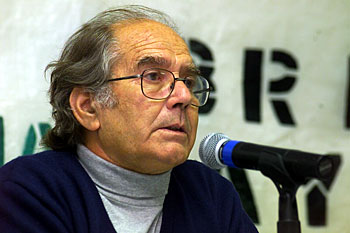
These are from Argentinian Nobel Peace Prize laureate (back in 1980) Adolfo Pérez Esquivel, via Scottish Friend (Quaker) Alastair McIntosh (whose work I just discovered and who appears to be a kindred soul, as does his spouse Vérène Nicolas).
Introductions and explanations are here.
The images are here in color in a pdf. Images are by Pérez Esquivel, words by McIntosh.
They are also available in PowerPoint format.

Introductions and explanations are here.
The images are here in color in a pdf. Images are by Pérez Esquivel, words by McIntosh.
They are also available in PowerPoint format.
Stations of the Cross: African American theologian, African (Tanzanian) artist
I love this book by Catholic womanist theologian Diana Hayes of Georgetown University. The art is by Charles Ndege of Tanzania.
The book was published by Orbis.


The book was published by Orbis.
Subscribe to:
Posts (Atom)